Mystery as remains of seven-arm deep-sea octopus wash up on beach
6 hours agoSteven McKenzieBBC Scotland

 NatureScot
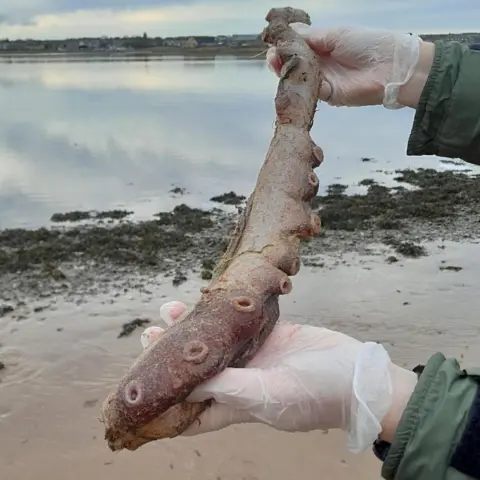
What appeared to be tentacles washed up on an Aberdeenshire beach are the remains of a deep-sea creature called a seven-arm octopus, say experts.
A local member of the public spotted the arms with rows of suckers at Forvie National Nature Reserve at Collieston, near Ellon, on Sunday and alerted reserve staff.
Detective work led to the animal being identified as one of the world’s largest species of octopus – although experts remain puzzled about how it washed up on the beach.
Also known as a septopus, giant gelatinous octopus or blob octopus, they have eight arms like other octopus – but in males one of the arms is also a reproductive organ that they attach to females when mating.
Marine biologist Dr Lauren Smith, of East Grampian Coastal Partnership, said seven-arm octopus were a “remarkable and rarely documented” species.
They live hundreds of metres below the surface of the sea and females, which are larger than males, can grow to 13ft (4m) long.
Forvie NNR covers about 2,471 acres (1,000 ha) of sand dunes and heath between the North Sea and the estuary of the River Ythan.
The area is known for seals and also has the largest tern and black-headed gull colony in mainland Scotland.
Reserve staff described the arms as a rare find.
NatureScot’s Forvie NNR reserve manager Catriona Reid said: “We were first made aware that there was something odd on the beach over the weekend, when a local walker spotted part of the octopus on the beach.
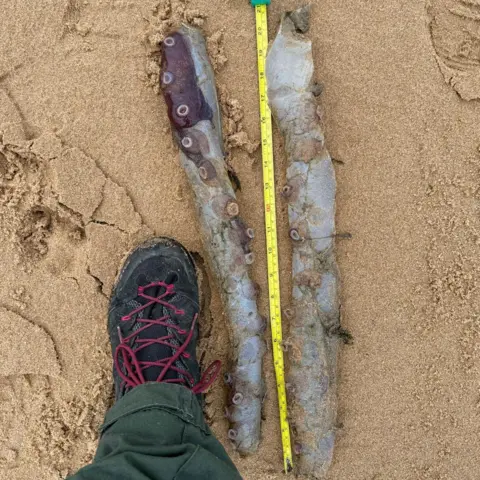
“However, we couldn’t get out until after the next high tide when only sections of the tentacles could be found.
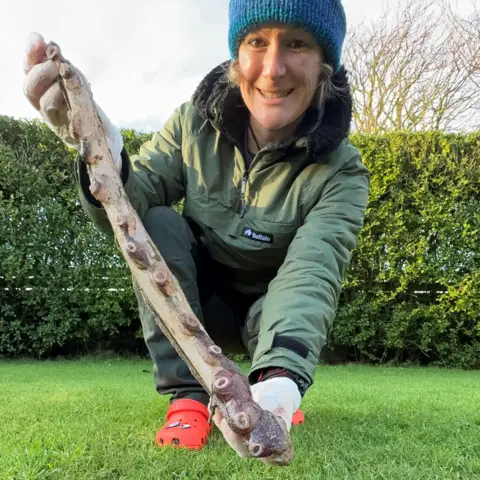
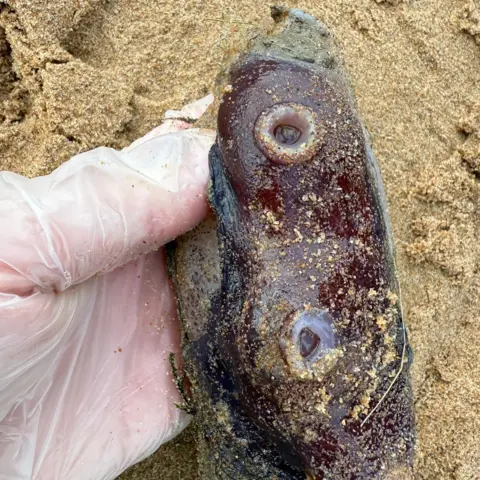
“These were something we clearly hadn’t seen before, with a large diameter and big suckers – far too big for the common curled octopus we see around the shore here.”
 Dr Lauren Smith/East Grampian Coastal Partnership
The reserve said speculation was rife it could be the remains of a giant squid, another elusive deep-water creature which can grow up to 14m (46ft) in length.
A giant squid was washed up dead at nearby Newburgh in 1998, but the suckers on the Forvie arms did not have teeth like a squid’s.
Ms Reid said this then left the reserve with “a mystery”.
It put out feelers, including to Aberdeen University’s zoology department and museums.
Eventually the arm were identified as belonging to a seven-arm octopus, which has the scientific name Haliphron atlanticus.
“These are a deep water species – usually found below 1,640ft (500m) – so it’s a puzzle how it came to be here,” said Ms Reid.
They said most of the North Sea – except the Norwegian Trench, which is about 2,296ft (700m) deep – was shallower than that.
“Washed up by deep water currents? Trawled up by fishermen? We’ll probably never know,” said Ms Reid.
“But it’s a fascinating find nonetheless and yet again serves to illustrate how little we know about deep-water creatures.”
 Dr Lauren Smith/East Grampian Coastal Partnership
 Dr Lauren Smith/East Grampian Coastal Partnership
Dr Lauren Smith said: “This is an extraordinary find, to have a deep-water species like Haliphron atlanticus appear here is incredibly rare and offers a valuable opportunity for further study.
“The recovered remains have been frozen down for further study, with some potentially being preserved as museum specimens.”
She thanked another marine biologist, Dr Steve O’Shea, for his expert verification of the species.
Dr Smith added: “The discovery highlights both the scientific value of community wildlife reporting and the enduring mysteries of the deep ocean.”
Related internet linksEllonCollieston