We’ll end children living in B&Bs, government says
2 hours agoHayley ClarkeEducation reporter

 Getty
GettyThe government has pledged to stop children growing up in B&Bs and to make childcare more accessible for families on Universal Credit as part of its child poverty strategy.
The government says the wide-ranging measures will lift around 550,000 children out of poverty by 2030, marking “the biggest reduction in a single Parliament since records began”.
But the Institute for Fiscal Studies (IFS) said there was “considerable uncertainty over how large a reduction in measured poverty these policies will ultimately deliver, partly due to genuine economic uncertainty”.
Homelessness charities welcomed the plans, but called for greater changes to lift people out of poverty.
In England alone, more than 172,000 children are living in temporary accommodation.
To address this, the government plans to end the “unlawful placement” of families in B&Bs beyond six weeks.
Councils are currently only meant to house families with children in B&Bs as a last resort, and for a maximium of six weeks, the law says.
But figures from April to June 2025 show that more than 2,000 children had been living in B&Bs for longer than that.
Child poverty levels are currently at a “historic high”, the government says, with 4.5 million children – roughly a third – living in relative poverty after housing costs. Three quarters of these come from working families.
“Too many families are struggling without the basics: a secure home, warm meals, and the support they need to make ends meet,” Prime Minister Keir Starmer said.
The government’s child poverty strategy comes after it reversed the two-child benefit cap, expanded free school meals to all children from families receiving Universal Credit, and introduced free breakfast clubs.
The IFS said ending the two-child benefit cap was forecast to account for 450,000 of the children lifted out of poverty by the end of the Parliament, with the remainder attributable to expanding free school meals.
Other announcements, including on temporary accommodation, were targeted at “much smaller groups of people”, it added.
Shadow work and pensions secretary Helen Whately said: “You don’t lift children out of poverty by making the whole country poorer.”
She said work was “the best way out of poverty”, adding: “Only the Conservatives have a credible plan to grow the economy, support parents back into work and tackle child poverty.”
The government says the “devastating impact” on children living in temporary accomodation includes damage to physical and mental health, missing school and family disruption.
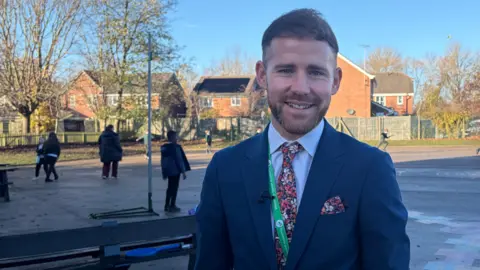
James Cassidy, headteacher of Eton Park Junior Academy in Burton-upon-Trent, told the BBC that he increasingly sees pupils coming into school tired, anxious and stressed, having a knock-on effect on their concentration and friendships.
He said the “vast majority” of pupils’ families were experiencing difficulties with the cost of living and retaining long-term employment.
The government’s measures on housing are “so welcomed”, Mr Cassidy said, adding that in his experience, families often try to cope alone when placed in temporary accommodation.
Under the government’s plans, councils will also have a new legal duty to notify schools, health visitors and GPs when a child is placed in temporary accommodation to provide “a more joined up” approach to supporting them.
The government confirmed that it will continue an £8m pilot to reduce dependence on B&Bs as emergency accomodation in the 20 local authorities with the highest use over the next three years.
It also plans to build 5,000 homes that can be used as more suitable temporary accommodation by 2020 as part of its upcoming homelessness strategy.
Children’s Commissioner Dame Rachel de Souza says it is a welcome focus on improving the quality of temporary accommodation, where many children live in “shocking Dickensian conditions”.
Homelessness charity Shelter agreed with the government that “no child should be growing up in a B&B or mouldy bedsit”.
But called on ministers to “get children out of temporary accommodation and into permanent homes” by unfreezing housing benefits and build a new generation of social rent homes.
The Health Foundation said the strategy marked progress, but “must go further” to deliver a “preventative approach that tackles the deep structural causes of poverty”.
Meanwhile, the founder of the Big Issue magazine Lord John Bird said the government’s strategy was lacking “ambitious targets”.
“In this challenging economic climate, there is every reason to worry warm words will not translate into tangible progress,” he said.
Pepe Di’Iasio, general secretary of the Association of School and College Leaders, said the plans will make a “real difference” but called for “more than just these policies in isolation”.
“A cross-Whitehall response, backed by widespread investment, is required,” he said.
More accessible childcare is also included in the strategy, the government says, as childcare costs are one of the biggest barriers for getting back to work, with many struggling to cover upfront fees before getting their first payslip.
It has pledged a rule change from next year to extend eligibility for upfront childcare costs to people returning from parental leave, which it said will make it easier for new parents who receive Universal Credit to return to work.
Other measures include helping parents to save money on baby formula.
Additional reporting by Vanessa Clarke