Iran protesters try to break into government building as unrest continues
10 minutes agoCaroline HawleyDiplomatic Correspondent

 Telegram
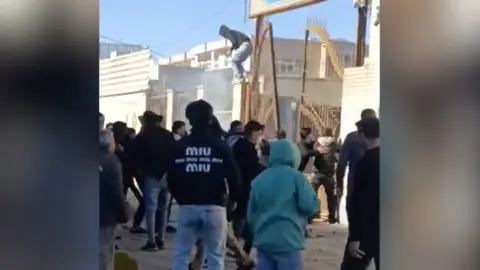
Protesters in Iran have tried to break into a local government building in the southern province of Fars, on a fourth day of demonstrations sparked by a currency collapse.
Officials said three police officers were injured and four people arrested in the city of Fasa.
Confrontations were also been reported in the western provinces of Hamedan and Lorestan.
The authorities in the capital, Tehran, had declared Wednesday a bank holiday – in an apparent effort to quell the unrest.
In video that emerged on social media and was verified by the BBC, a crowd is filmed breaking the gate of the governor’s office in Fasa.
Then, in another post, security men are seen shooting in response. Clouds of tear gas rise in front of shuttered shops.
Across the country, schools, universities and public institutions were closed because of the last-minute public holiday announced by the Iranian government.
It was ostensibly to save energy because of the cold weather, though it was seen by many Iranians as an attempt to contain the protests.
They began in Tehran on Sunday – among shopkeepers angered by another sharp fall in the value of the Iranian currency against the US dollar on the open market.
By Tuesday, university students were involved and they had spread to several cities, with people chanting against the country’s clerical rulers.
The protests have been the most widespread since an uprising in 2022 sparked by the death in custody of Mahsa Amini, a young woman who was accused by morality police of not wearing her veil properly. But they have not been on the same scale.
To prevent any escalation, tight security is now reported in the areas of Tehran where the demonstrations began.
President Masoud Pezeshkian has said his government will listen to the “legitimate demands” of the protesters.
But the prosecutor general, Mohammad Movahedi-Azad, has also warned that any attempt to create instability would be met with what he called a “decisive response”.