Sting pays Police bandmates more than £500,000 in royalties
36 minutes agoMark Savage,music correspondentandLizo Mzimba,culture correspondent

 Getty Images
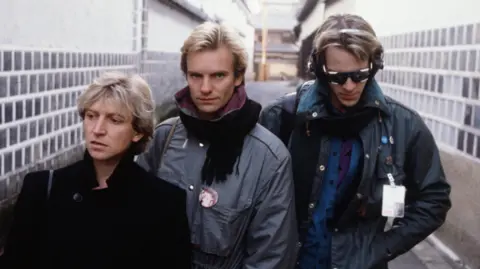
Sting has paid his former bandmates in The Police more than half a million pounds after acknowledging underpaying royalties, court documents show.
In a filing in London’s High Court, the musician’s lawyers said Andy Summers and Stewart Copeland received a payment of “over $800,000” after they launched legal proceedings last year.
The three musicians are arguing over royalties to songs such as Roxanne and Every Breath You Take.
Summers and Copeland contend that they are owed more than $2m (£1.5m) from Sting and his publishing company. But Sting denies that they are entitled to a portion of his income from streaming and download sales.
His bandmates did not receive writing credits on most of The Police’s hits, but argue that the band entered an “oral agreement” to share income in 1977, which was later formalised in written contracts.
The agreement acknowledged that, although Sting was the chief composer, the other two members sometimes made crucial contributions – such as Summers’ guitar line on Every Breath You Take.
As a result, the trio decided that when any of them received publishing income for a song they had written, they would share a percentage of that money – usually 15% – with the other two members, in what was termed an arrangers’ fee.
Summers and Copeland sued Sting last year, saying he had been withholding some of those payments.
 Getty Images
None of the band members was in court for the start of a two-day preliminary hearing on Wednesday.
But lawyers for guitarist Summers and drummer Copeland are asking the court for permission to bring new and additional arguments that they are owed money from all downloads and streaming income, under the terms of their prior agreements in 1997 and 2016.
They say that the language of those agreements should be interpreted in light of the changes to the record industry, where streaming income has largely replaced the sale of vinyl, CDs and cassettes.
In court papers, they acknowledged a recent payment from Sting and his publishing company, disclosing a figure of $870,000 (£647,000), but noted that no interest had been added to the “historic underpayment”.
Meanwhile, Sting’s lawyers argue that he shouldn’t have to give his former bandmates royalties when The Police’s music is played on streaming services like Spotify, because that counts as “public performance”, rather than a sale.
Furthermore, they say that Summers and Copeland are not eligible for royalties from streaming and digital sales, because their 2016 agreement only allows for royalty payments derived “from the manufacture of records”.
They added that the musicians’ attempt to amend their case should be thrown out as it has “no real prospect of success”.
Success, collapse and reunion
The Police formed in 1977 and quickly became one of the UK’s most commercially successful bands.
Their innovative fusion of rock guitars with reggae rhythms spawned chart-topping hits like Message in a Bottle, Walking on the Moon and Every Little Thing She Does is Magic.
They earned a US number one single with Every Breath You Take, taken from their fifth album, Synchronicity, in 1983.
It was later recognised as the most-played radio song of all time and was heavily sampled on P Diddy and Faith Evans’ 1997 song I’ll Be Missing You.
However, The Police split up in 1984 amid personal and musical animosity.
Copeland later told The Guardian that the members “beat the crap out of each other” during the “very dark” recording sessions for Synchronicity.
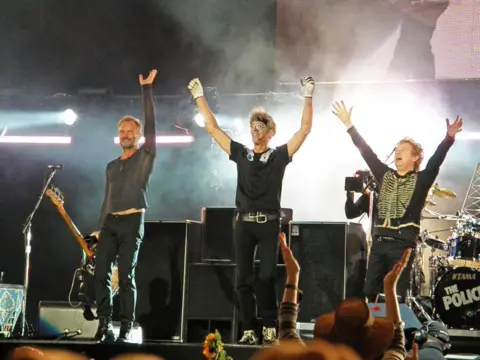
They reformed in 2007 to open the Grammy Awards, before setting out on a lucrative world tour. Tickets for the British leg sold out in just 30 minutes, but the band dissolved again after the final date.
In 2022, Sting sold the rights to his songwriting catalogue to Universal Music Group, with the deal covering both his solo hits and songs he penned for The Police.
The deal was estimated to be worth $200m.