Teachers on supply list for years or leaving country due to job shortages
51 minutes agoGabrielle WilliamsonandCatherine Lyst,BBC Scotland

 Louise Fraser
Some teachers in Scotland are spending years on the supply list or leaving the country due to a lack of permanent jobs, BBC Scotland has learned.
Analysis of Scottish government figures shows that most newly qualified teachers in Scotland are no longer getting permanent jobs, especially in primary schools, despite schools saying they are under pressure.
Louise Fraser, 24, moved to Dubai for job security because she struggled to find stable work in a Scottish primary while another teacher has been on the supply list for nine-and-a-half years.
Education Secretary Jenny Gilruth said pay rises for teachers had made employing them more expensive, but that progress was being made on teacher numbers.
Louise, from Ayrshire, graduated in 2022 but after her probation year could not find a teaching job.
She told BBC Radio Scotland Breakfast she moved to Dubai for more security and a better quality of life.
“I didn’t just to move to Dubai for the lifestyle, I moved because I needed the job security,” she said.
Louise now wants to move back to Scotland but is worried she may no longer be able to work as a teacher.
“I am now engaged and want to move back to Scotland to be with my family but I am so scared about coming home and having to re-enter this dire job crisis,” she said.
“I don’t know if I will be able to still be a teacher. I am having to save so much money at the moment, as I am fearing what I am going to have to return home to.”
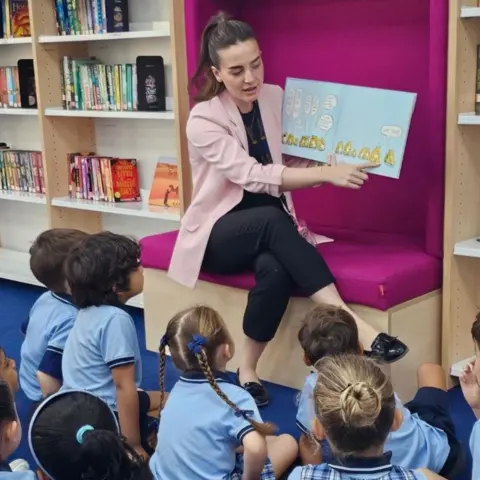 Louise Fraser
Another teacher, who did not wish to be named, is a qualified modern studies teacher who has been on the supply list for nine-and-a-half years.
He said his situation became so bad that he got into £50,000 of debt and tried to take his own life last year.
“I have been working contract to contract,” he said. “It has been so stressful, and has left me with bills I have been unable to pay.
“I have wracked up £50,000 in debt and almost had to file for bankruptcy in April last year.”
He said that on two occasions he was told he had been successful in job interviews, only to then receive emails from the council saying they had decided to fill the post using a probationer instead.
“The council do this to save money as the government pays for probationers,” he said.
“It means it leaves people like me unable to secure work.
“I got myself in such a bad place last year I tried to take my own life.
“I’m lucky I have a partner that has helped me battle these demons, but I never thought a vocation – something I love – would push me to this.”
It has been five years since the Scottish government made its 2021 manifesto promise to tackle excessive levels of teacher workload by employing 3,500 additional teachers and reducing teachers’ maximum class contact time commitment to 21 hours per week.
Scottish government figures for 2024/25 show that 2,294 newly qualified teachers completed their probation year (the Teacher Induction Scheme). This is the route every new teacher takes after university.
Only 568 (25%) of those teachers secured a permanent post – one in four.
Of the remaining 75%, 1,015 are in temporary or fixed-term contracts and 711 are in “other”‘ roles – mainly supply teaching, or not working in teaching at all.
Primary teachers are most affected.
In the first year after probation, only about 11–12% of primary teachers had a permanent job.
Nearly nine in 10 primary teachers are temporary, on supply or without a permanent post.
Stories you may have missed
The EIS teaching union said Scotland was 4,310 teachers down on the level promised in the 2021 SNP Manifesto pledge.
General secretary Andrea Bradley told Radio Scotland Breakfast a significant number of qualified teachers were “limping from one temporary contract to another”.
She said: “We receive regular correspondence from people in that situation in utter despair.
“They are unable to secure permanent jobs, it impacts on them financially but it also impacts on them emotionally and psychologically as well.
“It’s really concerning the number of them who talk about having to leave the profession entirely because they cannot afford to live their lives in that insecure way.”
She said, at the same time, teachers with permanent positions were so overworked they were having to work on average a “day-and-a-half extra unpaid”.
She added that while funds had been given to local authorities to employ extra teachers, a “large number” of councils had not used the money for that purpose because “they argue they are otherwise incredibly strapped for cash”.
“There’s a real funding crisis here and a lack of strong enough collaboration between national and local government to solve problems like this one,” she added.
The Scottish government said it was providing £186.5m to local authorities in 2025-26 with the aim of restoring teacher numbers to 2023 levels.
Education Secretary Jenny Gilruth told the programme she recognised the challenges but said figures from December had shown a rise in teacher numbers of 63, the first increase since 2022.
“We do need to remember that teachers are now much more expensive to employ than they were back in 2021,” she told Radio Scotland Breakfast.
“We do think meeting demands in terms of the teaching unions’ expectations on pay was the right thing to do, but it has cost the government in excess of £800m.”
Gilruth said it was not a “flat picture” across regions and subjects. “We are desperate for maths teachers,” she said.
She said extra posts created in response to Covid may have allowed people to get jobs locally, but that teachers may now have to travel further afield.
“I wonder to what extent people are opting not to travel to jobs, in ways that they might have previously, because for example we created those posts during the pandemic,” she said.
“You’re not guaranteed a job on qualification – you have to go out there and look for one, you have to apply to a range of different local authorities.”
Gilruth accepted the current situation was “not good enough” and said the government and local authorities had to work together to fix it.
Cosla, the body which represents councils, said: “Currently councils are experiencing recruitment challenges for specific subjects (e.g. maths, physics and others) and in specific geographical areas.
“In areas where there are more teachers seeking employment than there are permanent teacher vacancies there may be only temporary roles (eg maternity cover) or supply work (eg cover for sickness absence) available, however, we offer permanent employment when permanent vacancies arise.”