NI to become first in the UK to introduce graduated driving licences
34 minutes agoJulie McCulloughBBC News NI

 Getty Images
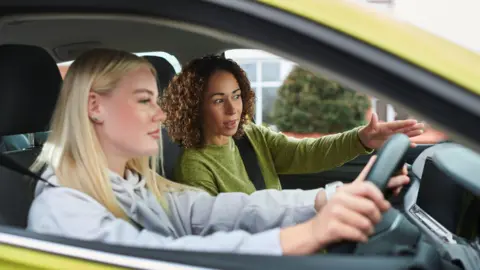
Northern Ireland will become the first area of the UK to bring in graduated driver licensing for learner drivers in a bid to reduce the amount of fatal road crashes involving young people, it has been announced.
The reforms, described as the most significant changes to licencing in 70 years, will see Northern Ireland adopt a version of laws in place in countries including Australia, the US and the Republic of Ireland.
The rules, due to be introduced in October, are aimed at 17 to 23-year-olds and will change how people learn to drive.
They include a six-month wait for learner drivers before taking a practical test, as well as restrictions on night-time driving and passenger numbers.
Infrastructure Minister Liz Kimmins said the changes were “aimed at young drivers who are sadly most likely to be killed or seriously injured on our roads”.
A senior Police Service of Northern Ireland (PSNI) officer, Ch Supt Sam Donaldson, said the scheme would save lives on the roads.
Some young people who spoke to BBC News NI gave a mixed reaction to the reforms, with one saying they were “not looking forward to the changes”.
Why is graduated driver licensing coming into NI?
The Department for Infrastructure said graduated driving licences were aimed at revising training and testing for new drivers and motorcyclists.
The minister said that in 2024, there were 164 people killed or seriously injured in Northern Ireland’s roads from crashes caused by a driver aged between 17 and 23.
“This age group of drivers account for 24% of fatal or serious collisions despite holding just 8% of licences,” she added.
Pat Delaney, director of operations in the Driver and Vehicle Agency Northern Ireland (DVANI) said the new measures would affect anyone who gets a provisional driving licence from 1 October.
He said the overall aim of these changes was to “improve road safety” for young people.
What are in NI’s graduate driving license rules?
The major rule changes are:
- New drivers will not be permitted to take their driving test for at least six months after being granted a provisional licence
- They must also complete 14 modules in a programme of training, which has to be signed off by an approved driving instructor or a supervising driver that could be a parent or guardian
- An increase in the restriction period from 12 months to 24 months requiring new drivers to display an ‘R’ plate style mark on their vehicles after passing their test – a different colour of ‘R’ plate will signify a driver in their initial six-month period
- For the first six months after passing their test, new drivers up to the age of 24 are only permitted to have one passenger aged between 14 and 20 in their car between the hours of 23:00 and 06:00
- That restriction would not include immediate family members and does not apply if someone aged 21 or over, who has held a drivers licence for at least three years, is sitting in the front seat
- Learner drivers will be allowed to drive on the motorway if accompanied by an approved instructor and will be allowed to drive on the motorway up to the posted speed limit, after passing their test
The current speed limit of 45mph for restricted drivers will also be removed.
Drivers who do not follow the restrictions could receive three penalty points or a fine of up to £1,000.
PSNI Ch Supt Donaldson welcomed the scheme, and said he wished it was introduced immediately.
“Young people who are 17, 18 and new drivers regardless of what age, they don’t recognise the risk the way perhaps some of us here a little bit older do,” he said.
“So I absolutely welcome this graduated response, some restrictions in terms of who they can carry, times of day they can travel and things like that because we’ve got to bring our new drivers on a slower journey to allow them to learn how to drive on the roads.
“That’s the way it’s done in Scandinavia and they have far safer roads than we have, so we’ve got to learn from them and we’ve got to bring this in.”
The Department for Infrastructure said it would shortly launch a public information campaign about graduated driver licensing, and officials would liaise with approved instructors, the PSNI and a range of others ahead of the new rules being introduced.
What have young people said about the changes?
At St Mark’s High School in Warrenpoint, County Down, present and past pupils from the GCSE Motor Vehicle & Road User Studies class give their reaction to the changes.
Oliver, 15, said: “It would be a bit of an annoyance to not be able to drive right way” but he does think it makes sense.
“There are people who get their licence too early and aren’t experienced enough on the road to be going out and driving themselves.”
Cormac – who passed his driving test in less than six months after his 17th birthday – said he would have understood if they required a “minimum lessons amount”.
But he does welcome the removal of the 45mph speed limit.
“When you’re on a dual carriageway and having to go 45mph it does feel more dangerous than safe,” he said.
Amy, 18, has not got her drivers licence yet, but said she did not like the idea of restricting the passengers she is allowed to take at night time.
“Instead of taking one car load you’d maybe have to take three,” she said, adding she accepts it is probably for the “greater good”.
“You wouldn’t be getting distracted as much if your friends were sitting beside you trying to show you something.”

Matthew, 17, said it would prevent him from being able to give someone a lift home late at night but thinks it would be safer.
“The majority of accidents do happen at those times. It is safer for everyone.”
What’s the view from driving instructors?
Peter Carmichael from NI Driving School has been teaching people to drive for more than 17 years.
He said there had been rumours about graduated driver licensing being introduced for many years and that it was great to “see something actually happening now”.
“If it prevents road deaths we’re absolutely on board,” he said.
However he said he would like to get more information about what it will involve.