Twenty years is ‘a death sentence’, son of British media tycoon jailed by China says
28 minutes agoJohanna ChisholmBBC News

 Getty Images
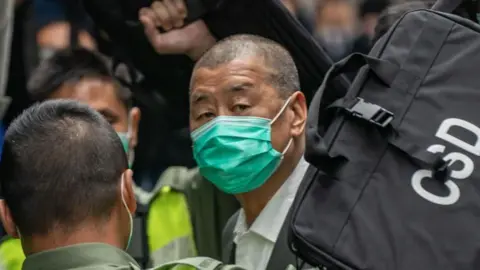
The son of Hong Kong media tycoon Jimmy Lai has called his imprisonment by Chinese authorities essentially a “death sentence”.
The 78-year-old British citizen was sentenced on Monday for 20 years after he was found guilty of national security offences last December, marking the harshest sentence to be given under the city’s controversial national security law (NSL).
Lai was one of the loudest critics of China, often wielding his pro-democracy paper, Apple Daily, as a tool of protest. He has always denied the charges against him.
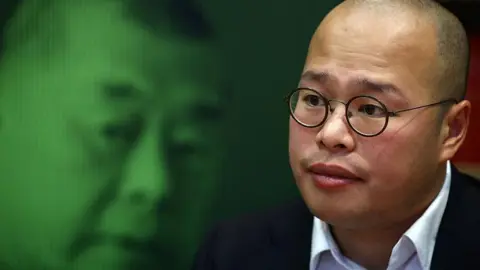
Sebastien Lai, his son, told the BBC that he believes his father is being punished for “defending the freedom of Hong Kong”.
As a British citizen, Sebastian told BBC Radio 4’s Today programme, that Lai deserves much more.
“Surely a man who has given so much for liberty, for freedom deserves a bit of it himself,” Sebastien said.
Foreign Secretary Yvette Cooper has said the UK government intends to “rapidly engage further” with Beijing on Lai’s release.
“I again call on the Hong Kong authorities to end this appalling ordeal and release him on humanitarian grounds, so that he may be reunited with his family,” Cooper said in a statement.
She added: “We stand with the people of Hong Kong.”
Hailed as a hero by the pro-democracy movement, Lai was also seen as a traitor by Beijing.
Western governments, including the UK and US, have for years called for his release, which Beijing and Hong Kong have rejected.
China introduced the controversial national security law in 2020 in response to pro-democracy protests which erupted in Hong Kong the year before.
The legislation makes illegal a wider range of dissenting acts, including anything the state regards as secession, subversion, terrorism and collusion with foreign forces.
It also allows Hong Kong to send cases to be tried in mainland China.
 Getty Images
Lai was found guilty of foreign collusion and publishing seditious material under the NSL.
A court found that he used his now-defunct Apple Daily newspaper as part of a wider effort to lobby foreign governments to impose sanctions on Hong Kong and China.
For the last five years, he has been held in solitary confinement at a maximum security prison – a detention his son believes is causing his health to “tremendously suffer”.
“Given his health, given that he has heart issues, given that he’s lost 10kg over the last year alone, that’s basically a death sentence,” his son said.
On a trip to Beijing last month, Prime Minister Keir Starmer told reporters that he had raised the issue of Lai’s release to Chinese authorities.
“Part of the rationale for engagement is to make sure that we can both seize the opportunities that are available – which is what we’ve done – but also have a mature discussion about issues that we disagree on,” Sir Keir said after his meeting with President Xi Jinping.
Former UK prime minister David Cameron joined the government in calling for Lai’s release, saying the activist’s imprisonment was “an affront to freedom of speech”.
“China must know that the world is watching,” he wrote in a social media post.
Following the prime minister’s visit to China, the UK government announced that Beijing had agreed to allow UK citizens to travel visa-free for trips under 30 days.
The trip also saw an agreement to cut import taxes on UK whisky from 10% to 5%, as the government seeks closer trade ties with Beijing to help boost economic growth.
Asked about how he viewed the UK government’s recent diplomatic efforts to normalise relations with China, Sebastien pointed out that his father’s case could present an “easy” opportunity to build even stronger ties.
“If we talk about warming a relationship, well, I think for most people listening to this, isn’t putting a 78-year-old man on a plane and sending him back here a very easy way for Hong Kong and China to do that?” Sebastien told the BBC.
China maintains that its actions in the Lai case were “reasonable, legitimate and legal”, with its foreign ministry saying on Monday there is “no room for argument”.