Andrew sent Epstein UK briefing on Afghan investments, document suggests
46 minutes agoSean Coughlan,Royal correspondentandJames Landale,Diplomatic correspondent

 Getty Images
A document apparently sent by Andrew Mountbatten-Windsor to Jeffrey Epstein included information on investment opportunities in gold and uranium in Afghanistan.
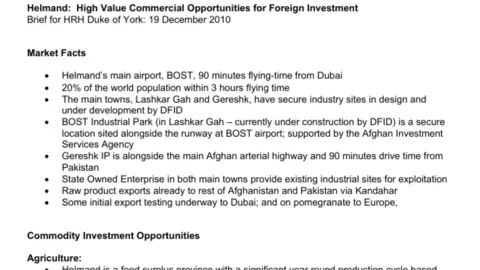
The BBC has seen a briefing, prepared for Andrew by UK officials when he was a trade envoy, which he forwarded to the convicted sex offender in December 2010 and includes a list of “high value commercial opportunities” in Helmand province.
This comes after the BBC reported that the former prince had called the document “confidential,” according to an email in the latest tranche of Epstein files.
Andrew has previously strongly denied any wrongdoing in his associations with Epstein and rejected any suggestion he used his time as trade envoy to further his own interests.
He has been approached for comment.
Sir Vince Cable, who was business secretary at the time, described sharing the briefing as “appalling behaviour”.
Thames Valley Police are already assessing whether to investigate the apparent sharing of documents related to Andrew’s time as trade envoy.
As well as the Afghan document, Andrew also seems to have sent the disgraced financier official reports from his visits as a trade envoy to Singapore, Hong Kong and Vietnam, according to emails in the Epstein files seen by the BBC.
Emails in the files raise the possibility Andrew shared further trade documents with Epstein. One message indicates that a few seconds after sending the reports from the South East Asia visits, the former prince then sent a second batch of files called “Overseas bids”.
These seem to be “Zip files” that usually contain many compressed pieces of information.
The Afghan document, which is in the Epstein files, was compiled by UK government officials specifically for the then Duke of York.
It provides an extensive overview of investment opportunities in Helmand province, at a time when the UK was militarily and politically committed to rebuilding Afghanistan.
As Andrew said in his note to Epstein, it’s a “confidential brief produced by the Provincial Reconstruction Team in Helmand Province”.
It was a briefing produced for Andrew – who was trade envoy between 2001 and 2011 – in the same month that he visited Helmand, where he saw UK troops based there.
It gives an assessment of the current local economy and the business opportunities, including “significant high value mineral deposits” and the “potential for low cost extraction”.
This includes valuable natural resources such as marble, gold, iridium, uranium and thorium and also possible deposits of oil and gas, with the information prepared by UK government officials, working for the Helmand reconstruction team.
According to official guidance, trade envoys have a duty of confidentiality over sensitive, commercial, or political information about their official visits.
 US Department of Justice
Sir Vince, who was seen as instrumental in ending Andrew’s time as trade envoy, called for more transparency on Andrew’s time as trade envoy.
“I have twice in the past asked to see the file on Andrew as trade envoy and, strangely, it is empty,” he said.
“I met Andrew once as secretary of state, when I was invited to Buckingham Palace and he was asking me to find something useful for him to do. I didn’t.
“Shortly after, in 2011, the first publicity appeared about his friend Epstein and I discontinued the envoy role,” said Sir Vince.
The role of trade envoy is to promote the UK’s business interests overseas and to encourage investment.
Speaking anonymously, a diplomatic source suggested that an envoy such as Andrew might legitimately have shared information with potential investors, encouraging them to support UK international business initiatives, which might have included in Afghanistan.
Andrew’s apparent note to Epstein says he is going to “offer this elsewhere in my network (including Abu Dhabi)”.
On the wider principle of sharing documents, a former senior trade official said many of the reports seen by a trade envoy would have been quite “pedestrian”, but sometimes the former Duke of York had “really important meetings with really important people” that produced real commercial opportunities.
“So it is always possible that there were significant commercial things in the documents which would have been useful,” the former official said.
“They were absolutely not for sending outside government and particularly not to somebody who might seek to use them for commercial purposes. This was certainly not something a trade envoy could possibly do and justify in any way.”
The former prince continues to be dogged by his links to Epstein after the latest tranche of documents released by the US government included pictures of Mountbatten-Windsor, fully clothed, kneeling on all fours over a woman lying on the ground.
He is facing growing pressure to testify in the US about his links to Epstein and last week moved from his Windsor home to the Sandringham Estate in Norfolk.
On Monday a Buckingham Palace spokesperson said the King was ready to support the police as they consider allegations against his brother.

Sign up here to get the latest royal stories and analysis every week with our Royal Watch newsletter. Those outside the UK can sign up here.