Why there’s no quick fix in sight for the problem of dazzling headlights
56 minutes ago
 Katy AustinTransport correspondent
 BBC
BBC
And when Jane mentioned this at a discussion group she attends, others felt the same. “Over 90% of us did not want to drive in the dark,” says Jane. “So we have changed the time of our meetings from 7.30pm to 1.30pm [for much of the year] so that we can drive home before dark.”
Jane and her friends aren’t alone. In a debate at Westminster last October, MPs voiced widespread concerns about bright headlights. Some described social isolation among constituents who had become too scared to drive in the dark.
The RAC motoring organisation, which has campaigned on headlight dazzle, has repeatedly asked its members for their views. Most recently, more than half of respondents to a survey of 1,745 UK drivers in January this year felt the problem had worsened in the past 12 months. A third of those who said they were affected by dazzle said they felt less safe when driving at night.
 Getty Images
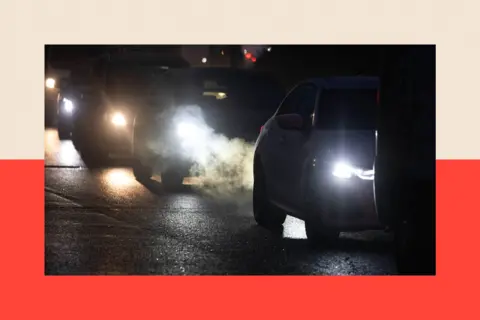
It’s not only older drivers who feel this way. Emily McGuire from Essex told the BBC: “I am in my 30s and sometimes I can’t tell if [other vehicles’] main beam is on or off and once they have passed, I can’t see properly for a good few minutes, it’s terrible.”
She owns a smaller car and feels that she can’t avoid the lights on higher, bigger cars: “I suffer with migraines when a car approaches me with extremely bright lights, I have to look down or in the other direction… I also have to slow right down when it’s really dark and I’m on a country lane.”
And experts say the problem is getting worse. Denise Voon, clinical advisor at the College of Optometrists – which also campaigns on the issue – says: “I am a practising optometrist and I’ve noticed that maybe 15 years ago, you rarely had people coming in complaining about headlight glare. But now it’s becoming more and more prevalent.”
It’s an issue that has even reached the United Nations – it will mandate all new cars to automatically adjust their headlight levels.
But this will only affect new cars. And so the questions many are asking are: what, if anything, can be done about all the cars currently out there causing headlight discomfort – and why did nobody spot that this might be a problem?
The impact of changing headlights
Experts believe a number of factors can cause headlight dazzle.
One is the angle of headlights. If misaligned, they are more likely to cause glare. Misalignment can cause a vehicle to fail its MoT test.
Then there’s the fact that headlights have got brighter, to help drivers see better.
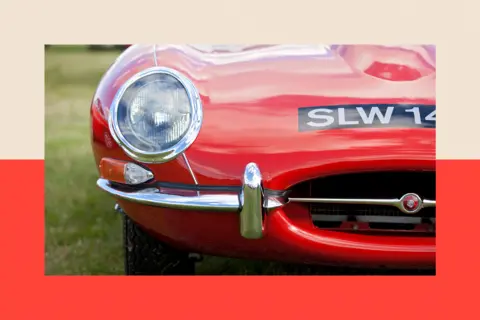
Headlights have moved a long way from the “kind of brown glow” produced by filament bulbs decades ago, according to Dale Harrow, professor of Intelligent Mobility and Car Design at the Royal College of Art in London. They have become more complex and “a design object in their own right,” he says.
Glass casings have given way to plastic and significantly, the light source has changed too, with most people now using LEDs instead of halogen bulbs, he says – the quality has improved and lights are now “brighter, but also a lot clearer”.
 Getty Images
While this “has to be a good thing” when it comes to helping the driver see clearly, Harrow says, it has also resulted in “unplanned drawbacks” – including dazzling other road users.
Another problem is the illegal retrofitting of LED bulbs, especially when fitted into units designed for halogen. The Driver and Vehicle Standards Agency has said it has stepped up a crackdown on retrofit bulbs, with sellers facing potential fines of up to £1,000.
“Recent advances in headlight technology have improved visibility but all headlights – whether LED or not – must still be aimed correctly and checked at the MOT test,” says Mike Hawes, chief executive of the Society of Motor Manufacturers and Traders (SMMT).
How bright lights affect our eyes
Our eyes adapt in the dark to become a lot more sensitive to light, says Denise Voon. As a result, being suddenly hit by very bright lights can temporarily make it very hard to see, even causing pain.
Retinal cells at the back of the eyes which detect the light can get bleached, and take a while to recover. That’s when people notice an imprint remaining in their vision after looking away.
Although headlight glare does affect younger people, age is thought to be a factor. Older people are more prone to conditions such as cataracts and glaucoma, for example.
 Bloomberg via Getty Images
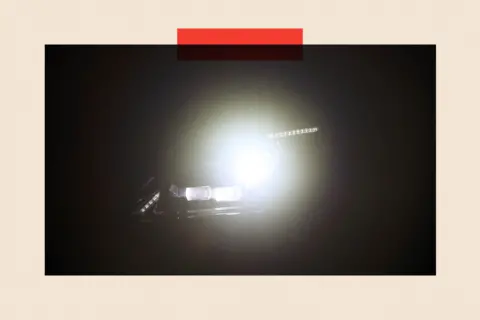
Voon says there are a number of reasons why LEDs may be particularly problematic. Firstly, they are two to three times as bright as traditional halogens, and their “colour temperature” is bluer and whiter, which mimics natural daylight.
Also, LED lights “are a lot more directional, so you’ve got this much brighter, whiter light in a very directional point hitting your eye compared to the more diffuse halogen ones”.
It’s not clear if it is the brightness, colour, temperature or the direction of the lights – or some combination of all of these – that causes most problems, she says: “But what we know is that’s one of the differences.”
What the data says – and doesn’t
Despite widespread concerns that the problem is getting worse, there isn’t evidence that brighter lights are causing more accidents.
Statistics from the Department for Transport (DfT) show that headlight dazzle was recorded as a contributory factor in 216 collisions in 2023. Four of those collisions were fatal.
Although the overall number of collisions rose very slightly compared to the previous year, it was far below the 330 recorded in 2014. The figure was also lower than any of the intervening years except 2020, when the pandemic meant fewer drivers on the roads.
But the fact that since 2024 “vision affected by dazzling headlights” is no longer listed in the DfT’s published statistics as a contributory factor in its own right, makes comparisons or identification of a trend harder.
Equally, these statistics don’t tell us whether some people are choosing not to drive at night and nor do they account for other changes in driver behaviour.
Still, a government-commissioned report by the Transport Research Laboratory (TRL), published last year, found that drivers “perceived glare from vehicle headlamps to be an important and widespread issue when driving at night”.
It also concluded that headlamps were perceived as “too bright”, and that “whiter” headlamps and those on larger vehicles were “generally perceived to be especially problematic for causing glare”.
So far so obvious, you may think, based on what campaigners have been saying for some time. But the study went further.
Researchers took out a car at night, rigged with equipment to measure light intensity and an observer in the vehicle could press a button if they felt glare might interfere with their driving.
The study drew a link between higher levels of luminance – meaning the intensity of light – and the likelihood of experiencing glare. It also suggested that 40,000 candela per sq m – a measure of luminance – may be an “important threshold for the experience of glare being more likely”.
Also, when the research car was travelling uphill or around a right-hand bend, glare was more likely, researchers said – a driver’s eyes are more likely to fall within the “throw” of headlamps from oncoming vehicles.
Echoing the concerns of experts, researchers also found “some tentative indication that larger body shapes such as SUVs and models with light-emitting diode (LED) headlamps may be more likely to be associated with glare”. However, further research was recommended in this area.
The government has since agreed to conduct such further research. But this has not started yet, and it’s unlikely to begin for at least a couple of months.
An unidentified problem
But all this raises the question of why nobody anticipated widespread complaints about glare – in spite of all the research and development work that’s been carried out by carmakers around the world. “It seems more priority has been put on giving drivers the best possible view of the road at night and less on the consequences for oncoming traffic,” says Simon Williams, the RAC’s head of policy.
Manufacturers reject this. “Safety is every car maker’s top priority and providing good visibility to drivers in darkened conditions is essential,” says Mike Hawes, chief executive of the SMMT. “All headlights must meet international standards so drivers can see as clearly as possible but without dazzling other drivers.”
In October, I had the opportunity to speak to Thomas Broberg, senior advisor for safety at Volvo’s Car Safety Centre in Gothenburg, Sweden. He explained how vehicles have to meet the standards of countries in which the manufacturer wants to sell them – vehicle manufacturing being an international business.
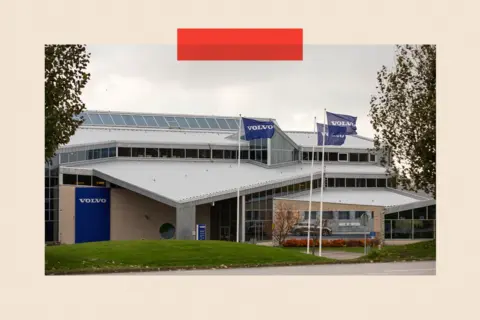 LightRocket via Getty Images
There are regulations around the headlights themselves, he says, covering their shape, intensity and glare. Also, headlights are tested on the road by different authorities and “as a global car company, we need to comply with all of them”.
Broberg said it was a “concern” that people are complaining about glare, but insisted that avoiding glare was part of the design process. He also pushed back against the suggestion that SUVs end up dazzling people more. “The angle of the light is actually regulated,” he says. “So if you have a higher vehicle, then you need to have a lower [beam] angle.”
He argues that road geometry, and poor aiming of headlights in cars that don’t have automatic levelling systems, are more likely culprits.
What is already being done?
In theory, technological innovations should help, particularly auto-dimming – although not everyone finds that they dip early enough.
Off the back of the TRL report, the government has promised to look further into design factors that may be contributing to glare. The idea would be to use the findings to propose changes to international regulations at the United Nations.
The United Nations Economic Commission for Europe (UNECE) has a World Forum for Harmonization of Vehicle Regulations. Following an agreement by this forum, new vehicles are meant to have mandatory automatic headlight levelling by September 2027. The effect of this technology is to correct the aim of headlights if the vehicle’s load changes.
But this would not change the headlight settings on the millions of cars on our roads already.
More from InDepth
The TRL report also points out that “many instances of glare are likely to remain even with stronger regulation”, because real-world situations of “road geometry” – the shape of the road, with ups, downs and corners – are not realistically under DfT’s control.
There are some basic things drivers can do to reduce the impact bright lights have on them. For example, keep their windscreen clean, inside and out.
The College of Optometrists reminds motorists to always wear glasses if they have them, and make sure they are clean. It also advises staying up to date with vision tests, which can also pick up problems with eye health.
More practical advice when confronted with bright oncoming headlights is to briefly look to the side of the road, keeping your eyes open – and of course, be considerate of other drivers when you’re behind the wheel yourself.
For Emily and others affected by glare, this guidance will have to make do for the time being. She says: “It’s tough but we cope and carry on until something is done about it.”

BBC InDepth is the home on the website and app for the best analysis, with fresh perspectives that challenge assumptions and deep reporting on the biggest issues of the day. Emma Barnett and John Simpson bring their pick of the most thought-provoking deep reads and analysis, every Saturday. Sign up for the newsletter here