SpaceX rocket fireball linked to plume of polluting lithium
1 hour agoGeorgina RannardScience reporter

 Gerd Baumgarten
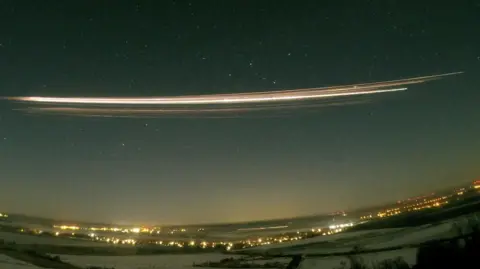
When a SpaceX rocket failure set the skies aflame over western Europe last February, no-one was sure if the debris was also polluting our atmosphere.
Now scientists are directly linking the uncontrolled rocket re-entry to a plume of lithium measured less than 100km above Earth.
It is the first time researchers have drawn a direct link between a known piece of space debris crashing to Earth and pollution levels.
They warn that as SpaceX chief Elon Musk pledges to launch one million satellites in the coming years, this contamination could be the tip of the iceberg.
The scientists were already investigating the problem of pollution from space debris when they realised a SpaceX Falcon 9 had failed in flight on 19 February 2025.
As it blazed through Earth’s atmosphere, the rocket vaporised into fireballs over Ireland, England, and Germany before it finally struck Earth.
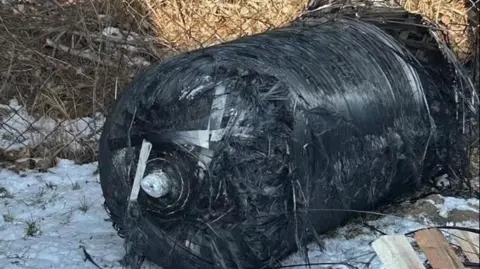
A man in Komorniki, Poland found a chunk measuring around 1.5m by 1m behind his warehouse.
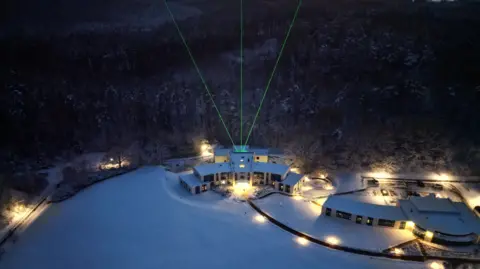
“We saw the news that this rocket had crashed into Poland. It had flown almost directly over us, and we thought, ‘oh, this is a great chance'”, explained Prof Robin Wing at the Leibniz Institute of Atmospheric Physics in Germany.
The team fired a laser that detected metal atoms released from the rocket body made of aluminium-lithium.
 Gerd Baumgarten
Working with Prof John Plane at the University of Leeds, they detected that the amount of lithium in the atmosphere at around 100km above Earth increased by a factor of 10.
The atmosphere naturally gets about 50-80g daily from small meteors, Wing explains.
“So, a single Falcon 9 rocket has about 30kg, so this is quite a lot more,” he says.
“Our largest concern is aluminium and aluminium oxides interacting with the ozone layer,” Wing says.
At the moment they do not know the long-term consequences of this pollution on the make-up of Earth’s atmosphere, but it is unlikely to be good.
The pollution could disrupt aerosols in the atmosphere and their ability to moderate our climate and temperature.
“This is a new scientific field. It’s hard to speculate because it’s changing so quickly,” Wing says.
He draws parallels to chlorofluorocarbons pollutants released from refrigerators that bore a hole in the ozone layer last century, and were eventually banned.
 Adam Borucki
“I hope that if we start our measurements now, perhaps we can get ahead of the curve and identify any potential problems before they become serious,” Wing says.
Earlier research has suggested that 10% of aerosols in the atmosphere are already contaminated by space debris.
SpaceX has not responded to emailed requests from BBC News for comment. The researchers also sent their findings to the company but did not receive a response.
Almost 30,000 pieces of debris are calculated to be free-floating in space, created when rockets break up in space or satellites disintegrate.
Scientists warn that the debris is congesting space, brightening the night sky, and threatens collision with rockets, the International Space Station, and our planet.
Musk’s SpaceX is the world’s leading company for rocket launches including for sending humans into space and maintaining a network of 10,000 Starlink internet satellites.
Musk recently announced he has applied to launch one million satellites to support artificial intelligence (AI) data centres in space.
Scientists warn that as humans move more activities off-Earth, more debris will fall to Earth, polluting as it plummets.
Last year a group of researchers from Nasa, the University of Plymouth and University of Texas called on the UN to include the protection of Earth’s orbit in its sustainable development goals.
Some scientists want stricter enforcement of existing space treatises or more regulation of space debris.
“Space regulations don’t cover the new problems emerging – interference with astronomical observations, risk of collision in orbit, risk of stuff falling on our heads, and now it is becoming clear, atmospheric pollution,” says Andy Lawrence, Professor of Astronomy at the University of Edinburgh.
“The international community is working hard trying to set standards and new regulations, but space commerce is changing faster than we can keep up,” he added.
The research is published in the journal Communications Earth & Environment.