What you need to know about the elections in England, Scotland and Wales
6 hours agoJennifer Clarke

 BBC
BBCThe biggest set of elections since the 2024 general election will see millions of people head to the polls on Thursday.
Voters in Scotland and Wales are electing representatives to their national parliaments, while a number of local council and mayoral polls are taking place in England.
Everyone voting in person in England will need valid photo ID, such as a passport or driving licence.
Polling stations in all elections are open until 22:00 BST.
Which elections are taking place in England?
About 5,000 seats across 136 local councils are up for grabs.
There are also six mayoral contests, in Watford and five London boroughs – Croydon, Hackney, Lewisham, Newham and Tower Hamlets.
In council elections, voters generally have one vote for each available seat in an election area, known as a ward or division. Some wards have more than one representative. Your ballot paper will tell you how many votes you have.
Like MPs in general elections, local councillors are elected under the first-past-the-post system. The candidate or candidates with the most votes in each ward win and become councillors.
The political party which wins the most seats gains control of the council.
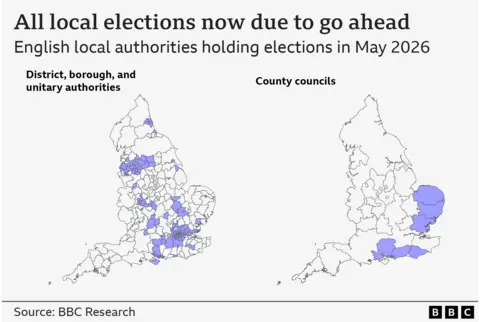
Councils are responsible for local services including care for older people and people with disabilities, rubbish collection and recycling, housing, education and road maintenance.
England elections 2026: What do local councils do?
Which elections are taking place in Scotland?
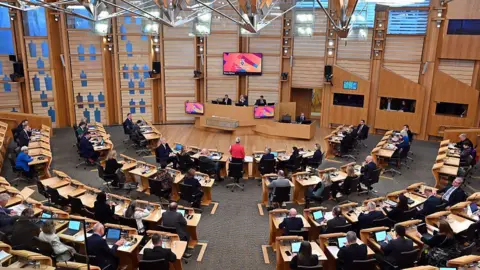
The Scottish Parliament election will decide who governs the country in key areas such as health and education and, as a result, the direction it takes on many issues.
All 129 Members of the Scottish Parliament (MSPs) are up for re-election.
There are 73 constituency MSPs and 56 regional MSPs (seven per region) in Holyrood.
Each voter has two ballot papers and casts two votes, one to elect their constituency MSP and one to elect their area’s regional MSPs.
Constituency MSPs are selected directly under first past the post, with the winner being the candidate who receives the most votes.
The process to select regional MSPs uses a type of proportional representation.
Voters choose either a political party or an individual candidate from a list. Political parties are allocated regional seats according to a formula which includes the number of votes they receive in each region and the number of constituencies they win outright.
Usually the party with the most MSPs forms the Scottish government, and its leader becomes first minister.
 Getty Images
The current Scottish Parliament was set up in 1999, when Scotland already had its own legal and education system.
Holyrood is now responsible for a much broader range of issues including health, housing, policing and prisons, as well as many aspects of transport, welfare and tax.
It can pass laws in any areas not “reserved” to the UK parliament at Westminster.
A simple guide to the Scottish Parliament election 2026
Which elections are taking place in Wales?
The 2026 Senedd election represents the biggest change to the parliament since powers began to be transferred to Wales in 1999. It will determine who governs Wales on many key issues.
The number of Members of the Senedd (MSs) is being expanded from 60 to 96 representatives from 16 newly devised constituencies.
Political parties can list up to eight candidates for each constituency. Independent candidates can also stand. Voters choose one party or one independent candidate.
The 96 seats will then be allocated according to the share of votes received by each party or independent candidate.
The party that wins the most seats in the Senedd election would expect to lead the government. However, no party has ever won a majority in the Welsh Parliament and the new system makes it highly unlikely that will change at this election.
Any MS can nominate any member to be first minister. If there are two or more candidates, MSs will vote to decide who they want to fill the role.
 Getty Images
The National Assembly for Wales opened in 1999.
Renamed Senedd Cymru or Welsh Parliament in 2020, its responsibilities now include health, schools, transport and farming, as well as some tax powers.
How can I vote in the May elections?
You must be 18 to vote in the local elections in England, or 16 to vote in the Scottish Parliament and Senedd elections.
You must be either a British or Irish citizen, or a qualifying foreign national – the rules vary according to which country you are from and the type of election.
For all the elections taking place you need to be registered to vote. The deadline for registering has passed.
There are three ways to vote:
- in person at your local polling station on election day – between 0700 BST and 2200 BST
- by nominating someone to vote on your behalf – a proxy
- by postal vote (if you have not already posted your ballot pack you can hand it in at a polling station in your area, if you are in Scotland or Wales. In England, the Electoral Commission advises checking where you can hand it in with your returning officer)
If you realise at the last minute that you will not be able to vote in person, you can apply for an emergency proxy vote until 1700 BST on polling day. Both you and your proxy must already have registered to vote.
Find your polling station
What ID do I need to vote?
You do not need ID to vote in person in the Scottish Parliament or Senedd elections on 7 May.
However, everyone voting in person in the local elections in England will need valid photo ID, such as a passport or driving licence.
You can use out-of-date ID as long as you are still recognisable.
Voters in England whose ID is lost or stolen can apply for an emergency proxy vote up until 17:00 on polling day. Your proxy will need to have the correct ID.
When will we know the results?
The timing of the counts – and the expected results – vary across the elections.
England
Previously, votes have been counted as soon as polls closed on Thursday.
This time, only a few local authorities will begin counting on Thursday night, with most starting on Friday morning.
The first results are expected to be announced in the early hours on Friday.
It is expected that the latest will be known by Saturday evening.
Scotland
Votes will begin to be counted for Scotland’s constituencies and regional lists on Friday morning.
It’s likely that the shape of the new parliament will be clear by early Friday evening.
But each count is the responsibility of a local returning officer and there may be delays or recounts.
In a Holyrood election such delays could prevent the calculation of full results and it is possible that some seats may not be declared until late Friday evening or even Saturday.
Wales
Votes will begin to be counted for all 16 of Wales’ constituencies on Friday morning.
It is estimated that results could then be declared from about lunchtime, continuing into the early evening.
But with some experts predicting a higher number of recounts compared to past elections, and the unknowns of a brand-new voting system and new constituencies in the mix, whether Wales’ results will be done and dusted before the weekend remains to be seen.
How can I follow the results on the BBC?
Thursday night
From 23:00 BST BBC Radio 4 and BBC Radio 5 Live will join forces for an overnight results programme, co-presented by Nick Robinson and Rachel Burden.
From 23:10 Laura Kuenssberg will host a special programme on BBC One, with analysis from polling expert Sir John Curtice and number-crunching from Reeta Chakrabarti.
Live pages on the BBC News website and app will keep you updated on results and reaction across the UK, with fact-checking from BBC Verify. Follow BBC News on TikTok, Instagram and YouTube for the latest updates on social media.
Friday morning
From 09:30 BST Sophie Raworth will continue election coverage on BBC One after a BBC Breakfast special, with Clive Myrie in Cardiff for the Senedd elections and Kirsty Wark in Edinburgh for the Holyrood vote.
From 09:30 BBC One Scotland and BBC Radio Scotland will bring live declarations, interviews and reporting from every count in Scotland.
From 11:00 a results programme will be broadcast on BBC One Wales and S4C, providing analysis and interviews. James Williams and Dot Davies will present a BBC Radio Wales programme and listeners can join Dewi Llwyd and Kate Crockett on BBC Radio Cymru.
How does the BBC report polling day?
The BBC, like other broadcasters, is not allowed to report details of campaigning or election issues while polls are open in England, Scotland and Wales.
Subjects which have been at issue during the campaign – or other controversial matters relating to the election – must not be covered until the polls close at 22:00 BST.
No opinion poll on any issue relating to politics or the election can be published while people are able to vote.
While the polls are open, it is a criminal offence to publish information about how people have voted, including “exit polls” which may predict the election result based on information from voters (although there are no reliable exit polls for these elections).
Coverage on the day is usually restricted to uncontroversial factual accounts, such as the appearance of politicians at polling stations, the mechanics of voting or the weather.
However, online sites do not have to remove archived reports, including, for instance, programmes on iPlayer. For Scotland and Wales, the lists of candidates, as well as the manifesto guides, remain available online during polling day.
From 22:00 BST, after the close of the polls, the election guidelines no longer apply – but the BBC must still report on the election, of course, with the impartiality requirements set out by both Ofcom and the BBC’s own Editorial Guidelines.
How does the BBC report polling day?

Sign up for our Politics Essential newsletter to keep up with the inner workings of Westminster and beyond.