HS2 could cost up to £102.7bn and trains will be slower than first planned
2 hours agoKaty Austin,Transport correspondentandRachel Clun,Business reporter

 PA Media
HS2 could now cost up to £102.7bn, the transport secretary has announced,
Trains will not start running until between 2036 and 2039, up to six years later than the most recent official target of 2033, Heidi Alexander told the House of Commons.
To save money, the trains’ top speed – originally planned to be 360km/h (224mph) – will be reduced to 320km/h.
The new cost range,
As of March 2026, £44.2bn has already been spent on the programme.
Heidi Alexander said Labour had inherited a “litany of failure” from the previous government.
“Instead of signalling the country’s ambition, HS2 became a signal of the country’s decline,” she told MPs.
Alexander said the rail project was now expected to cost between £87.7bn and £102.7bn in 2025 prices.
When readjusted to 2019 prices, that is roughly double the price range set under the previous government.
“If it seems like an obscene increase in time and costs, it is because it is,” she said. “If it seems like I’m angry, it is because I am.”
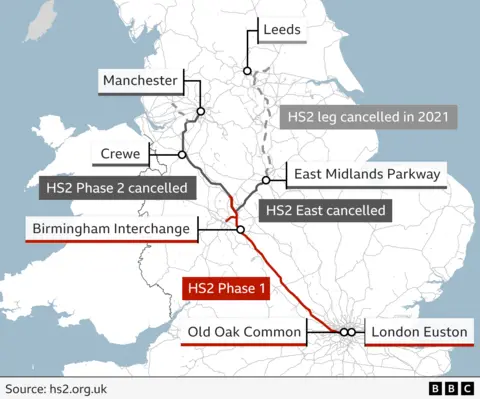
In its original plan, the HS2 project was due to go to Manchester and Leeds, but those legs were cancelled by previous Conservative prime ministers. The current project is set to run from London to Birmingham.
Alexander said the government was committed to delivering the project despite the cost increase.
“I can confirm today that it could cost almost as much to cancel the line as it would to finish it, while delivering none of the benefits,” she said.
“This country can build big things, we just need competent people at the helm to deliver them.”
Two-thirds of the increase in cost is due to an underestimate of costs by the previous government, inefficient delivery, and to works being missed from the scope of the original plan, according to the government. One third of the increase is due to inflation, Alexander said.
The new, lower speed for HS2 trains is in line with high-speed services in Europe and Japan, and the government says it could save up to £2.5bn and allow the project to be delivered a year earlier.
The updated timeline for the start of services is for trains between Old Oak Common in west London and Birmingham Curzon Street.
The full service from London Euston to Curzon Street and a connection to the West Coast Main Line is not expected to run until between 2040 and 2043.
“We will get the job done but we will also take every opportunity to save time and money in the process, getting a grip on delivery, controlling costs, and stripping out the complexity that’s plagued the project in the past,” she said.
Shadow transport minister Jerome Mayhew accepted the project had not gone to plan at the beginning.
“It is true that the early years of the HS2 project were beset with delay and cost overruns, with HS2 Ltd failing to maintain control of the budget, and frankly, the Department for Transport allowing them to get away with it,” he said.
Mayhew said both Alexander and HS2 Ltd should set out “in detail” their plan for saving money and delivering the project on the new timeline.
“If she’s as angry as she says she is, that must be backed up by consequential legislative changes that stop these cost overruns from occurring in the future,” he said.
Alexander said HS2 Ltd chief executive Mark Wild has set the organisation a target of delivering the project by 2037 at a cost of £92.2bn.
“We support it, which gives him a clear mandate to drive down costs and improve productivity,” she said.
Wild said he recognised this would be an unwelcome update on the project for local communities and taxpayers, but the reset was “the only way to regain control of the project”.
“We have turned a corner in the last 12 months with significantly improved levels of productivity, helping us to deliver major milestones ahead of schedule,” he said.
Andy Meaney, who contributed to the Oakervee HS2 review commissioned by former Prime Minister Boris Johnson, said he was shocked at what had been revealed on Tuesday.
He said it was clear in 2019 that questions needed to be asked about plans for very high-speed trains.
“It’s really frustrating that there’s been this continual failure of decision making right back to the conception of the scheme 16, 17 years ago,” he said.
“Really that decision on [reducing] speed should have been taken a long time ago to enable us to deliver the scheme at a lot less cost.”