‘A sad day’ – curling cheating row at Winter Games unsettles Canadians
9 minutes agoAna Faguy,Washington DCandEloise Alanna,Montreal
A scandal at the Winter Olympics has left the Canadian curling teams on the defensive and Canadians reeling over the crack in their country’s polite persona.
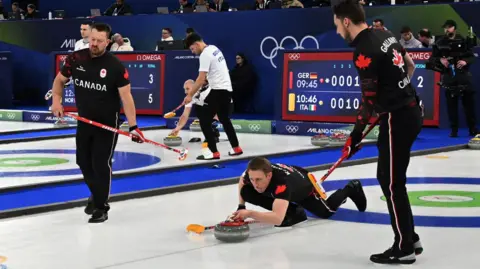
Over the weekend, Canadian curler Marc Kennedy had an expletive-filled outburst after Sweden accused him of cheating during a match, and later said his team might be the target of a “premeditated” attack by their rivals.
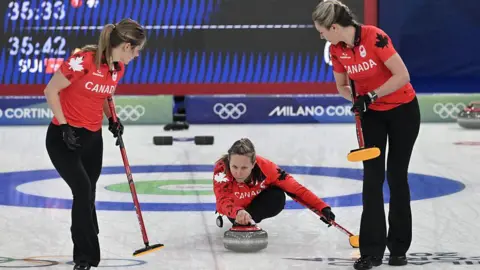
Kennedy was accused of “double-touching” – touching the stone a second time after initially releasing it down the ice. The next day, Canadian women’s captain Rachel Holman was accused of using the same move.
Both have denied the accusations, but Canada’s curling teams, who historically have dominated the sport, now face questions over their tactics.
While the curlers have shown their anger over the situation during matches, fans of the sport and Canadians have questioned whether the team acted in the spirit of curling.
In a country well known for its “niceness”, the cheating row has stung for some. The BBC asked tourists and locals in Montreal what they made of it.
“It’s a sad day for Canadian sport,” said Tim Gray, from Alberta. “Integrity in the sport is important, even if you have to call it on yourself.”
“As Canadians, we aren’t supposed to do these things,” said Samar, from Ontario.
Without sportsmanship, said Dwayne from British Columbia, it’s not sport any more.
Can Canada teach the rest of us to be nicer?
There was a more nuanced take at the Royal Montreal Curling Club.
One of the curling instructors, Ankara Leonard, said the publicity could be good for the sport by generating interest.
She added: “Do I think [Kennedy’s] finger affects the rock? No I do not. Do I think we have to play within the rules? Yes.”
The controversy began on Friday when Swedish player Oskar Eriksson accused Kennedy of double-touching.
As the game continued, Kennedy and Eriksson got into a verbal back-and-forth that included expletives.
Their exchange quickly went viral as a video emerged that appeared to show Kennedy pushing the stone with his finger after releasing it.
Kennedy got a verbal warning from World Curling for using foul language, but he was not formally charged with cheating by the governing body.

 Reuters
The next day, Kennedy said: “I probably could have handled it better. But we’re human out there and there’s a lot of emotions. I’m not going to apologise for defending my teammates and standing up for myself.”
“I’ve curled my whole life, never once with the intention of getting an advantage through cheating,” he added.
An opinion piece in the Canadian news outlet, the Globe and Mail, pointed to some of the frustration felt back home
“These Canadian curling teams are not fun bad guys. They come off like the sort of competitors who need so desperately to win that they will do anything – even things that are pointless – in order to get there.”
Cathal Kelly, the writer of the opinion piece, continued: “There’s an easy way out of this – stop struggling. Stop acting like our curling reputation matters more than our national one. Be the bigger man and woman, even if you don’t think you did anything wrong.”
 AFP via Getty Images
There was a second cheating row on Saturday when match officials accused the Canadian women’s team of the same double-touch violation.
Rachel Homan said there was a “zero percent chance” there had truly been a violation, as she and her teammates looked on frustratingly. The Canadians lost to the Swiss, 8-7.
On Sunday, Great Britain’s men’s team was accused of the same violation.
Both Homan and British men’s curler Bobby Lammie had stones removed from play due to alleged violations.
Homan later slammed the officials’ decision to remove her stone during a defeat to Switzerland, saying it was “insane”.
All of the incidents led World Curling to clarify that double-tapping is not allowed.
“During forward motion, touching the granite of the stone is not allowed. This will result in the stone being removed from play,” they said.
World Curling does not use video to review play, but they did send two officials to monitor how players released their stones in subsequent games.
Curling columnist and Olympian Tomi Rantamaki, in an article for The Curling News, warned that Canada’s dominance in the world of curling means its players should be mindful of the influence they have.
“Young players in Finland, Korea, Italy, Sweden – everywhere – often copy what Canadian teams do. They copy the athlete’s delivery, the sweeping, the tactics, the communication,” Rantamaki wrote. “And they copy the behaviour.”