Andrew investigation could be about more than Epstein files
55 minutes agoDaniel SandfordUK correspondent

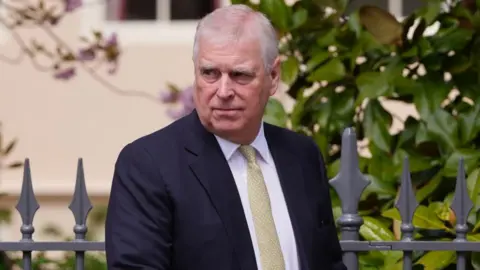 PA Media
When Andrew Mountbatten-Windsor was arrested at about 08:00 on Thursday, it had nothing to do with Virginia Giuffre, the woman who accused him of sexual abuse.
What led to him being arrested started with information that came out in the massive Epstein file release in January, around activities while he was a trade envoy for the British government. But it will not have stopped there.
It was emails in those files that seem to be between Andrew and the late sex offender Jeffrey Epstein that led to Thames Valley Police getting involved.
One email in particular stood out. In November 2010, after Andrew had returned from a UK government-funded trip to Asia, he was sent a series of country reports relating to his trip.
Within five minutes of receiving them he seems to have forwarded them to Epstein, who had by this point already been convicted and spent time in prison for sex offences.
There were further email revelations from the files.
A month later, on Christmas Eve, Andrew appeared to email Epstein a confidential briefing on investment opportunities in the reconstruction of Helmand Province, Afghanistan, which was overseen at the time by British armed forces and funded by UK government money.
In a further email dated 9 February 2011, Andrew seems to suggest Epstein invest in a private equity firm he had visited a week before.
These will have formed the beginning of what today turned into a full investigation by Thames Valley Police. But detectives will have not relied only on the emails that we have seen.
In order to build a case they will have gone to the government and to the palace asking for emails that might explain what was going on. The palace said last Monday that it would “support” Thames Valley Police.
Detectives will also have done their own trawl of the three million documents in the Epstein files, and they will have asked for unredacted copies from the FBI or the US Department of Justice. The National Crime Agency is helping UK police forces with those requests.
So far we have seen only the tip of the iceberg, but detectives may have seen more of what lies under the surface
It is highly unlikely that the police arrested Andrew on Thursday on the basis of just a couple of emails people have seen within the Epstein files.
At this stage, Andrew has only been arrested. He has not been charged. He has always denied any wrongdoing arising from his relationship with Epstein and has not responded to specific BBC questions about the files released in January.
And a reminder, this arrest has nothing to do with allegations Andrew has previously faced from Giuffre, who said she was made to have sex with Andrew on a number of occasions in the early 2000s. An out-of-court financial settlement was reached between Andrew and Giuffre in 2022, which made no admission of wrongdoing on Andrew’s part.
It is unlikely the police will hold Andrew overnight, as typically with arrests relating to white collar crime, people are held for a few hours to allow for searches and initial questioning.
Police could hold Andrew for 24 hours and get extensions, but it is unlikely.
Eventually, the person arrested is typically given police bail and a date to return to a police station for potential further questioning.
Once detectives have conducted their searches and questioned Andrew they will have a big decision to make. This could take weeks.
Police officers with a crown on their cap badges will sit down with lawyers from the Crown Prosecution Service and decide if there is sufficient evidence to charge the King’s brother.
If they decide to take the case to court, it will be called R v Mountbatten-Windsor, or in layman’s terms, the King against the King’s brother.