Are wetter winters and frequent flooding here to stay?
8 hours agoEsme StallardClimate and science reporter

 Ben Birchall/PA Wire
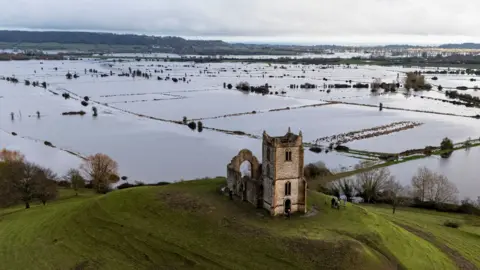
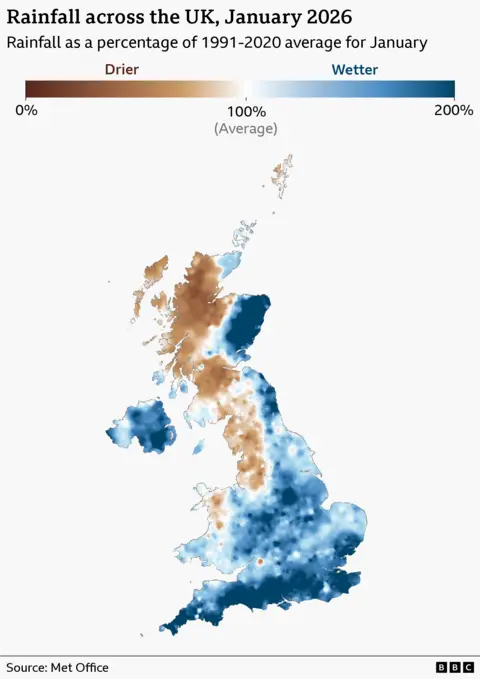
Areas across the UK from Cornwall to County Down have seen their wettest January on record continue with heavy rain in February.
The deluge the country has been experiencing in the last week has been put down to a blocked weather pattern – a high pressure system over Scandinavia is preventing the wet weather from moving away.
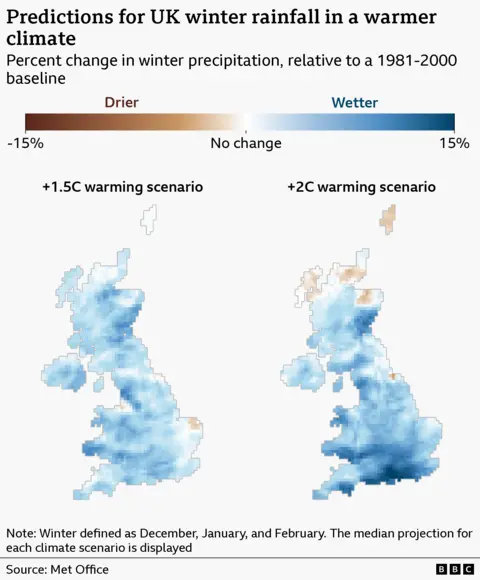
The Met Office estimates that at current levels of global warming, wet winters like 2023/24 have gone from being once in 80-year events to once in 20 – and with further warming this could become even more frequent.
This could have significant impacts for housing, transport and food supply.
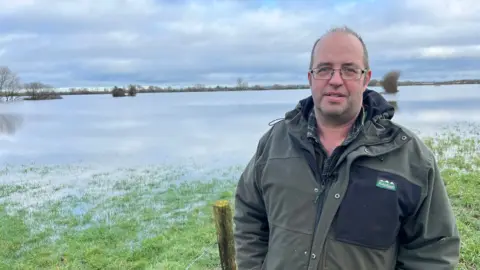
One farmer in Somerset told the BBC that he was living on a “knife edge” as his crops were days away from rotting in the floodwater.
Wetter winters more common
On Tuesday, more than 100 locations across the UK faced flood warnings and more than 300 homes had already succumbed to the flood waters, according to the Environment Agency (EA).
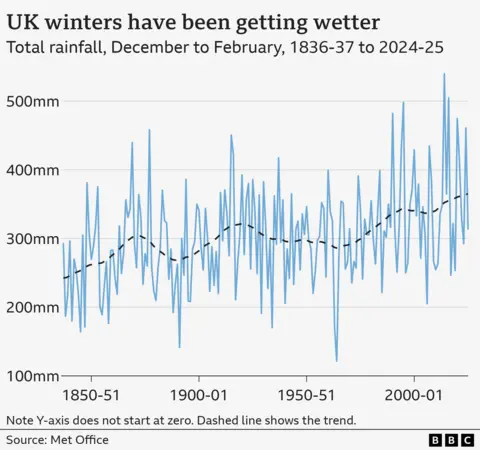
The heavy and continuous days of rainfall follow a similar pattern to the last few years of wetter winters. Six of the ten wettest since records began nearly 250 years ago have been this century, according to the Met Office.
The UK’s rainfall is strongly influenced by natural variability, but the trend towards wetter winters is in line with predictions from the UK’s meteorological organisation.
Increased burning of fossil fuels like coal and oil over the last two centuries has released greenhouse gases like CO2 into the atmosphere, which have warmed our planet.
It might not sound a lot, but for every 1C temperature rise our atmosphere can hold 7% more moisture – this can create heavier rainfall.
At the same time sea level rise around the UK is also accelerating, due to warmer, expanding oceans and melting glaciers.
Since 1901, sea levels have increased by 20cm, which may not sound like a lot but coupled with extreme storm events and tidal surges can exacerbate coastal flooding.
How much wetter could our winters get?
Currently the UK experiences about seven days a year where rainfall is more than 80mm a day – considered a heavy rainfall event. If 30mm of this falls in an hour it typically triggers a flash flooding warning.
But, according to the Met Office, if global temperatures rise by more than 2C (above pre-industrial levels) this would increase to nine days.
Even with current policies to reduce our emissions, global temperatures are expected to have increased by at least 2.5C by the end of the century, according to the United Nations.
As well as more intense rainfall we are also seeing more rainfall clustered together, explained Prof Lizzie Kendon, head of climate projections at the Met Office.
“That is really important, because that can lead to successive rainfall events, [which] can lead to very saturated soils, and as we’re seeing currently in the UK, that can lead to exacerbated flooding as well,” she said.
What is the damage from wetter winters?
Heavy deluges and saturated soils have the potential to cause significant damage to homes, transport infrastructure and food supply.
In December, the Environment Agency estimated that by 2050 one in four properties would be at risk from flooding. This is the first time the EA has considered how a warmer climate could affect flooding in the UK.
The East Midlands, Yorkshire and The Humber, and south-east England are particularly at risk.
This number, the EA said, would rise if more homes were built on floodplains. The UK government plans to build 1.5 million homes in this Parliament, and in some parts of the country more than 10% of new homes are being built in flood-prone zones.
The same picture is seen across the transport network – currently a third of railways are at risk of flooding, which leads to cancellations and damaged infrastructure.
In less than 25 years this will rise to more than half of the rail network being at risk, according to the government’s own figures.
The National Farmers Union (NFU) wrote to MPs in November last year to lay out the severe risks the farming sector was facing.
“Farmers and growers experience both [drought and floods] on an annual basis, and both severely impact their ability to produce food,” it said.
The wet winter of 2024 – the second wettest on record – saw the sector experience £1bn losses from damaged crops.
James Winslade, a beef and arable farmer from Somerset, has seen more than 90% of his farm submerged in the recent rains, and said he is days away from losing his crops to rot.
“We can’t protect everywhere. There isn’t insurance for crop damage. We don’t get compensation.”
He said he is a third-generation farmer, and that his father and grandfather never saw this level and recurrence of flooding.
The UK does have an extensive network of flood defences but there is a patchwork of organisations – including farmers, water companies and charities – responsible for them.
Half of flood defences – around 100,000 – are maintained by the Environment Agency and 9% of those are currently below their target condition. Each defence is given a score out of five they must achieve depending on their importance.
But previous analysis by the BBC Shared Data Unit estimated that the defences not maintained by the EA were 45% more likely to be below target.
And increased development will only exacerbate flooding – concreting over surfaces for housing or car parks prevents rain being absorbed and instead it runs off into drains and rivers which can become overwhelmed and breach defences.
An Environment Agency spokesperson told the BBC: “As a result of climate change, we are seeing more flooding and extreme weather. Whilst it is sadly not possible to stop all flooding, the Environment Agency is committed to helping communities to adapt.
“Through the government’s flood programme a further £10.5bn [will be] invested in protecting 900,000 more properties by 2036.”
With additional reporting from Mark Poynting, Jonah Fisher, Miho Tanaka and Tom Ingham.

Sign up for our Future Earth newsletter to keep up with the latest climate and environment stories with the BBC’s Justin Rowlatt. Outside the UK? Sign up to our international newsletter here.