Australian IS families in Syria camp turned back after leaving for home
2 hours agoTom Bennett

 Reuters
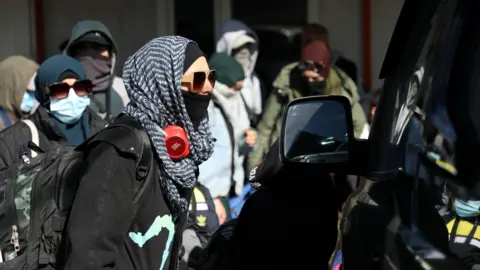
A group of 34 Australian women and children who have been held in a camp in northern Syria for nearly seven years due to their links to the Islamic State (IS) group were released on Monday to head home, but then returned to the camp for “technical reasons”.
The group – thought by authorities to be the wives and children of IS fighters – have been stuck in Roj detention camp until now, with the Australian government refusing to officially repatriate them.
It is unclear why their release was halted, but Australian media has reported it may have been due to a failure to coordinate the correct permissions between the factions governing the region.
Their future – and that of thousands of other IS relatives in Syria – remains unclear. Other foreign governments have also refused to repatriate their citizens.
Reuters news agency quoted a co-director of Roj camp as saying that the 34 Australians had been handed over to members of their families who had travelled to Syria for their release, and had boarded minibuses to travel to Damascus with a military escort.
Australian media reported that the group were intending to continue their journey to Beirut, where they hoped to be issued passports.
The Australian government has repeatedly said it would not repatriate people from Syria and said those who returned who had committed crimes would be “met with the full force of the law”.
But it has previously taken the position that it is obliged to issue passports to citizens who present themselves at an Australian embassy.
Roj is home to more than 2,000 others from 40 different nationalities – mainly women and children – who have been held there since IS was driven from its final foothold in Syria in 2019.
Among them is thought to be Shamima Begum, who was stripped of her British citizenship in 2019 on national security grounds.
Speaking to Australian Broadcasting Corporation (ABC), the camp’s director, Hakmiyeh Ibrahim said: “My message is not only to Australia but to all countries: take your citizens, take these children and women”.
She added that children were growing up surrounded by “dangerous ideas and ideologies” in the camp.
“We brought families of ISIS-affiliated women and children here in 2017 and now it’s 2026,” she said. “The more time passes, the more complicated the situation becomes.”
The Australian government said in a statement: “Our security agencies have been monitoring – and continue to monitor – the situation in Syria to ensure they are prepared for any Australians seeking to return to Australia”.
“People in this cohort need to know that if they have committed a crime and if they return to Australia they will be met with the full force of the law.
“The safety of Australians and the protection of Australia’s national interests remain the overriding priority.”
In 2022, another group of Australians, consisting of four women and 13 children, were released from the Roj detention camp and brought back to Sydney, prompting a backlash from some in Australia.
Last month the UK home secretary said she would “robustly defend” the decision to remove Shamima Begum’s citizenship, according to a government source.
The European Court of Human Rights (ECHR) has called for an investigation, but the government source said the decision had already been upheld by UK courts.
Ms Begum was 15 when she travelled from east London to the Middle East, to a territory held by the Islamic State group, where she married a fighter.