Enzo Maresca’s Chelsea won only once in the Premier League in December
Nizaar KinsellaFootball reporter
- 31 December 2025
- 1041 Comments
Updated 4 minutes ago
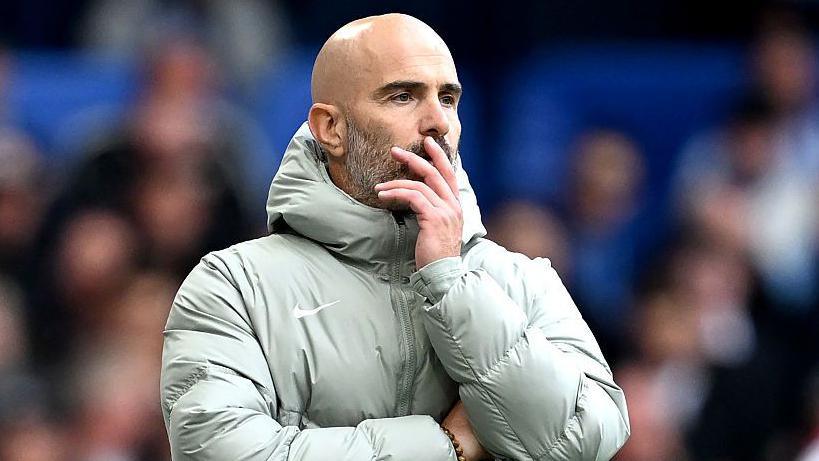
Less than six months after guiding Chelsea to Club World Cup success, Enzo Maresca has left his post as head coach.
The Blues won just one of their final seven Premier League matches under Maresca and sit fifth in the table – 15 points adrift of leaders Arsenal.
After their most recent game – a 2-2 draw with Bournemouth on 30 December – assistant manager Willy Caballero said Maresca felt too unwell to speak to the media, but it is understood his absence was more due to him considering his next steps.
Two days on, Maresca has gone. But how did things unravel?
From stability to trouble
From Match of the Day on 13 December: What did Maresca mean?
At the end of November, Chelsea appeared in a harmonious place, with the team third in the Premier League and having recently dismantled Barcelona in the Champions League.
On 12 December, Maresca was named Premier League manager of the month for November.
Just one league win followed in December but it was not just results that added to the focus on Maresca, with fissures emerging between the Italian and the club’s hierarchy.
Maresca stunned key figures at Stamford Bridge – and even his own staff – when, after beating Everton 2-0 for Chelsea‘s solitary Premier League win in December, he said “many people” had made it his “worst 48 hours” since joining the club.
Those comments came from a position of strength after a good performance but were viewed dimly by the club hierarchy, at whom they appeared to be aimed.
They have since been explained as being linked to medical recommendations. Maresca felt the club were telling him who to pick, and that crossed a red line. But the staff were trying to limit injured players’ minutes through standard protocols, which senior figures inside the club said were ignored and either risked players getting injured again – or prevented them from training because of overload.
Even after that, the plan remained to conduct an end-of-season review to decide whether to move forward with Maresca or part company.
Those with knowledge of Maresca’s views, though, said he was capable of walking away having grown unhappy at a multitude of factors, including encouragement over which players should start and which substitutions should be made during matches.
He also felt a lack of protection from the club over the quality of his work.
And on Thursday came news that was not unexpected, with Chelsea confirming the two parties had gone their separate ways.
The Blues’ players will return to work on Friday closer in points to 15th place than third in the Premier League as they prepare for a defining period.
They face Manchester City on Sunday to start a difficult month that also includes games against Arsenal and Napoli.
Chelsea‘s primary goal this season is to qualify for the Champions League, which remains realistic, while also aiming for domestic cup runs.
What happened to Maresca behind the scenes?
Chelsea were satisfied with Maresca at the end of last season when he delivered Champions League qualification – regarded internally as his most important achievement – plus success in the Conference League and Club World Cup.
While victory in Europe’s third-tier competition was broadly expected, beating Paris St-Germain to be crowned ‘world champions’ was a welcome surprise.
Maresca had delighted key figures at Stamford Bridge – including sporting directors Paul Winstanley and Lawrence Stewart, and influential co-owner Behdad Eghbali.
In line with the agreed strategy when the Italian moved from Leicester City in 2024 – for which the club paid £10m – he focused on coaching while those above him oversaw much of the backroom staff, medical department and transfers.
Their transfer policy – signing the world’s best young players from ‘lesser’ leagues to create the youngest team in the Premier League – remains in place.
Maresca knew what he was signing up for – and his issues were not with the quality of players or the strategy, but about the perception of his work with a young group.
This season, he and his agent had informed the club of interest from Juventus and Manchester City, while also making it clear he had no intention of leaving and was open to a possible contract renewal.
But difficulties remained in his working relationship with the Chelsea ownership.
The Italian was encouraged to rotate his squad, but often felt that when he did so in the Premier League, they dropped points. He openly urged reporters to question the club’s hierarchy but there was frustration each time Maresca sought to make his complaints public rather than discussing internally first.
He later admitted his comments after the Everton were premeditated – rejecting the club’s claim they were an emotional outburst after a tense match.
Maresca also wanted to take on some external engagements following the club’s recent successes. He had floated the idea of publishing a book but was blocked by the club. A claim a source close to Maresca denies. He also spoke at Il Festival dello Sport – an event in Italy organised by La Gazzetta dello Sport newspaper – without their permission.
He also made public that he disagreed with the club not signing a central defender after Levi Colwill injured his anterior cruciate ligament in pre-season. The club’s hierarchy explained that doing so could prompt academy prospect Josh Acheampong to request a transfer, which ultimately led Maresca to back down.
Those close to Maresca, who has switched agents from the Wasserman agency to Jorge Mendes, made it known he was weighing up his future.
The last week seemed to be the turning point in Maresca’s mind, with Chelsea more keen to make any change of manager in the summer.
The home supporters, who Maresca holds in high regard, booed his decisions to take off Cole Palmer in a defeat by Aston Villa and the draw with Bournemouth.
Maresca was reportedly told by the medical department he needed to make that change, despite insisting in his news conference his star attacker could complete 90 minutes if he wanted to.
All of this after a positive start…
After Maresca’s side beat Cardiff City in the Carabao Cup in December, supporters chanted his name.
They hadn’t done so as openly since appearing to be mounting an unlikely title challenge last season, when fans also sang ‘We’ve got our Chelsea back’.
But a disappointing run followed, and supporters turned on Maresca both inside the stadium and on social media.
Part of the criticism was Maresca seemed a distant, project-focused manager, as fans struggled to move on from the very different and successful era under Roman Abramovich’s stewardship.
Though he won the Club World Cup, many supporters disliked his communication style and slow, patient football – and influential fans said chants in support of Maresca were largely a protest against the club’s BlueCo ownership.
That is why Chelsea continued efforts to convince supporters Maresca was the right manager and that the ownership’s ultra long-term approach would eventually bring sustained success.
Key figures at the club admired Maresca’s style of play, insisting it improved players, and that any successor would adopt a similar approach. Further progress was made with team spirit after Mauricio Pochettino had laid the foundations.
Regular starters broadly liked Maresca, but – perhaps inevitably – he was less popular on the fringes if the squad.
There were complaints after one-off tactical missteps. One player questioned their man-to-man marking approach in a heavy defeat at Manchester City in January 2025, and Maresca said he needed to coach better after a home loss to Brighton, when Chelsea had a player sent off.
The club’s only real concern in his first season was his sometimes clumsy news conferences, attributed – as an Italian who speaks Spanish at home – to English being his third language.
In their view, he had played down Chelsea‘s chances of Champions League qualification too much, – alienating ambitious fans. There was also a curious moment at the Club World Cup when he awkwardly refused to praise Mexican set-piece coach Bernardo Cueva to a compatriot in the media, despite previously praising coaches closer to him.
Maresca also adopted a cold, aggressive tone towards Chelsea‘s so-called ‘bomb squad’.
Initially, it proved useful – leaving unwanted players in no doubt they had to leave. But when players such as Raheem Sterling and Axel Disasi failed to secure transfers, the approach became counterproductive, as the Blues have a legal obligation to look after the interests of all players on their books.
Sources close to Maresca say he felt he deserved backing similar to that enjoyed by Mikel Arteta at Arsenal, Jurgen Klopp at Liverpool and even Ruben Amorim during his struggles at Manchester United – including a say in shaping the project. Arteta, for example, has significant influence over Arsenal‘s transfer policy.
But at Chelsea, the project is king – and the club are more comfortable seeing another manager slot in, rather than ceding any control.
Can Chelsea move forward?
Chelsea face a packed January schedule across four competitions.
They begin with Sunday’s Premier League trip to the Etihad, with a series of London derbies – home and away – against Fulham, Crystal Palace, Brentford and West Ham before the end of the month.
In addition, they have an FA Cup third-round tie away to Charlton, a Carabao Cup semi-final first leg against Arsenal, and two Champions League fixtures – at home to Pafos and away to Napoli.
Chelsea realistically need to win both European games to avoid the play-off round and secure a top-eight finish in the league phase.
The fifth place they occupy in the Premier League may be enough to secure a return to the Champions League for the 2026-27 season.