Epstein eyed record label investment to access women, files suggest
5 hours agoBen KingBusiness reporter

 AFP via Getty Images
Warning: this article contains offensive and derogatory language
Jeffrey Epstein considered investing in music company EMI after his associate David Stern appeared to suggest it potentially offered access to women, recently released emails suggest.
Stern told the convicted sex offender that the music industry was “related to P”, a way Epstein apparently often referred to women, in emails newly released by the US Department of Justice (DOJ).
Epstein replied that he was interested, adding: “Do we need help – mandelson? [sic]”
Stern and Lord Mandelson did not reply to requests for comment.
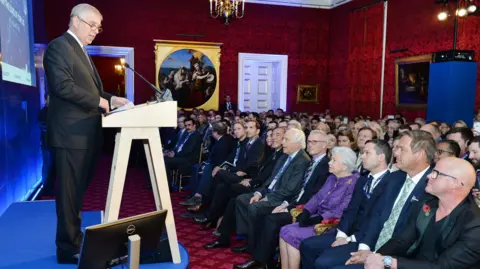
Stern was a London-based German businessman who was close to Andrew Mountbatten-Windsor and previously directed the former prince’s start-up business competition Pitch@Palace.
He acted as a go-between in negotiations with Mountbatten-Windsor over Sarah Ferguson’s money troubles, and has connections to China.
Many of his emails to Epstein flagged potential deals, and in February 2010 he forwarded a short news article about the financial woes of EMI at the time.
EMI is a now-defunct conglomerate that included EMI Records, formerly one of the major players of the music industry. It was acquired by Universal Music in 2012.
“Troubled industry but related to P,” Stern wrote to Epstein.
“P”, which Epstein apparently used to refer to women, is believed to be an abbreviation of the word “pussy”, another term Epstein often used.
For birthdays and New Year greetings, Stern wished Epstein “lots of P”, according to the recently released files. He once offered to get Epstein fashion show tickets “to review Chinese P”.
He would send Epstein a “P factor” for the places he visited, giving the Spanish island Ibiza 9/10, and Sarah Ferguson’s 50th birthday party 0.2/10.
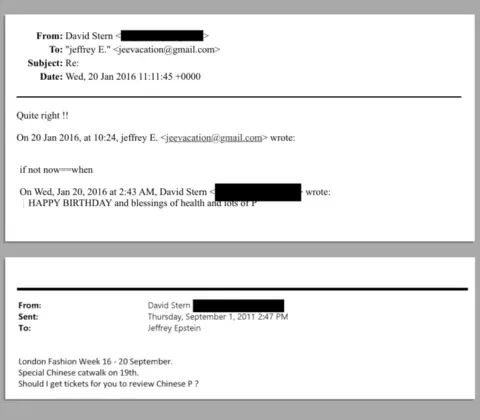
At the time Epstein had considered asking Stern for his help in an EMI investment, Lord Mandelson was First Secretary of State and Business Secretary in the UK government.
Stern said it was “too early to get Mandelson involved before i know more”.
Epstein appears to have emailed Lord Mandelson a few days later, saying: “please email me bens contact info.. or havehim cal me re emi. [sic]”
In reply, Lord Mandelson appears to say: “Gave to [redacted]. Email is [redacted]. Talk re EMI ??”.
It’s not clear exactly who “ben” is.
Epstein sent another reply to Stern, suggesting that if the deal went ahead, he would put US businessman and former Sony Music company CEO Tommy Mottola in charge of it.
He wrote, “my friend is tommy mottola former head of sony I’d like him to be brought in to fix it”.
Mottola did not reply to a request for comment.
Mottola’s name appears more than 700 times in the DOJ’s recently released files. An appearance in the Epstein files is not a sign of wrongdoing.
 US Department of Justice
Epstein’s proposed deal did not go ahead – and EMI’s main lender Citigroup ended up taking control of the company.
However later on, in 2011, Epstein’s circle were still discussing a bid for EMI.
Kevin Law, a businessmen in the US state of Connecticut who was often in touch with Epstein, apparently wrote: “Tell your buddy Andrew from the UK if he’s interested in EMI as we discussed I can put him in the syndicate w KKR.”
It is not clear if Epstein’s “buddy” referred to here is Andrew Mountbatten-Windsor.
 PA Media
Law has said he “never bid on EMI with any group nor did I ever do a business deal with Epstein,” and said he did not know the former prince.
The giant private equity firm KKR declined to comment. At the time KKR had a controlling stake in a rival record company, BMG.
Stern was apparently still keen on acquiring a record company in 2011. He wrote: “EMI may now come up for sale. Could actually be of interest to Chinese if structured properly. Also, most certainly great asset to have for P!”
However Epstein did not buy it then either.
In November 2011, Citigroup split EMI into two parts and, the following year, sold it to Universal and a consortium involving Sony and record executive David Geffen.
The DOJ files show other discussions between Epstein and associates about buying model agencies and fashion-related businesses, which also did not go ahead.
French prosecutors have previously suspected that Epstein used his contact in the fashion industry, Jean-Luc Brunel, to house and transport young girls.
More on this storyJeffrey Epstein