How South Korea’s democracy rallied after the president tried to impose military rule
42 minutes agoJake Kwon,Seoul correspondentandGavin Butler

 AFP via Getty Images
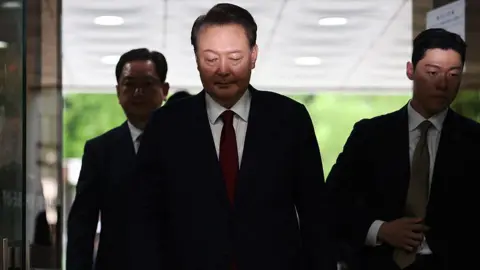
It took just over 14 months for Yoon Suk Yeol to go from South Korea’s presidential residence to a life behind bars.
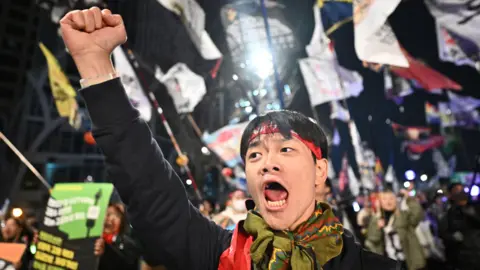
It took South Koreans less than six hours to thwart the insurrection attempt that put him there.
On 4 December, 2024, Yoon announced to the nation that he was declaring martial law – plunging South Korea into chaos and setting in motion a series of events that would precipitate his downfall.
The 443 days that followed saw months-long protests, Yoon’s impeachment, a string of indictments and a widening fracture that now runs through the heart of South Korean politics.
On Thursday, Yoon was found guilty of masterminding an insurrection and jailed for life. Prosecutors had demanded that the 65-year-old be sentenced to death – which, in a country that has not carried out an execution since 1997, would have amounted to a life sentence.
 AFP via Getty Images
The outcome of the verdict – and the expediency with which South Koreans held their leader accountable – sends a powerful message at a time when the United Nations has warned of rising authoritarianism around the world.
“At a time when global democracy appears fragile, the Korean case offers a rare example of democratic resilience,” Gi-Wook Shin, director of the Korea program at Stanford University, tells the BBC.
“It reminds us that democracy ultimately depends not only on formal rules, but on citizens and institutions willing to defend them.”
The night of insurrection
It was just after 22:00 in December 2024 when Yoon appeared on television to announce he was imposing martial law, claiming “anti-state forces” had infiltrated South Korea.
Shortly thereafter, he issued a list of new decrees: outlawing political activity and ordering the military to censor all media.
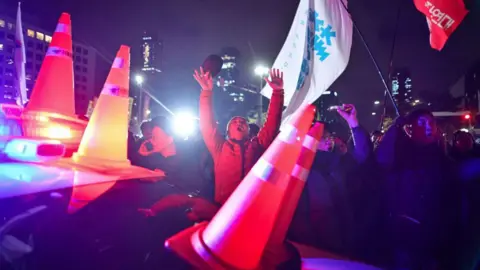
By the time the BBC arrived at the National Assembly in central Seoul around midnight, thousands of citizens had already braved the biting cold to gather against a backdrop of chaos – police cars pulsing red and blue lights as officers scrambled to form a barricade around the assembly grounds.
This crowd was breaking the law, according to Yoon’s decree. But it kept growing. One protester climbed onto an impromptu stage and bravely proclaimed: “I am a Yoon voter… But he really crossed the line. I regret voting for him.” The crowd cheered.
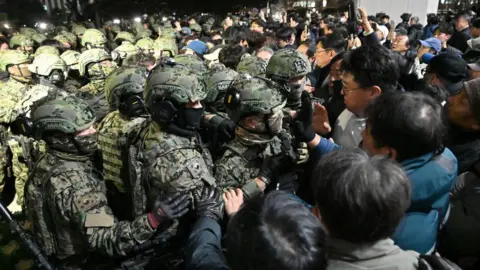
Throughout the course of those turbulent hours, some 190 lawmakers rushed to the main hall of the assembly building – in some cases breaching the police perimeter and vaulting the fences – to vote against the martial law bid.
They barricaded the doors with tables and chairs and fought off armed soldiers even as helicopters dropped special forces troops on the lawn.
Then, shortly after 01:00, the crowd erupted:
The lawmakers had unanimously voted to strike down the martial law attempt, and within another three hours Yoon had backed down.
 Getty Images
As the dust settled and it became clear that Yoon’s martial law attempt had failed, the public began to call for his removal. He was impeached on 14 December, and on 3 January – after confining himself inside the presidential residence for two-and-a-half weeks – arrested.
South Korean civilians, legislators and institutions had prevented an insurrection.
“The rapid response – from the National Assembly, courts, media, and civil society – demonstrates that democratic safeguards are robust and effective,” Shin says. “Rather than collapsing under executive overreach, the system activated its constitutional defences.”
Six months later, South Koreans took further action at the ballot box, rejecting Yoon’s party by handing a decisive victory to opposition candidate Lee Jae Myung at the presidential election.
In South Korea, Shin explains, democracy “is not merely procedural but actively defended by both institutions and citizens”.
“South Korea has one of the strongest traditions of democratic protest in the world. Citizens have repeatedly demonstrated their willingness to mobilise in defence of democracy.”
 AFP via Getty Images
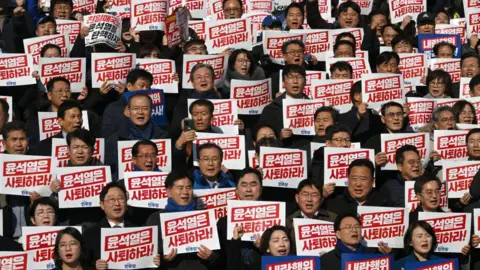
Protest is a crucial slice of life in the young democracy, and it knows how to turn it into a party – packed with songs, chants, dancing and open mic sessions.
Some of the songs protesters marched to in 2016 against then-president Park Geun-hye – including a pro-democracy anthem and a K-pop hit – reappeared in the rallies opposing Yoon.
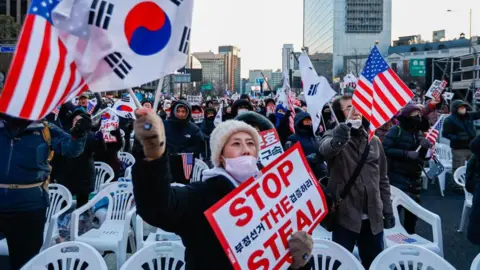
There were protests on the other side too, as throngs of Yoon’s supporters took to the streets to defend what they saw as a legitimate attempt to protect the country from “leftist forces”. Though smaller in scale, these demonstrations were no less emphatic than those denouncing the martial law attempt.
There’s a reason this protest streak runs so hot in South Korea, which only became a democracy in the late 1980s and is well-acquainted with political interference, dictatorships and military overreach. It is a legacy South Koreans are eager to shake free of – and many still remember what pre-democracy Korea looked like.
Yet for global audiences who watched the events unfold from afar, the ferocity of the civilian response may have come as a surprise, says Su-kyoung Hwang, senior lecturer in Korean studies at the University of Sydney.
“It may have seemed a stark contrast to the polished global image of South Korea shaped by K-pop and popular culture,” she tells the BBC. “[But] for South Koreans this outcome reflects a long historical lesson they have worked hard to learn.”
Memories of oppression
In the immediate aftermath of Yoon’s shock martial law declaration, emotional reactions among South Koreans were largely divided along generational lines.
For many younger people, the prevailing feelings that night were confusion and disbelief. In the following days, “martial law” was among the most searched terms on South Korean internet as people tried to make sense of what was happening.
Meanwhile, for many older South Koreans, the prevailing emotion was fear.
In the wake of the Korean War of 1950-53, emerging dictators in South Korea repeatedly used martial law to clamp down on anti-government sentiment and civilian demonstrations – stationing soldiers, tanks and military hardware in public streets.
Park Chung Hee, who seized power in 1961 by way of the country’s first successful coup, regularly used the tactic to quash dissent – as did his successor, Chun Doo Hwan.
Both military dictatorships tortured and killed dissenters, often falsely accusing them of spying for North Korea.
When Yoon stood before the cameras in December 2024 and made the baseless claim that his political opponents were Pyongyang-aligned insurrectionists, he seemed to be evoking South Korea’s past authoritarian purges.
Such fresh memories, Hwang says, would have spurred many South Korean people to action.
 Getty Images
“Older and middle-aged Koreans still recall stories of torture chambers under the Park Chung Hee and Chun Doo Hwan regimes, [as well as] nightly curfews, martial law declarations, and the violent suppression of peaceful protesters,” Hwang explains.
“Because this memory is still recent, many were able to respond quickly to signs of authoritarian revival – or even its insinuation.”
A polarised nation
While many will be celebrating Yoon’s sentence as a triumph, the tumultuous saga of his ill-fated martial law bid has come at an immense cost to South Korea.
As prosecutors have pointed out, the attempt, though unsuccessful, deeply divided the country.
Yoon made the move amid plummeting approval ratings and growing political challenges as a lame-duck president.
And his justification for it – that the opposition party had allegedly colluded with foreign forces and stolen past elections – stoked Cold War-era paranoia about the “enemy within” and brought what was considered a fringe conspiracy theory into the realm of mainstream politics.
But Yoon also tapped into pre-existing anxieties and grievances, especially among young men, activating a latent undercurrent of discontent and driving it to the surface.
Ironically, the very thing that ended his lame-duck presidency has now made him more popular than ever among certain sections of the right.
Many of Yoon’s newly-energised supporters echo narratives that have been peddled by influential right-wing YouTubers, including suggestions that South Korea’s Democratic Party, which is now in power, is obsequious to Beijing and that the country is at risk of communist infiltration.
Even today, about 27% of Korean voters believe he is not guilty of insurrection – and in the wake of Thursday’s court verdict, his supporters said they were “deeply disappointed”.
“I’m at a loss and ache on behalf of our former president,” one woman told the BBC.
“I will keep coming out,” she added. “I’m hopeful that the sentencing will change in his favour down the line.”
 Getty Images
Yoon’s time in front of the court is not over: he still faces two trials in connection with the failed martial law bid, and four others over corruption charges. He can also appeal for a presidential pardon – though the ruling party is now working on a bill to prevent this.
Nonetheless, observers say the outcome of Yoon’s case is remarkable.
“Despite its flaws and deep polarisation, South Korean democracy is working,” Hwang says. “It should reassure citizens that they retain the agency to shape their political and social lives.”
Shin says it also sets an example for other democracies.
“Around the world, we have seen elected leaders weaken democratic institutions from within, often without meaningful consequences.”
What happened in South Korea, he adds, “shows that democratic erosion is not inevitable and that institutions can successfully constrain authoritarian ambitions… when institutional and societal actors are willing to act”.
On the night of the attempted insurrection, the BBC spoke to an elderly man who was watching the fracas from afar. He remembered what South Korea was like under military rule, he explained, and that’s why he felt he had to come out to protest.
“It was a terrifying time,” he said. “It cannot happen here again.”