How the ‘postcode lottery’ of parenting really impacts young children
19 minutes agoEmma Barnett,Presenter of Today and broadcaster,Luke Mintz,BBC NewsandVanessa Clarke,Education correspondent

 BBC
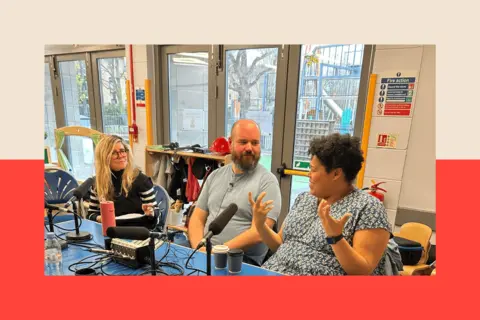
BBCAt a children’s centre in south London, six soon-to-be parents are comparing notes on the size of their unborn babies. They are all discussing how big the foetus is at various stages of pregnancy, using fruit and vegetables as a guide.
Dan from Edinburgh says that his baby, due in early January, was at one point the size of a grapefruit. Another father – Shaun from Gateshead – chimes in that his is cabbage-sized.
All six people – among them, a nurse, an electrician, a writer, a publicist, a physician’s associate and a software developer – have travelled from across the country on a drizzly afternoon to take part in a social experiment.
BBC Radio 4’s Today programme plans to follow these families for five years, chronicling the ups and downs of looking after a young child in modern Britain.
Early childhood is an important stage of life in determining a child’s long-term future, scientists say. But it’s also a period that can get lost in our national politics, which so often seems to focus on the needs of the elderly and middle-aged.
Wes Streeting, the Health Secretary, says: “Talk to the overwhelming majority of parents, good parents, they will take bullets for their children. I don’t think that’s reflected sufficiently in the state.”
And for many British parents raising a child can feel like a game of chance.
 The Today Programme
Access to childcare can be highly dependent on your postcode, campaigners say, and parental leave pay fluctuates wildly, depending on the generosity of employers, while others rely solely on statutory maternity and paternity leave pay.
So what effect does this so-called “lottery” of early years provision have, not only on the family but on the child and their future?
Generous employers vs statutory pay
Shaun, an electrician, is getting two weeks of paternity leave – the statutory minimum.
“It’s not the best,” he admits. “And I found out the other day, if we had to go into hospital earlier for whatever reason, I would have to use holiday for that. [It] only starts when [the baby] is born.”
Still, he feels lucky. “My work’s been quite flexible.”
The UK has a mixed record on maternity and paternity pay, explains Abby Jitendra, policy adviser at the Joseph Rowntree Foundation think tank. Mothers get more time off compared with other European countries, but a relatively poor replacement for their wages, while fathers get one of the least generous deals in Europe, she argues.
But what really shines through is the sense of lottery. How much you’re paid in your baby’s first year is determined largely by your employer, she says – and this of course impacts how much time parents can afford to take off.
 The Today Programme
The state guarantees employed mothers a basic pay of 90% of their average weekly earnings for six weeks, and then a statutory minimum of £187.18 per week for the next 33 weeks (or 90% of their earnings, if that is lower). Employed fathers, meanwhile, receive that same statutory minimum for two weeks. Self-employed parents get a different benefit.
But certain employers – including some tech and financial services firms, and some highly unionised public sector employers – offer their staff much more. Some workers get six months off on full pay.
The income difference between those generous workplace policies and statutory provision is “really night and day”, Ms Jitendra argues. It ultimately means that some parents are forced back to work much quicker than others, giving them less time with their children.
It is hard to pinpoint exactly what impact these policies have on a child’s long-term future, says Emily Jones, an early years neuroscientist at Birkbeck, University of London.
Some assume that a generous maternity or paternity leave policy benefits an infant, because it allows a parent to be at home for more time during their child’s crucial first year of development. But Prof Jones says it is more complicated.
 PA
PAWhat matters is that a baby has regular interaction with at least one “stable attachment figure”, she says – it is not important whether that is a parent, or a nursery worker or childminder.
What is true, she says, is that a generous parental leave policy can reduce stress in a household, which certainly benefits a child.
Without decent parental leave, she says, there is a risk that parents are forced to “juggle” work with childcare, or simply get by on a lower income.
“Those increases in stress, not being able to spend the time you have with [the] baby in a relaxed way – those are things that are going to be problematic.”
Low uptake of shared parental leave
Shaun and Miranda considered taking Shared Parental Leave (SPL), a state-funded scheme that allows parents to share up to 50 weeks of leave and up to 37 weeks of state-funded pay – but they calculated that it wouldn’t make financial sense for them.
Take-up of shared parental leave has risen since it was introduced by the Coalition in 2015, but it remains low. Just 1% of mothers and 5% of fathers used it between 2015 and 2020, a government report from 2023 suggests.
Among those fathers who did not take shared parental leave, almost half (45%) were not even aware the scheme existed, the report found.
Campaign group The Dad Shift, has argued that the scheme is “failing working families”. According to the group’s analysis of HMRC data, 95% of claims for state-funded SPL in 2024-25 were made by fathers or partners in the top half of earners.
 Cameron Smith/Getty Images
But others argue that it should not be the responsibility of the state to ensure that everybody gets equal time off work to look after their child. Maxwell Marlow, director of public affairs at the Adam Smith Institute, a think tank, says there should be a “baseline minimum” maternity and paternity pay, but beyond that it should be left to individual workers to negotiate with their employers.
Any attempt by the government to expand parental leave provision risks placing onerous demands on already-struggling businesses, he thinks.
The Department for Work and Pensions say they have launched a review into parental leave and pay “to better support working families as part of our Plan for Change”.
The childcare ‘postcode lottery’
Miranda, a nurse, is already thinking about what happens when her maternity leave ends. Her own mother has saved up annual leave to use.
“Your mum’s going to be very, very busy,” Shaun laughs.
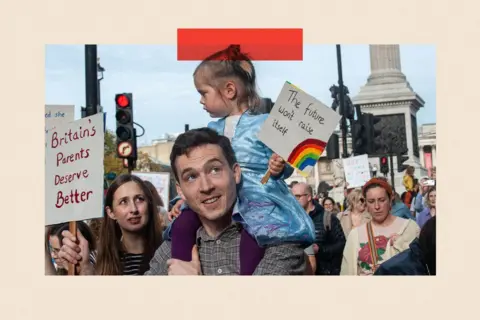
Working parents in England are now eligible for 30 hours of state-funded childcare per week during term-time, for children from the age of nine months to four.
The policy, which came fully into effect in September 2025, was initiated by the Conservatives and continued by Labour, and marked a “step change” in childcare provision, says Ms Jitendra.
Yet some families say they have fallen between the gaps.
That’s because all adults in a household must be working and earn more than £10,158 but less than £100,000 per year to be eligible.
One father, David from London, whose wife was retraining to be an occupational therapist, told the BBC last year that he was devastated after realising they didn’t qualify because she wasn’t earning at the time.
“It seems to be a huge oversight,” he said at the time.
 Guy Smallman/Getty Images
Even for those who do qualify, a place is not guaranteed as nursery provision varies so much.
A report last year from Ofsted, the body that regulates and inspects early years education, found vast inequalities across different areas. For example, it identified Walsall in the West Midlands as a childcare “desert”, with just 13.5 childcare places per 100 nursery-age children; while Richmond-upon-Thames in west London was named an “oasis”, on account of its 39.8 places per 100 nursery-aged children. (This may sound low too but only 64% of children use formal childcare, and many only do so on certain days.)
This so-called postcode lottery is partly driven by money. Private nursery chains, which have become a bigger share of the childcare market in recent years, tend to open in more affluent areas where there is a greater profit incentive.
But the lottery is even more random than that. Even within postcodes, there’s huge variability between nurseries based on training and experience of staff, argues Chris Pascal, a professor of early years education and the director of the Centre for Research in Early Childhood, a charity.
“It depends on [many things] – have they got people who love children, who enjoy their work, who have been professionally trained?”
More from InDepth
A Department for Education spokesperson said they are investing £9.5bn into early years over 2026, part of an effort “to back working parents” by covering the costs of 30 hours childcare a week, saving families up to £7,500 per child per year.
They added: “The latest data shows childcare capacity is continuing to grow, and our new school-based nurseries and government-funded childcare expansion are already playing a vital role in supporting families in more disadvantaged communities.”
Brain development and early socialisation
Sam Wass, a neuroscientist specialising in early years at the University of East London, says that during the first few years of a child’s life, the learning capacity of an infant’s brain “far outstrips an adult’s brain”.
Early socialisation is particularly important, he says. “What babies need and what they learn from the best are simple, slow, repetitious, face-to-face interactions.”
Some experts think that the more support parents get – either from the state, or from their employer – the better their baby’s brain develops.
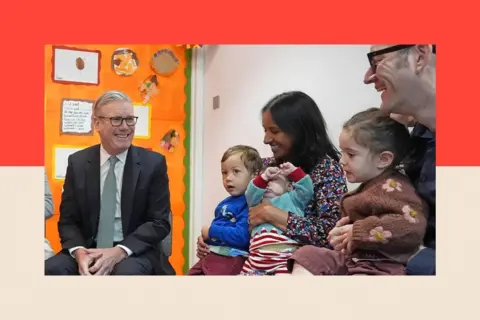
Take childcare. Prof Pascal argues that what a child crucially needs during their early years is interaction, both from adults and from other children – and that a high-quality nursery can be the ideal environment for this.
There, professionally trained staff can teach children how to play, explore, and negotiate conflicts with other children – all of which helps stimulate their brains.
 WPA Pool/Getty Images
“A quality nursery is astonishingly good in terms of advancing a child’s life chances,” she says.
But Prof Jones thinks the long-term impact of nursery on a child’s development is more complicated. Before a child turns two, she says, they need a “stable caregiver” they can interact with.
They can get that at nursery but they can also find it at home, she says.
It’s after a child is two that nursery becomes “actively beneficial”. At that point, “they start to interact with their peers and understand who other children are – that all becomes really important.”
Baby boxes and green spaces
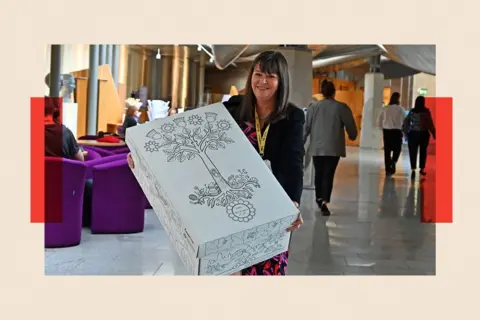
Anna and Dan, another couple taking part in the experiment, received a “baby box” in the post in the autumn – a cardboard box containing a digital thermometer, changing mat, mattress, health information, clothes, and baby books.
They live in Scotland, where every pregnant mother is entitled to one, as part of a policy introduced by the Holyrood government in 2017.
Anna says it’s a “massive lifeline”. “It really does provide everything you need for the first six months.”
“We’ve heard about the box,” Adam, from Staffordshire, says with a laugh. As he lives in England, he and his partner aren’t eligible to receive one.
It’s another of the other small differences that affect parents across the UK.
 Ken Jack/Getty Images
The benefits of the box aren’t entirely clear. Research carried out at the University of Glasgow found that the introduction of the box brought no change to infant hospital admissions, though it did lead to a small increase in breastfeeding and a small decrease in tobacco exposure (perhaps because of health information included in the box on those topics).
The “absolute effects were small”, the researchers concluded.
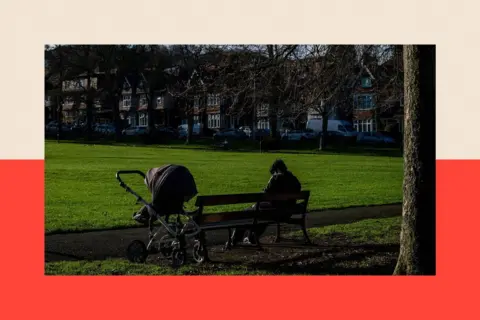
Then there is the varying availability – and quality – of parks, playgrounds, and libraries depending on where you live.
A report last year by charity, Fields in Trust, looked at how many people in Britain live within a 10-minute walk of an accessible green space (like a public park or an open sports field).
In big cities such as London, Manchester, and Liverpool, more than 95% of people have this benefit, the report found. But in other places – including East Lindsey in Lincolnshire – fewer than 75% do.
Prof Pascal says these public places are vital. “For young children, play is the stuff of life. This is how they operate, learn, interact.
“For cognitive development, brain development, play is where the child is really pushing the boundaries.”
 AFP via Getty Images
Ultimately, parenting in modern Britain remains unpredictable. Small, seemingly unimportant details – like postcode, or employment status – can have big effects on the amount of help a parent receives during the early years of their child’s life.
Prof Pascal wants to see a change of thinking in the UK, so it’s no longer left to chance. “Young children aren’t just an individual or a family responsibility – they’re a social and civic political responsibility,” she argues.
But others say that big state handouts to parents end up placing a huge burden on the taxpayer – one that in their view the UK can’t afford.
Back at the children’s centre, the soon-to-be parents are aware of the unpredictable nature of parenting.
“We can have all the theories in the world about what kind of parents we’re going to be, says Anna. “But it’s going to depend on what kind of kid we get.”
Top image credit: Getty Images

BBC InDepth is the home on the website and app for the best analysis, with fresh perspectives that challenge assumptions and deep reporting on the biggest issues of the day. You can now sign up for notifications that will alert you whenever an InDepth story is published – click here to find out how.