Nasa names next astronauts for Artemis Moon programme
50 minutes agoPallab Ghosh,Science CorrespondentandAlison Francis,Senior Science Journalist

 AFP
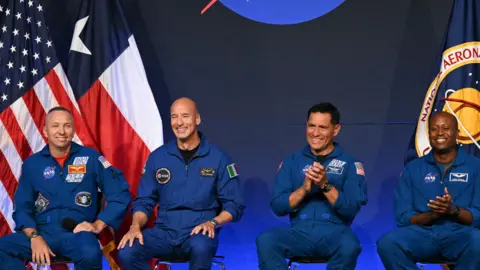
AFPNASA has named its crew for its next major Moon mission, Artemis III, though the astronauts will not walk on the Moon or go anywhere near it.
The mission was originally planned as the first crewed lunar landing since Apollo 17 in 1972, with two astronauts due to set down near the Moon’s south pole and spend a week on the surface.
But in February, Nasa changed that plan and said the mission would fly only in low Earth orbit, barely deeper in space than the International Space Station, and dock with prototype lunar landers.
Nasa’s Administrator Jared Isaacman said the mission would nevertheless be the most complex ever.
“This mission will require the most awe-inspiring coordination of heavy-lift rocket launches in history, drawing on the talent and capability of teams across government and the spaceflight community,” he said.
Randy Bresnik, a Nasa astronaut, will serve as the mission’s commander.
Luca Parmitano, of the Italian Space Agency, will be the pilot of Artemis III. He’s spent more than 300 days in space.
Americans Andre Douglas and Frank Rubio will be the mission specialists.
Bob Heintz will serve as a backup crew member. He is a test pilot who logged 170 days in space and can step into any role needed on the mission.
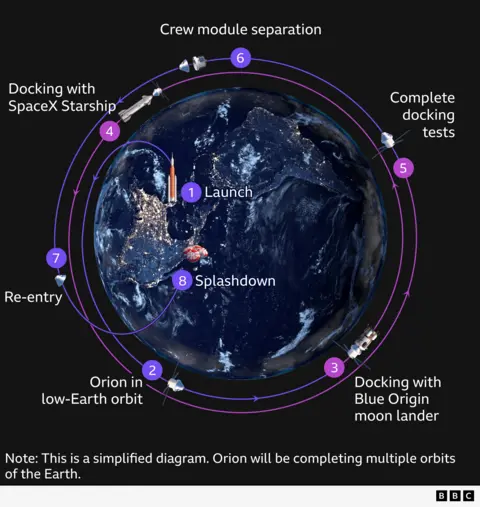
Artemis III changed from being an historic, crewed Moon landing to a technology test in Earth orbit because of delays to Elon Musk’s SpaceX’s Starship rocket. This is the vehicle intended to take astronauts from lunar orbit to its surface.
It was also judged to be too big a leap to go from looping the Moon, with Artemis II, to go straight to a lunar landing without first testing the procedure to dock with the lunar landers in Earth orbit.
In March 2026, the Government Accountability Office found that SpaceX had made “limited progress maturing the technologies needed for in-orbit refuelling and cryogenic propellant storage.”
Starship is so heavy that it cannot reach the Moon withot being refuelled in Earth orbit first. This involves launching a fleet of tanker vehicles which transfer cryogenic liquid methane and liquid oxygen across in sequence, a highly ambitious manoever has not yet been tested.
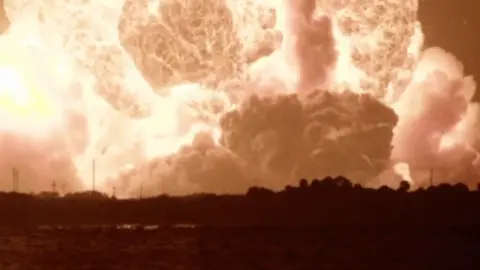
Nasa’s Moon mission team received a further setback last month when its other partner, Blue Origin, watched its New Glenn rocket blow up during a routine engine test.
No one was hurt, but the launch pad was extensively damaged.
 SPACEFLIGHTNOW
Blue Origin has no other way to launch New Glenn and it could take months to repair the damage.
When SpaceX suffered an explosion in September 2016, it took 15 months to return to service – and SpaceX had other pads to fall back on. Blue Origin does not.
The consequences are immediate: the Blue Moon cargo lander intended for a Moon flight possibly as early as this autumn may not be able to launch on schedule; the crewed lander needed for Artemis 4 faces an uncertain timeline; and there are questions over both lander pathfinders that Artemis 3 is supposed to test.
On Nasa’s most optimistic timeline, Artemis 3 flies in 2027 as a demonstration. Artemis 4 targets landing on the Moon in early 2028. Artemis 5, designed for a second landing and the start of base construction, follows later that year.
John Couluris, a vice president at Blue Origin, said that Nasa and Blue Origin were working around the clock to be ready for launch in 2027.
Most independent experts regard that timeline as ambitious.
What drives the urgency is partly geopolitical. China has announced a target of a crewed Moon landing by 2030. A Trump executive order in December 2025 directed Nasa to return astronauts to the Moon by 2028, when his term of office comes to an end, and establish initial base elements by 2030.
“It would not surprise me at all if China gets there first,” Dr Simeon Barber, a lunar scientist at the Open University, told BBC News.
Nasa’s margin for error is thin. The refuelling technology for Starship has yet to be demonstrated. A key commercial partner no longer has a functioning launch pad. And the first lunar landing now depends on a sequence of things that have never been done before all going right in the right order.
Nasa Administrator Jared Isaacman said after last month’s explosion that the agency is “committed to helping the Blue team recover.”
The question now is how much time recovery will take, and whether the calendar can absorb it.