Police turned me from victim to offender after I reported school assault
6 hours agoAmy JohnstonWest Midlands Investigations Team

 BBC
BBCThe son of a former police officer was “misled” by a force into accepting a community resolution for violence he did not admit to, an investigation has found.
Theo Rose reported being a victim of an assault at school to West Midlands Police (WMP) but was himself given a sanction over the incident instead.
A report by the Office of the West Midlands Police and Crime Commissioner (OPCC) expressed “concern” the teenager might have agreed to accept it under “false pretences” – even if they were unintended – and was “misinformed” about the potential consequences.
The force rescinded the community resolution in February and apologised to Theo the following month, in a letter seen by the BBC.
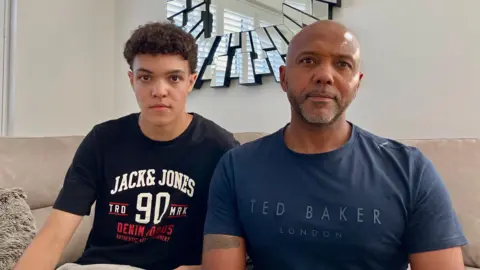
Theo made the initial report to Halesowen police station in December 2023 claiming that he had been twice attacked by a fellow student at his sixth form college.
The then-18-year-old said he had been advised to do so on the advice of a lecturer, who had seen the attack, and told officers he had been kicked and punched.
Police asked him to return to the station the following February and the OPCC found in an interview that day, Theo was “misled” into accepting a community resolution for affray – the use or threatening of unlawful violence towards another person.
Theo said it was only afterwards, when he spoke to his parents, that he realised he had potentially been unfairly treated and the sanction could affect his job prospects.
“I was quite fearful for my future,” said Theo, from Halesowen.
‘I still didn’t understand’
His father Rod Rose, a serving detective chief inspector with the force at the time, helped Theo lodge a complaint with its professional standards department.
That investigation found officers told the teenager there was “overwhelming and contradictory evidence” against him.
A further review of the complaint by the OPCC included bodycam footage which showed Theo telling police: “I didn’t use or threaten violence towards [the other teenager]”.
It also found the “most relevant” witness statement backed up Theo’s account.
Theo, now 19, told the BBC he didn’t know what affray was and had asked the handling officer.
“He explained it to me and I still didn’t really understand,” he said.
According to the professional standards department, officers later reclassified the affray as two assaults – one with Theo as a victim and one as an offender – which he did not know and had not admitted to.
The OPCC raised the question as to whether Theo would therefore have been entitled to use “reasonable force” to defend himself.
Its report said: “Although it appears unintended, [we] remain concerned that the document may have been signed under false pretences… It appears that Mr Rose had agreed to a resolution for one crime but it turned out to be another.”
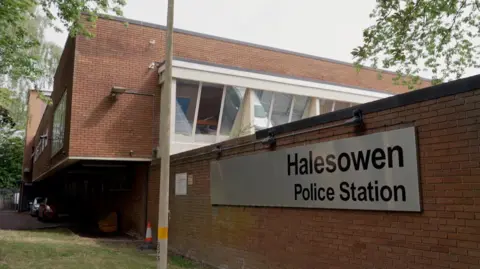
Community resolution orders allow police to deal with low-level offences without going through the courts.
They’re usually aimed at first-time offenders but guidelines state there must be a clear admission of guilt and they must have the victim’s agreement.
They do not show up on a criminal record but do appear on enhanced Disclosure and Barring service (DBS) checks, which are required by certain jobs and can therefore affect a person’s future career options.
According to the OPCC report, officers “misinformed” Theo about the consequences of accepting the sanction.
He told the BBC he asked for assurance several times and only accepted it because he feared being taken to court.
“That was the only reason why I was more than happy to accept a community resolution,” Theo said.
‘What have you admitted to?’
Mr Rose, who is now retired, was working at Halesowen station at the time and had previously worked in the out-of-court disposals department that dealt with community resolutions.
He realised officers had not followed procedure during the handling of Theo’s case.
“My first words were, what have you admitted to Theo? And he said, ‘uh, I don’t know’,” said Mr Rose.
“I was angry because it seemed like they [had] interviewed [Theo] without letting him know they [were] interviewing him and not giving him an opportunity to seek advice.”
Following the investigation and OPCC review, which made recommendations, WMP rescinded the community resolution, accepting that “it would appear on review you [Theo] did not take responsibility for the offence of affray or assault”.
Theo said “no justice has been served” as his original complaint as a victim of assault had not been resolved.
“My trust in the police has just been diminished,” said Mr Rose.
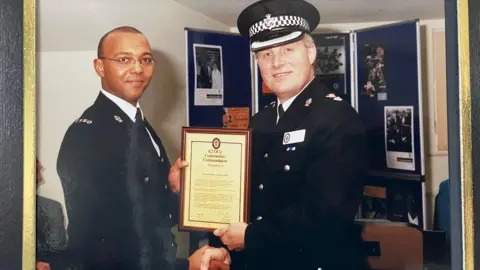 Rod Rose
Mr Rose said he was “disheartened” by Theo’s experience and said it was the first time in his 30-year career he had “seen this side of policing”.
“It’s going to take a lot for Theo to have any sort of trust and confidence back in the police. And if he doesn’t, he’s going to tell his children, don’t trust the police because of my experiences.”
Two days before his retirement last year, Mr Rose was served gross misconduct papers by the force, the timing of which he described as “malicious”.
It was alleged he abused his role over Theo’s sanction but the force’s professional standards department found there was no case to answer in January.
“I was just a parent supporting and defending my son,” he said.
‘Decisions can be reviewed’
When asked by the BBC, the force did not comment on Mr Rose’s claims about the timing of the misconduct allegations.
A police spokesperson added: “Community resolutions enable officers to make decisions about how to deal proportionately with lower-level crime but interventions agreed within them are voluntary and not legally enforceable.
“As it is an informal disposal which does not create a formal criminal record, we would not confirm the details of any person issued with a community resolution.
“As with all disposal types, it is occasionally appropriate that decisions can be reviewed, and where necessary rescinded.”
WMP issued 8,280 community resolutions in 2024, accounting for 77% of total out of court disposals – a 163% increase from 2019, when they accounted for only 47%.
National statistics from the Ministry of Justice for that year showed 164,000 community resolutions were issued, also accounting for 77% of total out of court disposals – a 56% increase on five years ago.
In a Freedom of Information request, the BBC asked WMP and other Midlands forces how many complaints they had received regarding community resolutions and how many had been rescinded.
They
The National Police Chiefs’ Council said out-of-court resolutions were a “highly effective” way of delivering justice.
Its deputy assistant commissioner, Dr Alison Heydari, added: “We regularly review the use of community resolutions and over the next few months will be updating our guidance to reflect several recent and forthcoming significant reports.”
WMP was placed in special measures by His Majesty’s Inspectorate of Constabulary and Fire & Rescue Services in November 2023 for four points, including “failure to carry out effective investigations leading to satisfactory results for victims”.
It came out of special measures in September.
Follow BBC Birmingham on BBC Sounds, Facebook, X and Instagram.