Powerful winter storm targets US northeast as NYC issues travel ban
43 minutes agoNardine Saad
A historic winter storm has placed 54 million people under blizzard warnings and prompted travel restrictions in multiple areas, including a travel ban New York City.
States of emergency have been declared in states including Connecticut, Delaware, New Jersey and Rhode Island, with restrictions on travel. New York, Connecticut and Massachusetts have similar orders in place as the storm approaches the coast.
Other parts of US northeast and the Canadian Maritimes are also expected to be affected on Sunday and Monday, forecasters say.
It’s expected to be the most powerful nor’easter storm in nearly a decade for many parts of the northeast, bringing snow, fierce winds and coastal flooding.
About 35 million people are impacted by the blizzard warning, and another 19 million are under winter storm warnings, which covers the Central Appalachians to coastal Maine.
The low centre of the storm is expected to develop late Sunday afternoon through evening, the National Weather Service said.
“While we do get plenty of these nor’easters that produce heavy snow and strong impacts, it’s been several years since we saw one of this magnitude across this large of a region in this very populated part of the country,” Cody Snell, a meteorologist at the National Weather Service’s Weather Prediction Center, told the BBC’s US partner CBS News.
More than 3,500 US flights have been cancelled on Sunday and hundreds of others have been delayed, according to flight-tracking website FlightAware.
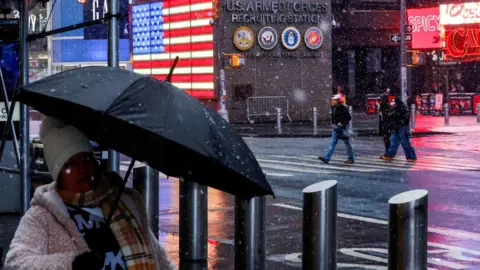
It’s the first time in nine years that New York City – the most populated US city – has been under a blizzard warning. The city is expected to be hit particularly hard with 18-24 inches (0.5-0.6m) of snow expected to fall in the metro area and temperatures dropping to about 20F (-6C).
A full travel ban is in place in New York City from 2100 local time (0200 GMT) on Sunday to 1200 local time (1700 GMT) on Monday, with Mayor Zohran Mamdani saying schools would be cancelled and all streets, highways and bridges would be shut to traffic – besides for emergencies.

 Reuters
During a news conference, Mamdani said the most severe snowfall is expected overnight, with up to 28 inches (0.7m) in certain areas. He declared a state of emergency in the city. This is the second major snowstorm of the first-time mayor’s administration, coming after 19 people died during a three-week cold snap in January.
Across the state, the highest wind gusts are expected along the coast, up to 65 to 70 mph (104 to 112 kph), with officials warning of downed tree limbs and power outages too.
New York Governor Kathy Hochul declared a state of emergency for the whole state ahead of the nor’easter storm and activated about 100 members of the National Guard.
“This will be something the likes of which we’ve not seen in years,” she said. “People will be in the dark. Long Island and New York City and lower Hudson are literally in the direct eye of the storm.”
New Jersey Governor Mikie Sherrill also declared a state of emergency and halted service on the state’s transit network from Sunday evening for all buses, light rail, and Access Link.
She said this could be “the worst storm we have seen since 1996” and encouraged residents to stay home and off the roads.
In Connecticut, which along with New York and New Jersey comprises the metropolitan Tri-state area, Governor Ned Lamont signed an emergency order halting all commercial vehicles from traveling on highways across the state.
The order takes effect at 1700 local time (2200 GMT) and remains in effect until further notice, Lamont said.
Massachusetts, Delaware and Rhode Island have also declared a state of emergency ahead of the storm and Boston, Massachusetts, has also closed schools due to the storm.
In Pennsylvania, Governor Josh Shapiro has signed a disaster declaration ahead of the storm to ensure state agencies “have every resource they need to prepare and keep people safe” and told residents to avoid unnecessary travel and follow instructions from local officials and agencies.
In Canada, Nova Scotia’s east coast is expected to be hit the worst, with many parts currently under an orange weather warning from Monday morning until early Tuesday.