Shot in school uniform: BBC reveals police order led to Gen Z protest killings
25 minutes agoSubina Shrestha,BBC Eye InvestigationsandDeepak Kharel,BBC Eye Investigations

 BBC
BBCAn order allowing the use of lethal fire against thousands of young, unarmed protesters in Nepal was issued by the country’s former police chief, a BBC investigation reveals.
Among the 19 people killed in the capital, Kathmandu, on 8 September last year was a teenager in school uniform, who had been walking away from the crowd when he was shot in the back of the head. Dozens more were injured.
The events at the so-called Gen Z demonstrations – which had followed weeks of simmering anger about political corruption – sparked further protests leading to the resignation of Nepal’s prime minister and the collapse of its government a day later.
The BBC World Service team has seen an internal police document detailing events on 8 September. It reveals someone using the call sign “Peter 1” told his officers to “deploy necessary force” 10 minutes after a curfew had come into effect, and after repeated requests by officers on the ground to use lethal force.
Peter 1 was the call sign used by Nepal’s former police inspector general, Chandra Kuber Khapung, sources have told BBC Eye Investigations.
Khapung has not denied that he issued the order, but Nepal Police says that this was only after he was given authorisation by a government security committee and once all other forms of force had been used, in line with Nepali law.
Khapung – who retired in November – has not replied to the BBC’s request for comment.
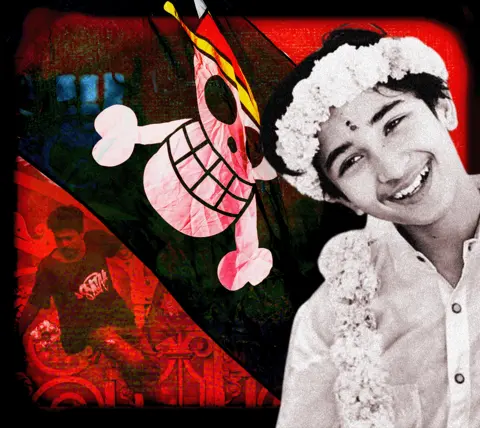
Video evidence examined by the BBC reveals that 17-year-old Shreeyam Chaulagain – the youngest of the 19 victims – had been unarmed and was trying to leave the scene when he died.
The events of 8 September are now being examined by a public inquiry, which has yet to report. So far, no-one has been held accountable – and general elections are set to take place on 5 March.
The BBC has established the chain of events, detailed by the leaked police log and supported by insider accounts from serving officers, that led to the shootings.
By analysing visual evidence, including more than 4,000 videos and photos, and details from those on the streets and in the command centre where security officials were monitoring events, we have pieced together the most comprehensive account so far of one of the most dramatic and bloody days in Nepal’s recent history.
Warning: This story contains images of dead bodies
Nepal is a young democracy. It became a republic in 2008, after a civil war that killed more than 17,000 people and lasted 10 years.
A decade after a new constitution promised a fresh start, many young people say those hopes remain unmet. By some estimates, about one in five young Nepalis is out of work.
Much of the frustration has been voiced online, particularly among Generation Z – those currently aged between 14 and 29.
Last August, Gen Z activists began to share terms on social media such as “nepo baby”, to describe the privileged children of the Nepalese elite. On 4 September, the government banned some platforms, including Facebook, YouTube, Instagram and X.
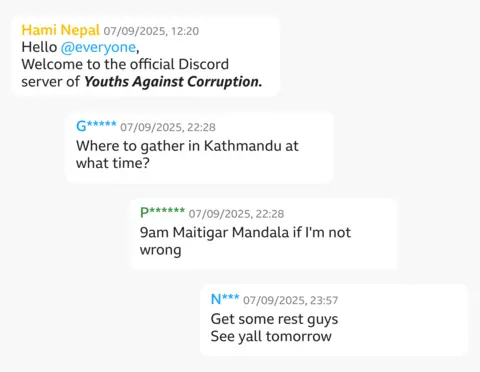
Activists moved onto the gaming chat platform Discord, which became a hub for organising.
In one forum, Youth Against Corruption, members planned the protest outside parliament on 8 September.
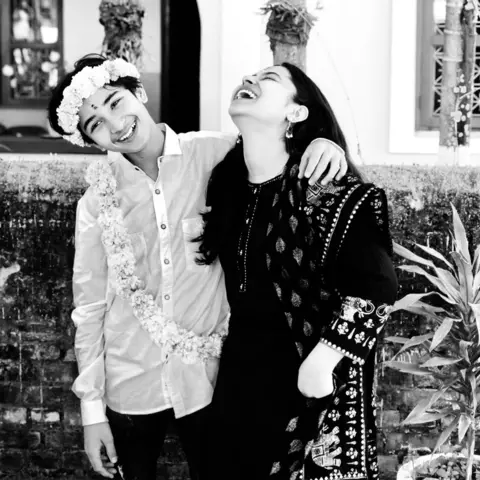
Shreeyam Chaulagain’s mother did not want him to go.
“I told him not to participate. Things can happen at protests,” she told the BBC. But Shreeyam was deeply engaged with politics, his father said. “He said corruption had hollowed out [Nepal]. He was far more informed than I was.”
Shreeyam reassured his mother the protesters would not be targeted because they were young, and in school uniforms.
“He was so curious – he wanted to know what was going on in the world,” she said.
The hours that led to bloodshed
09:00: Young people begin gathering at Maitighar Mandala, a busy intersection in central Kathmandu where demonstrations are often held.
A barricade stands several hundred metres from parliament.
Security officials “hugely underestimated the crowd”, says Basanta Basnet, editor of Nepal’s daily online news portal Online Khabar. “I spoke to security personnel, and also to members of the political class – they said that ‘children’ were joining.”
About 30,000 people arrive to protest – 10 times the number anticipated by police.
“We have an expected behaviour pattern [for protests],” one police officer has told the BBC anonymously. “But with this new generation, we do not understand their social media or how they mobilise on the ground.”
The protesters begin moving towards parliament, but are stopped by the police barricade.
11:47: A group of demonstrators finds a way around the cordon – the police, taken by surprise, abandon the barricade.
The crowds surge past and protesters reach the gates of parliament.
12:15: One group of protesters breaches the walls of the parliament compound. Police fire tear gas and use batons. The crowd does not retreat, even as organisers urge people on Discord to pull back.
Video footage shows Shreeyam outside the gates. Wearing a green school jumper and carrying a backpack, he holds a banner reading: “Youths Against Corruption”.
Elsewhere, the protests are becoming more violent.
Inside the situation room
Senior security officials are gathered in a control room almost 3km (1.9 miles) away, near a complex of government offices.
Representatives of the civilian police, army, armed police and intelligence officials are present. The security committee is chaired by the capital’s chief district officer, senior civil servant Chhabi Lal Rijal.
Within the command centre, officials work to obtain live visual feeds from CCTV cameras positioned around the parliamentary complex. According to one anonymous officer, they have a TV but no dedicated internet line, and that when they attempt to establish a connection, it is “not stable”.
No individual or unit has a comprehensive understanding of the overall situation, according to police officers we speak to who were there on the day.
12:30: The chief district officer imposes an immediate curfew, making the protests illegal. Officers use loudhailers to order people home.
Rather than obeying, some protesters surround a police unit and pelt them with bricks and stones.
About the same time, footage shows the parliament gatehouse on fire.
According to multiple police sources and the police log, panicked officers in and around parliament radio the command centre for help. “Some of us were badly hurt. One of us asked to be rescued,” one anonymous police source tells us.
They repeatedly ask their superiors for permission to use live ammunition, after batons, water cannons and rubber bullets fail to disperse the crowd.
12:40: That authorisation is given now, according to the log we’ve seen, as well as several police sources.
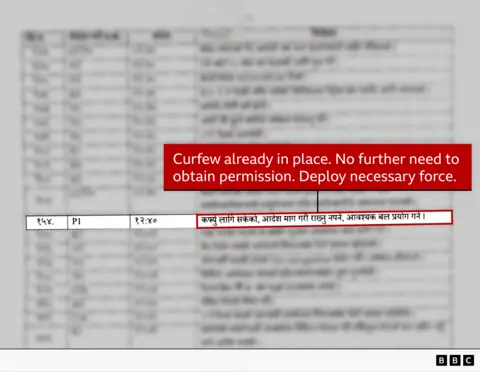
They pinpoint the source of the approval to one call sign: Peter 1.
The instruction from Peter 1 is recorded in the police log: “Curfew already in place. No further need to obtain permission. Deploy necessary force.”
Peter 1 is Chandra Kuber Khapung, then inspector general of police.
In a filing to the supreme court of Nepal, Khapung later denied responsibility, and Nepal Police told the BBC that the decision to give the order to fire was made by the committee that Rijal headed up. In a letter, the force said that Khapung “did not issue the order to use force ahead of the committee’s decision”.
In public order situations, the security committee – rather than the police – has legal authority over decisions concerning escalation of force.
However, its then chair, Rijal, has denied in court that he authorised live rounds.
Some police officers we spoke to have since acknowledged failures in intelligence, planning and command. Several said they had been unprepared for a crowd rapidly mobilised on Discord. Others questioned why military support did not arrive sooner.
Many say they are still struggling with the memory of that day.
“Our officers fired on them like they were enemies,” one says.
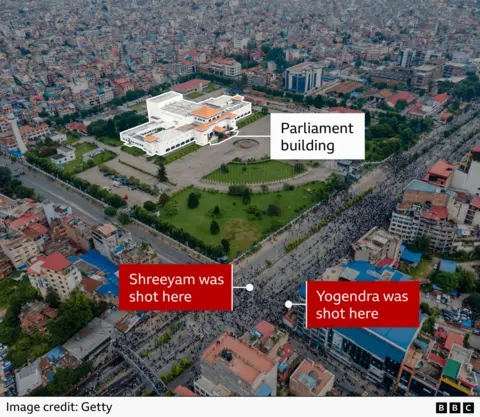
13:15: The first death from live fire is recorded by the BBC. Video evidence shows one protester, 34-year-old Binod Maharjan, being carried away with a wound to the head. He died later in hospital.
The BBC has been able to analyse six shootings after the curfew order. In the footage we examined, we have not seen any of the victims engaging in violence.
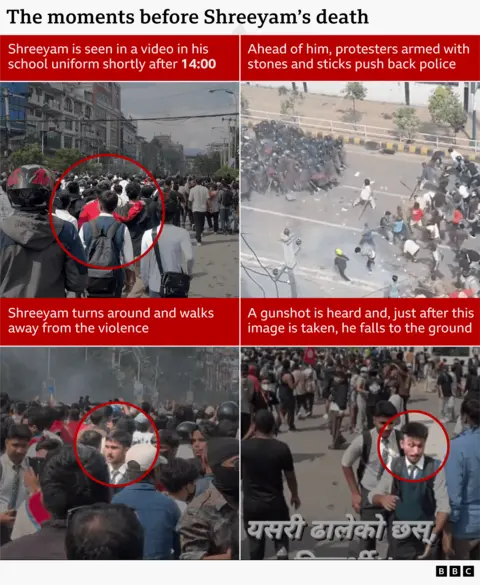
14:09: Shreeyam – the youngest victim of the shootings that day – is seen peacefully walking away from the front line, where other protesters are pelting police with stones. Still carrying his school bag, he claps his hands – a gesture that appears calm.
A bullet strikes the back of his head, and he falls to the ground.
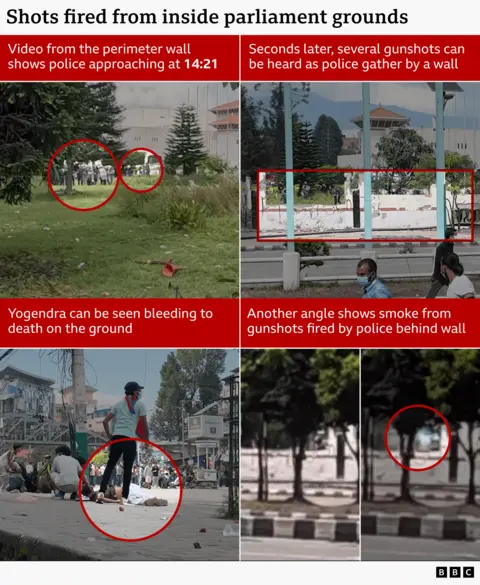
14:21: Video evidence obtained by the BBC shows police firing at protesters from inside the parliamentary complex. We have been able to establish that police fired seven shots at the crowd.
Protesters scatter, ducking into the gaps between buildings and pavement. Some simply cover their heads for protection. Yogendra Nyaupane, 24, is hit and fatally wounded.
The last shooting recorded by the BBC takes place at about 16:00, and the protest outside parliament dies down at dusk. But smaller sporadic protests continue through the night.
Angered by the killings at the gates of parliament on 8 September, Nepalis of all ages took to the streets the following day. What had begun as protest rapidly hardened into mob violence, and police became immediate targets. Police stations were set ablaze, officers were assaulted, and three were killed.
There were arson attacks on the parliamentary compound, the supreme court and other government buildings. In total, 77 people were killed during the unrest.
Although it has been widely alleged – by politicians, police and protesters – that organised groups and infiltrators acting on behalf of political interests helped drive the destruction, we have found no evidence to substantiate the claim.
At about 14:30 on 9 September, Prime Minister KP Sharma Oli resigned and Nepal’s government collapsed. By nightfall, buildings were burning across Kathmandu, and at least 50 more people were reported dead.
The army took control at 21:00.
No-one has yet taken responsibility for what happened.
Ramesh Lekhak, the then home minister, and former Prime Minister Oli, have denied responsibility as well as Khapung and Rijal.
Nepal Police told the BBC that they “were faced with an overwhelming situation where we had to respond to multiple incidents simultaneously”.
Meanwhile, families of all the victims are waiting for justice. Shreeyam’s mother, Karki, says she has not been able to cry.
“I don’t feel he’s gone yet – I still feel he’ll be back soon,” she tells us. “In my mind, he’s in his school uniform. He’ll return, swinging his bag.”