Six key questions about Keir Starmer’s future
19 minutes agoHenry ZeffmanBBC chief political correspondent

 PA Media
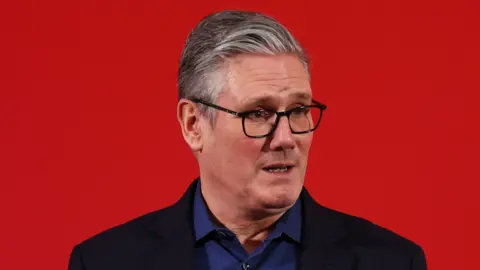
Monday was probably Sir Keir Starmer’s toughest day as prime minister – but arguably, it became one of his best.
There is no doubting the “peril” he was in, nor that Labour MPs “looked over the precipice” and considered ditching the prime minister.
After all, those are the words of Ed Miliband, the energy secretary, on BBC Breakfast this morning.
The question of whether Labour MPs wanted to stick with Sir Keir was answered.
But there are plenty of other unanswered questions.
Is Sir Keir Starmer safe in his job?
For now, yes.
Sir Keir got to a position on Monday afternoon where Anas Sarwar, the Scottish Labour leader, was about to call for his head and most of the cabinet were conspicuously silent.
Many in Westminster concluded that the prime minister would not see out the day without resigning – and that included at least some officials in Downing Street.
It’s worth remembering how fragile things were at that point just to emphasise the scale of the political achievement from Sir Keir and his team in recovering control.
As Sarwar stood up in Glasgow to call for the prime minister’s resignation, the crucial moment came from David Lammy, the deputy prime minister – posting on X that Sir Keir’s “massive mandate” should be respected.
It triggered a cascade of similar messages from the rest of the cabinet and, before long, other ministers, MPs and Labour powerbrokers too.
This show of support was the product of an intense rearguard action from Sir Keir’s inner team, some of them in interim positions after days of turmoil.
They gathered in the cabinet room, temporarily and dramatically dubbed the ‘war room’, to hit the phones – instructing ministers to declare their support for the PM and providing them with suggested forms of words to use.
When Sarwar and Sir Keir had a brief and acrimonious call at about 1330 on Monday, Sir Keir is said to have responded with a volley of questions. Who would replace him? How would they improve Labour’s prospects? Is there a plan?
Similar questions were then posed by Sir Keir’s war room to MPs wobbling over whether to back a coup.
How long is Sir Keir safe for?
Midway through Monday, Sir Keir was fighting for survival hour by hour.
He is no longer in that position, but the next pinch points are likely to come in weeks rather than months.
It is important to be realistic – as those around the prime minister are – about what the endorsements he received yesterday do and do not mean.
Yes, in some quarters, there is total incomprehension at the idea of replacing a landslide-winning leader, and fury at Sarwar’s intervention.
One cabinet minister raged at me – with expletives removed: “Who does he think he is to try to bring down a Labour government? I like him but I’m furious. I get that he’s upset he probably won’t be first minister but he doesn’t need to drag the rest of us down with him. It’s a disgrace.”
But others are privately clear that their endorsements are time-limited and that they are essentially reserving their position.
In some cases, that is until the May elections, which now take on an even greater significance at Westminster, never mind their important consequences for who runs the devolved governments and councils across England.
Yet some believe another crisis could come in less than three weeks after the Gorton and Denton by-election, where Labour are challenged by the Greens to their left and Reform UK to their right.
What is Wes Streeting up to?
 EPA
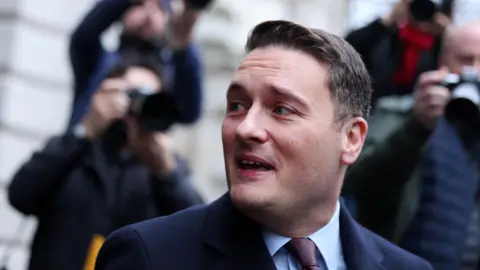
EPAIt depends who you ask. There’s no shortage of those loyal to Sir Keir who now interpret almost everything the health secretary does through the prism of his desire to move into 10 Downing Street.
And to be fair, even some who admire Streeting were interpreting his decision to pre-emptively release his WhatsApp messages with Lord Mandelson in that light too. “It shows leadership and is decisive,” one supportive MP said.
Streeting insists, including to the BBC after this morning’s cabinet meeting, that he is supportive of the prime minister and wants to focus on reducing waiting lists.
Anyway, his decision to release his WhatsApps with Lord Mandelson outside of the parliament-mandated process involving the Intelligence and Security Committee will not be copied by other cabinet ministers.
We know that because after Streeting’s gambit, a missive was sent around government by the Cabinet Office ordering them not to.
The most incendiary claim from some around the prime minister is that Streeting was behind Sarwar’s intervention. This is denied.
And yesterday various Labour figures were claiming that a clutch of Streeting-supporting ministers were going to resign from government before the meeting of the Parliamentary Labour Party. Evidently, that was wrong.
Yet the fact that so many rumours of that sort are circulating, and that Streeting’s hand is perceived in so many of them, attests to how sour the relationship between the PM and his health secretary has become.
Who are the other leadership contenders?
 PA Media
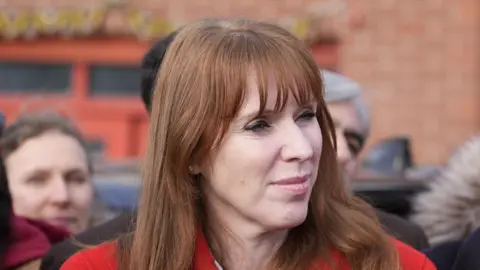
The names mentioned most frequently by their Labour colleagues yesterday were Streeting; Angela Rayner, the former deputy prime minister; Shabana Mahmood, the deputy prime minister; John Healey, the deputy prime minister; and Ed Miliband, the energy secretary.
Yet most of them are mentioned more often by their colleagues to describe their drawbacks and flaws than to talk up their suitability.
That is a big part of the reason that Sir Keir is still leader of the Labour Party today.
Will there be other changes in 10 Downing Street?
The prime minister’s chief of staff Morgan McSweeney left on Sunday, and he was followed by the director of communications, the fourth person to hold that title in less than a year, on Monday.
Yet the prime minister’s depleted team are still winning plaudits across the party today for the effectiveness of their operation to shore him up.
That may be one reason for Sir Keir to take his time in deciding who will fill those roles permanently.
One change we are expecting imminently is the departure of Sir Chris Wormald, who as cabinet secretary is the head of the civil service.
Sir Chris was appointed by Sir Keir in December 2024 – and within days of his appointment people at the top of government were already expressing severe reservations about whether this experienced civil servant was the right fit given the government’s stated ambition to “rewire the state”.
Of course, Sir Keir will know that having parted company with so many people who he himself appointed, that the onus is now on him to make things work.
Will the government’s agenda now change?
That is perhaps the most important question now. Miliband set out the case this morning for the prime minister to be “bolder”. There are certainly plenty of Labour MPs would like him to be more left-wing – to put it simplistically.
Parts of Sir Keir’s agenda have been challenging for Labour MPs, as has been evident from his decisions to change course on various controversial areas. McSweeney, the departed chief of staff, was often the lightning rod on some of those controversies. We will now learn whether Sir Keir’s decision-making can really be disentangled from McSweeney’s in this way.
Much of this may depend on who becomes the new permanent chief of staff.
And while Labour MPs were rapturous about Sir Keir’s performance at the Parliamentary Labour Party (PLP) meeting on Monday evening – in which he declared that he would fight against Reform, and fight for “the country that I love” – it does not change the fact that there are potential policy flashpoints coming down the track, for example on reforms to the SEND system.
One sceptical Labour MP said: “He says he’s won every fight he’s ever been in. Not true – he’s lost every fight he’s ever had with the PLP. And that situation is untenable.”