Starmer criticised for welcoming Egyptian activist
22 minutes agoAlex KleidermanandNick Eardley

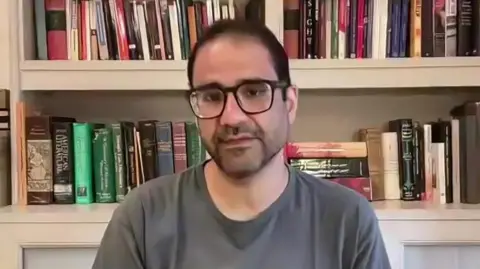 BBC
BBCShadow justice secretary Robert Jenrick has criticised Sir Keir Starmer for welcoming the arrival of an Egyptian pro-democracy activist to the UK – after historical social media messages emerged showing the campaigner apparently calling for Zionists to be killed.
Alaa Abdel Fattah, who is a dual British national, left Egypt earlier this week after being released from prison following a presidential pardon.
He was convicted in 2021 of “spreading fake news” after sharing a Facebook post about torture in the country.
The prime minister said he was “delighted” to hear the activist had landed in the UK to be reunited with family and said his case had long been a “top priority” for the government.
But Jenrick said Sir Keir’s remarks were a “serious error of judgement”, as he highlighted a number of Mr Abdel Fattah’s messages from over a decade ago that endorsed the killing of “Zionists” and “police”.
The shadow justice secretary added that the prime minister’s message amounted to a “personal, public endorsement” of the activist.
“Nobody should be imprisoned arbitrarily, nor for peaceful dissent. But neither should the prime minister place the authority of his office behind someone whose own words cross into the language of racism and bloodshed,” Jenrick said in a letter.
Cabinet ministers including Foreign Secretary Yvette Cooper and Justice Secretary David Lammy also published similar posts of support after Abdel Fattah’s return.
The Jewish Leadership Council, a charity representing Jewish organisations across the UK, criticised what it described as an “effusive welcome” from the UK government.
The BBC understands the activist’s messages had not been brought to attention of the prime minister until they were highlighted in recent days – and the government considers them to be abhorrent.
Abdel Fattah’s
He had spent more than a decade of his life behind bars, including being handed a five-year sentence in December 2021 following a trial that human rights groups said was grossly unfair.
The previous Conservative administration had also lobbied for the activist to be freed and a government spokesman said: “He is a British citizen. It has been a long-standing priority under successive governments to work for his release from detention, and to see him reunited with his family in the UK.”
A Labour source also accused Jenrick of trying to rewrite history for his own political advantage.
A writer, intellectual and software developer, Abdel Fattah rose to prominence during an uprising in 2011 that forced the former Egyptian president, Hosni Mubarak, to resign.
In 2014, Abdel Fattah was nominated for a European human rights award, the Sakharov Prize, but this was withdrawn over tweets about Israel he had posted in 2012.
He said his comments had been part of a “private conversation” that took place during an Israeli offensive in Gaza and had been been taken out of context.
After being removed from a travel ban list imposed by Egyptian authorities that kept him in the country for three months after his release from jail, Abdel Fattah has now reunited with his 14-year-old son, who lives in Brighton.
Speaking to the BBC from Cairo in October after his release, he had said: “I’m learning how to get back into life.”
He added: “I’m doing much better than I would have expected. Much better than most people would have expected.”