Starmer to host Zelensky for Ukraine talks in London
14 minutes agoPaul SeddonandRachel Muller-Heyndyk

 Reuters
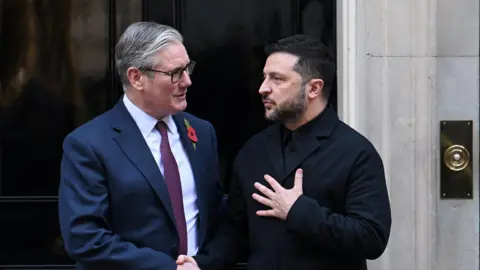
Sir Keir Starmer will host Volodymyr Zelensky in London on Monday amid a continuing deadlock in negotiations to end the war in Ukraine.
The Ukrainian president will attend the talks in Downing Street alongside French President Emmanuel Macron and Germany’s Friedrich Merz.
Cabinet minister Pat McFadden said on Sunday that Ukraine’s security and self-determination would be “at the heart” of the leaders’ discussions in London. He said that US-led talks were at a “really pivotal moment”.
After three days of discussions in Miami, US President Donald Trump’s outgoing Ukraine envoy said that a deal to end the war was “really close” but hinged on Russia’s co-operation.
Negotiations remain stuck on issues including the size of Ukraine’s army after the conflict with Moscow ends and Russian control of the Donbas.
“If we get those two issues settled, I think the rest of the things will work out fairly well,” US special envoy for Ukraine Keith Kellogg told Reuters. “We’re almost there.”
Monday’s in-person talks are the latest attempt by Ukraine’s European allies to carve out a role in the ongoing efforts to end the war.
Confirming the meeting on Sunday, Downing Street said the leaders would “focus on the ongoing peace negotiations and next steps”, without providing details.
The White House has been pushing Kyiv and Moscow to agree to a multi-point plan to end the war but there has been little sign of a breakthrough, despite both sides engaging with the process.
The latest US-Ukraine talks concluded over the weekend – with Zelensky saying he was “determined” to continue working with the US after speaking to Trump’s special envoy, Steve Witkoff.
European leaders have pushed back against early versions of the US-led peace plan, which has since been revised after criticism it was too favourable towards Russia.
It has sought to win US support for its own proposals, including a European-led security force to police any peace deal in Ukraine, an idea that has been rejected by Moscow.
The original version of the US plan faced criticism from Ukraine and its allies for accepting Russian demands including on Nato involvement, restrictions to Ukraine’s army and control of the eastern Donbas region.
Russian President Vladimir Putin has in turn rejected the revisions.
Despite blows to Russia’s economy and heavy losses on the battlefield, Putin has been unwilling to compromise on key points.
He has said Russia would take the Donbas by force if Ukraine did not cede control of the region, 85% of which is currently held by Russia.
“Either we liberate these territories by force, or Ukrainian troops will leave these territories,” Putin said in an interview with India Today.
While talks continued, Russia launched another large aerial bombardment on targets across Ukraine overnight into Sunday.
Twenty-four hours earlier, Russia had launched 653 drones and 51 missiles on Ukraine, triggering air raid alerts across the country.
Macron was among the European leaders to offer his “full solidarity” to Ukraine amid the attacks and that he would “continue efforts with the Americans” to secure peace.
Meanwhile, the US National Security Strategy, which was unveiled last week, did not consider Russia to be a threat to Europe.
Moscow responded that the strategy was consistent with its own vision and was a “positive step” forward.
With further diplomatic negotiations on the horizon, EU officials have urged the US to keep historic ties between the two continents intact.
“This is the only reasonable strategy of our common security,” Polish Prime Minister Donald Tusk said in response.