Tehran morgue videos show the brutality of Iran’s crackdown on protesters
33 minutes agoShayan Sardarizadeh,Merlyn Thomas,BBC VerifyandGhoncheh Habibiazad,BBC Persian

 BBC
BBCWarning: this story contains content which some readers might find distressing
Distressing new videos have emerged from a mortuary in Tehran showing rows of bodies, blood soaked floors and crowds of people searching for loved ones following a deadly government crackdown on protesters in Iran.
The videos analysed by BBC Verify and BBC Persian, which are too graphic to show, contain some of the most shocking examples so far of how brutal the government’s retaliation has been since the unrest began on 28 December.
Forensic examination of the footage reveals nearly 200 bodies laid throughout the mortuary complex, many with visible wounds and one victim identified as young as 16.
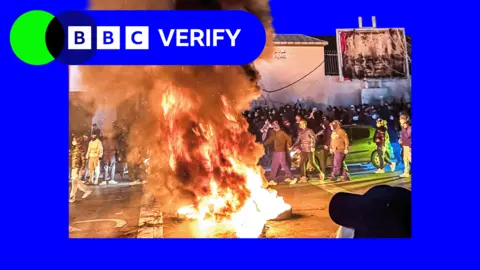
Anti-government demonstrations have spread to more than 68 towns and cities, verified videos show, though the true figure is likely to be much higher. The near total internet blackout imposed by the government since last week has left more than 90 million Iranians almost completely cut off from the outside world.
The number of people who have been killed in the protests is not fully known. US-based Human Rights Activists News Agency (HRANA) places the estimate at more than 2,500. An Iranian official previously told Reuters 2,000 people have been killed but claimed “terrorists” were to blame.
BBC Verify and BBC Persian have previously reported on images emerging from this mortuary but we are not showing these new videos because the images are too graphic.
The footage was posted on Tuesday by Vahid, a US-based Iranian social media influencer and activist, who said they were filmed on 10 January inside the Kahrizak Forensic Medical Centre in south Tehran.
Vahid said the videos were filmed by a man who had travelled nearly 1,000km to find internet access. The man told BBC Persian he used mobile networks from neighbouring countries to upload the footage. Vahid has been posting dozens of videos documenting events inside the country for the outside world to see.
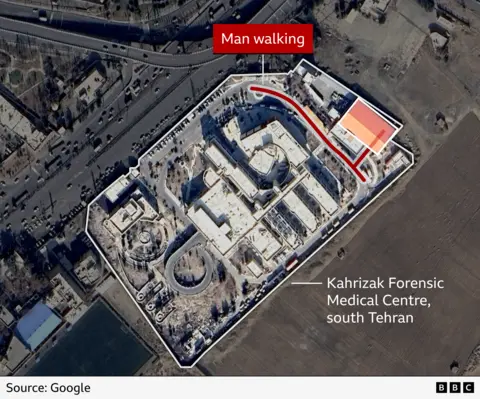
Two of the videos show rows of body bags on the floor as the man walks up and down a road that runs through the northern section of the vast mortuary complex. He later moves through a courtyard and inside a large warehouse, and walks in and out of adjacent rooms filled with more body bags. At one point he is heard describing the scene as “the apocalypse”.
The man filming is heard saying, “Today is Saturday, a day after the call”. He is referring to the call made by Reza Pahlavi, the exiled son of the late Shah, for nationwide protests that took place last Thursday and Friday night.
Two more clips contain a collection of photos taken from the mortuary showing several bodies wrapped in the zip-up bags, including one which appears burnt.
BBC Verify and BBC Persian have counted at least 186 bodies in the five-minute video and at least 178 bodies in the 16-minute clip. The two videos likely show some of the same bodies so we cannot be definitive, but the true figure is likely to be much higher.
The videos contain at least nine separate clips edited together. The positions of shadows in the footage indicate these sections were likely filmed at different times throughout the day. We have matched identifiable features from the complex, including separate buildings, the red roof of a warehouse and fences with satellite images on Google.
The man films as he moves around inside the centre, where more bodies are kept on stretchers as well as the floor. The footage shows some body bags fully zipped up while others are either half or entirely unzipped, revealing victims’ faces and injuries. Some are completely uncovered. We can see blood-soaked towels and sheets scattered around the complex with streaks of blood on the floor.
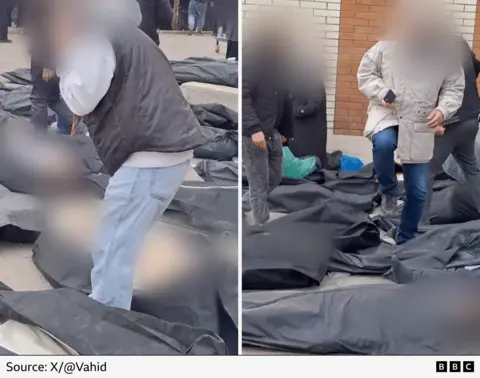
A number of the bodies have visible wounds. Two bodies appear to be soaked in blood, and another is seen with a deep stomach wound.
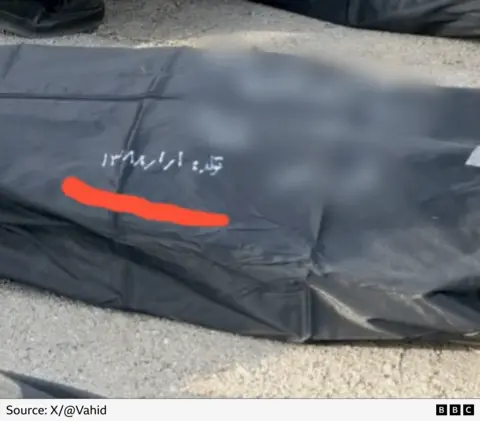
Some body bags have papers attached to them or details written on the body bags in a white marker such as a name, national ID number, date of birth and death, and in some cases their father’s name. At least two men are described as unidentified on a sheet of paper attached to their bag, and at least one woman and one teenager are among the victims.
The date of death on three of the male victims’ body bags states 9 January. Another body bag shows a date of birth using the Iranian calendar. It says 1/1/1388, which corresponds to 21/3/2009, indicating that it belongs to a 16-year-old.
During one moment in the 16-minute clip the man points his phone at a building to his right and a voice can be heard saying: “There are many [bodies] inside. It’s not possible to go inside… this is the women’s area”. Iranian mortuaries separate the bodies of men and women for religious reasons.
At a different point we can see a body bag at the back of a hearse and a man nearby is heard telling a female official that it is his sister.
Several ambulances, hearses and vans are filmed around the grounds. Officials are seen inspecting the rows of bodies, taking swabs from the victims, and talking to potential loved ones.
It is not clear why the bodies of those killed in anti-government protests may have been transferred to the centre, but eyewitness accounts provided to BBC Persian suggest hospitals have been overwhelmed with the number of casualties in the protests.
HRANA, which has been tracking the death toll since the unrest began, has reported that 2,403 protesters, 147 people affiliated with the government, nine civilians and 12 children have been killed so far.
Crowds of people, many who appear to be family members and friends, are seen walking in and out of the complex as they try to identify the bodies. Cries and wails are repeatedly heard throughout the videos as people mourn the loss of their loves ones.
“Some of our best people have been killed,” the man filming is heard saying.
Iranian state TV has since reported that a “substantial” number of bodies had been taken to the mortuary. It claimed the majority of the victims were members of Iran’s security forces or passers-by who had nothing to do with the demonstrations.
Most international news organisation, including the BBC, are restricted from operating inside the country so we have to rely on verifying footage on social media.
Additional reporting by Roja Assadi and Richard Irvine-Brown