The surprising truth about the generations that suffer loneliness the most
21 minutes ago
 Luke MintzBBC News
 BBC
BBC“I wasn’t alone all the time, but […] I was a bit of an outsider,” he remembers.
As he headed home, the streets were full of Halloween partygoers in monster and cat costumes. “I walked past people turning up to friend’s houses, people running into shops to buy beer.
“All the pubs were full. It just [felt] like a different world that you’re not part of. And you feel like you can never be part of it.”
That night, he felt like the only person experiencing serious loneliness. In fact, it is becoming a defining feature of his generation.
Conversations around social isolation tend to focus on the elderly, especially around Christmas. But by some measures, people in their 20s are the loneliest group in Britain.
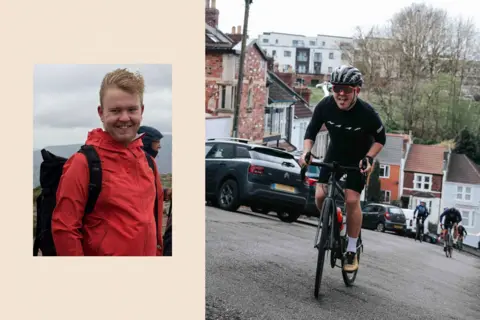 Adam Becket
According to Office for National Statistics (ONS) research published last month, 33% of Britons aged 16 to 29 reported feeling lonely “often, always or some of the time” – the highest of all age groups (17% of over-70s said the same thing).
This year, the World Health Organization reviewed various studies published across the world and found that young adults and adolescents report the highest levels of loneliness too.
The data is complex, and there are indications that, in some countries, among the very oldest group (over-85s), loneliness shoots up and could match that of 18-to-30s. But analysts say that in most research, young adults shine through as a particularly isolated group.
“Adults between 18 and 24 are the most lonely – followed by older people,” says Prof Andrea Wigfield, director of the Centre for Loneliness Studies at Sheffield Hallam University. “It’s a growing problem.”
But why has this happened – and is there a solution?
The problem of ‘scattering’
Increasingly, experts say the modern world is to blame. Many twenty-somethings live in house-shares where they do not know or like their housemates. Work increasingly is done from home and friends are often spoken to on social media.
It is not all bleak. Thanks to the internet, young adults enjoy access to friendships from all over the world. But broadly speaking, experts say, the image of gregarious twenty-something life presented in sitcoms like Friends needs urgent correction.
 NBC Universal via Getty Images
“We tend to romanticise young adulthood as a carefree time – when it’s usually the most miserable time in people’s lives,” says Prof Richard Weissbourd, a lecturer in education at Harvard University.
In some ways, early adulthood has always been a time of instability. Young adults tend to leave their childhood home and move around. Friends depart, and family ties weaken. These transitory life events can, for some, lead to intense loneliness.
“A big problem is the scattering – everybody you ever knew now lives in a million different places,” says Dr Meg Jay, a clinical psychologist and author of The Twenty-Something Treatment.
This “scattering” proved difficult for Adam Becket. He had a rich social life when he lived in London in his early 20s – but after moving to Bristol, he had to make friends from scratch.
“Not only did I not know anyone, I didn’t know where to start meeting people either. You can’t just go up to someone and be like, ‘Can I join in this fun?’ It’s easy to spiral into self-doubt and self-flagellation – ‘I’m clearly not interesting or cool, or the right kind of person.'”
Things improved when he joined running and cycling clubs and met people that he “clicked with” – though he says his loneliness still comes and goes.
The Bowling Alone thesis
Today, there is also a set of new, distinctly modern factors that could be making the problem worse.
In many parts of the world, people are getting married and having children later (or not at all).
The average age of first marriage in the UK is now 31, according to the ONS, up from 1970 when it was 23 for men and 21 for women. Young adults tend to be more reliant on friends for emotional connection – and if those friends don’t deliver, loneliness can follow.
Prof Weissbourd points to a broader fragmenting of communities too. In rich countries, membership of civic institutions – like churches, community groups, or trade unions – has dropped since the 1970s.
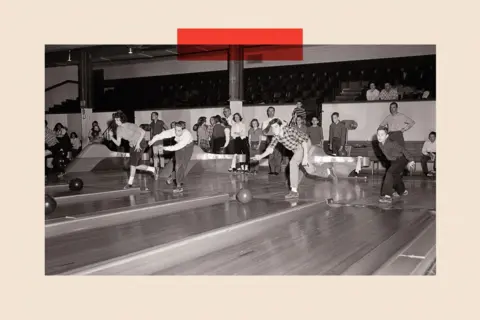
This is sometimes known as the Bowling Alone thesis, named after an influential 1995 essay by political scientist Robert Putnam, who observed that more young Americans were bowling on their own rather than in teams, a symbol of a wider collapse of social relations.
Twenty-somethings – who might have left their childhood home but not yet started their own family – can feel that decline of community most sharply, says Prof Weissbourd.
“We live in an increasingly individualistic society. I think loneliness is a symptom of our failure to care for each other.”
 Getty Images
This resonates with Zeyneb, 23, who lives alone in Cheltenham. Her own feelings of loneliness peaked last year during her master’s degree. With only a few hours of teaching each week, she struggled to find meaningful connections with her classmates. And with her family far away in Romania, she now spends much of her time alone while she looks for a job.
“It does feel cripplingly lonely when everyone has their own thing to do.”
She craves what psychologists call a “third place”: a social setting like a park or library that is different from your “first place” (home) or your “second place” (work or university). “We don’t really have that space to meet people,” she says.
The closest thing she can think of is her gym – but virtually everyone there wears headphones, she tells me, and few make eye contact.
The urban houseshare paradox
Then there is the post-pandemic rise in working from home. Though young adults in the UK don’t work from home as often as older generations – 28% of 16-to-29-year-olds worked from home at least some of the time in the first quarter of 2025, compared with 54% of 30-to-49-year-olds, one study suggests – remote work can hit people in their 20s particularly hard.
“Work from home has been, in my opinion, a nightmare for twenty-somethings,” says Dr Jay. “It’s really hard to make friends when you don’t leave the house.”
Nor do shared living situations always help. There is something of a paradox here, as young adults are the most likely to live with other people. (In England and Wales only 5% of people in their early 20s live alone, versus 49% of over-85s, suggests the ONS.) But living under the same roof as others doesn’t always seem to make young adults any less lonely.
More from InDepth
“Some of my most pitiful memories of my 20s were being stuck living with people that I didn’t like,” recalls Dr Jay. “If I was having a hard time, they didn’t care, they were too wrapped up in themselves.”
Of course this isn’t the case for all house-shares – but she thinks having an emotionally distant flatmate can make people “even more lonely” than if they lived alone.
‘Compare and despair’ on smartphones
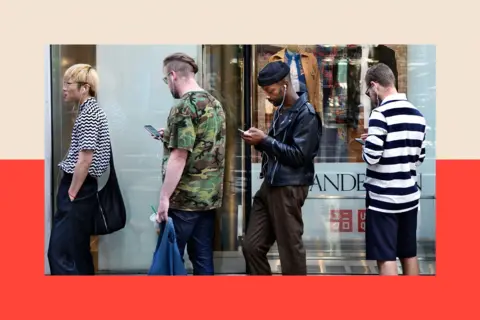
All of this is complicated by smartphones and social media. This year, the average British 18-to-24-year-old spent six hours and 20 minutes online every day, according to the media regulator Ofcom, higher than other adult age groups.
Some might assume that apps like Instagram and Snapchat contribute to feelings of loneliness because they encourage people to speak online rather than in person – but the data doesn’t cleanly support this.
What is certainly true, say some experts, is that social media amplifies pre-existing feelings of loneliness because of what Dr Jay calls the “compare and despair” factor.
“You feel like, ‘Everybody seems to have best friends and they’re all skydiving in Dubai – what’s wrong with me, I didn’t see anyone all weekend.'”
 Getty Images
Yet it is also possible that reporting biases are playing a role.
Studies about loneliness are mostly based on self-report surveys (meaning people are simply asked whether they feel lonely). And Prof Weissbourd says it is plausible that young adults, who tend to be more fluent in the language of mental health and therapy, are more likely than older people to describe themselves as lonely in surveys.
He thinks reporting biases may explain a “piece” of the puzzle – but certainly not all of it.
Prof Wigfield also thinks the high level of young-adult loneliness is a real phenomenon, not a statistical mirage.
The ‘lottery’ of social prescribing
At first, David Gradon’s story was fairly typical. In his late 20s, his friends moved away from London. “My social circle really shrunk,” he remembers – and he developed symptoms of depression. It was an NHS counsellor who suggested this could be loneliness.
He tried meeting people over dating apps (a “terrible” idea) and joined a tag rugby club, but injured his leg in the first session. Increasingly despondent, he organised a park walk on social media.
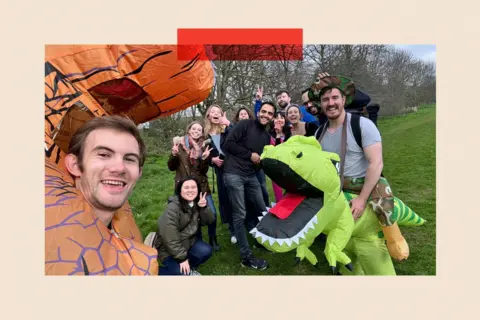
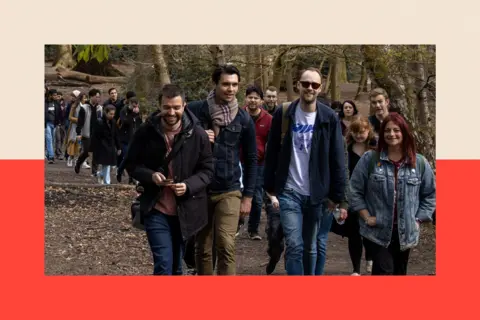
One autumn day in 2021, Mr Gradon and 11 strangers met at Hampstead Heath in north London. He organised more walks and in time this became his full-time job. He now runs The Great Friendship Project, a non-profit group to combat young adult loneliness, which runs social events for under-35s across London.
“Everyone’s in that same boat. And actually, that brings down barriers. Because you know you’re not going to be judged,” he explains.
 The Great Friendship Project
Council-funded youth clubs operate around the country. Most are currently aimed at teenagers and children, but Laura Cunliffe-Hall, head of policy at charity UK Youth, wants to see more clubs for people in their early 20s. She argues that youth work should serve everyone up to the age of 25.
Funding, she says, is the barrier. Local authority spending on youth services in England fell by 73% between 2010/11 and 2023/24, according to the charity YMCA.
Some argue that spending money on friendship services can save money over the long term, because the health consequences of long-term loneliness can be severe. Prof Wigfield says that chronic loneliness is linked to inflammation, and can increase the risk of cardiovascular disease and dementia in later life.
In recent years the NHS has invested in “social prescribing”, where GPs connect patients with certain mental health problems to charity-run services in their area – like art classes or gardening.
More than one million people (of all ages) were referred to NHS social prescribing services in 2023, a recent study found.
But Prof Wigfield says infrastructure remains patchy. “It really is a lottery in terms of where you live [and] whether the GP has knowledge of local services.”
 The Great Friendship Project
Looking ahead to the next decade, Dr Jay sees signs of hope. For one, she thinks working from home has “lost some of its lustre” among twenty-somethings. (Several large employers – including Barclays and WPP – asked staff to spend longer in the office this year.)
Dr Jay also notes that some high-profile people are turning against social media – though she says there is not yet much evidence of a significant fall in usage among young adults.
“I’d love to see more of a backlash against [social media], but it’s just so in our pockets,” she adds.
Then there are those who find their solution to loneliness in unexpected places. For Zeyneb, the best antidote to social isolation was adopting a black cat, Olive.
“She’s quite cuddly,” says Zeyneb. “She knows when I need time with her.
“Without her, I would have been much lonelier.”
Top picture credit: Getty.

BBC InDepth is the home on the website and app for the best analysis, with fresh perspectives that challenge assumptions and deep reporting on the biggest issues of the day. You can now sign up for notifications that will alert you whenever an InDepth story is published – click here to find out how.