The tech bros might show more humility in Delhi – but will they make AI any safer?
1 hour agoZoe KleinmanTechnology editor

 Getty Images
Those who shout the loudest about artificial intelligence tend to be in the West, notably the US and Europe.
So it’s significant that a gathering of powerful leaders is being held in the Global South, a region of the world that runs the risk of being left behind in the AI race.
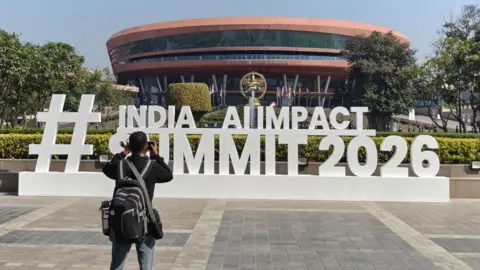
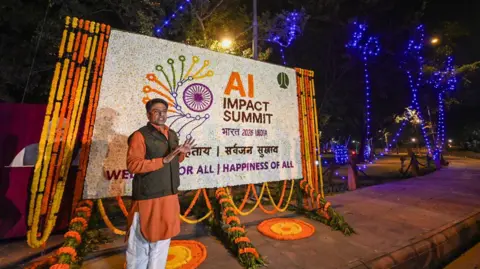
Tech bosses, politicians, scientists, academics and campaigners are meeting at the AI Impact Summit in India this week for top-level discussions about what the world should be doing to try to marshal the AI revolution in the right direction.
At last year’s AI Action Summit, as it was then known, an ugly power struggle broke out between some Western countries over who should be in charge.
The various Western powers jostled for pole position in Paris, and US vice president JD Vance delivered a blistering speech in which he said America’s place at the top of the pack was non-negotiable.
I suspect there may be a more humble vibe this week in Delhi: the capital of a country which has helped to build the foundations that support this mega-powerful new tech – but is not reaping as much reward as the more affluent west.
There are some significant AI hubs in India, including in Bengaluru, Hyderabad and Mumbai. It has a large tech workforce, and has attracted some big infrastructure investments from the likes of Google, Nvidia and Amazon.
At the same time, low-paid workers there have long been carrying out the unseen and painstaking task of manually categorising the vast amounts of data used to train the world’s AI tools.
In her book Empire of AI, the journalist Karen Hao writes about an unnamed firm in India which was contracted to do content moderation of AI-generated images: she claimed it included workers looking at horrifying ones to decide which should be blocked from being reproduced.
According to the recruitment website Glassdoor, the average salary for an AI data trainer in Chennai is 480,000 rupees – less than £4,000 ($5,000) per year.
It’s an essential role, but to put this into perspective OpenAI, the creator of ChatGPT, is valued at over $500bn.
 Getty Images
‘More than technology’ for India
The 2026 International AI Safety Report notes that while “in some countries over 50% of the population uses AI, across much of Africa, Asia, and Latin America adoption rates likely remain below 10%.”
The world’s biggest US AI chatbots do not work in all of India’s 22 official languages – let alone the hundreds of dialects that exist within them. ChatGPT and Claude currently support around half of them. Google’s Gemini supports nine.
“Without tech that understands and speaks these languages, millions are excluded from the digital revolution – especially in education, governance, healthcare, and banking,” Professor Pushpak Bhattacharyya, from IIT Mumbai, told the BBC last summer.
To counter this, India is building its own sovereign AI platforms – the Indian government calls this the AI Mission – but progress is relatively slow.
While the US products – as well as Chinese ones such as DeepSeek and ByteDance – race ahead with new releases, many of India’s remain in development.
The Indian government budget of $1.2bn for this project pales into comparison of the deep pockets of the multi-billion dollar corporations.
Before Christmas, an Indian government official told me, perhaps unsurprisingly, that India has little interest in AI’s geopolitical power struggles. The country’s focus is on harnessing the tech to drive its own growth.
“For India, this is about more than technology, it is about economic transformation, digital sovereignty and building capability at scale,” said Rajan Anandan, managing director at one of India’s biggest tech investors Peak XV.
“Within the country there is a strong sense of momentum and confidence.”
The US, meanwhile, may find itself rather unusually forced into more of a back seat. I imagine it’s not going to like that very much.
“The Americans will have less to say with the Summit’s proposed bottom-up, Global South approach to AI governance that focuses on people, planet and progress,” says Professor Gina Neff, an AI ethics expert from Queen Mary University London.
“We need governments to act together to shape a more inclusive, democratic and people-centred vision of AI in the face of unprecedented corporate power,” argues Jeni Tennison, executive director of the think tank Connected by Data.
“As the world’s largest ‘middle power’, India could make that happen,” she adds.
AI expert Henry Ajder agrees. “I hope we will see pragmatic efforts to move beyond a legislative patchwork towards meaningful consensus in addressing AI harms, maliciously caused or otherwise,” he told me.
Amanda Brock, chief executive of tech industry body OpenUK, thinks the answer is to force the AI companies to share how their products work so that others can build their own versions, make improvements and properly scrutinise the tech.
“For this summit to have any real impact for the Global South, there needs to be access for all to AI and that can only be achieved by opening it up,” she argues.
There has been movement in that direction, but many of the AI giants are still keeping key elements, such as what training data they use, confidential.
Some AI experts have told me privately that they are concerned about how far down the agenda safety and responsibility appears to have slipped.
After the first AI Safety Summit, held in the UK in 2023, the word “safety” was quietly dropped from its title. One expert told me they have decided not go to Delhi at all this week as they have little confidence in any meaningful outcomes from it.
British computer scientist Professor Dame Wendy Hall is attending the Summit but told me she shares these concerns. She fears there will be “nothing significant” from the event about how to minimise the dangers posed by AI.
“It’s important that we go but my expectations of anything useful coming out of it are very low,” she said.

Sign up for our Tech Decoded newsletter to follow the world’s top tech stories and trends. Outside the UK? Sign up here.