
 Reuters
More than two months after the US and Israel first began their war with Iran, the White House and the Iranian regime have agreed a framework deal to bring about a more long-term end to hostilities.
The Middle East crisis sent global oil prices soaring as the conflict effectively closed one of the world’s key water transport routes for oil, liquid natural gas and other essential commodities, limiting global supplies.
But experts warn a return to normal shipping through the Strait of Hormuz will take time, and the impact of the war will continue to affect the global economy for potentially months to come.
“Let the oil flow!” US President Donald Trump said in a social media post heralding the agreement, which he said would include the reopening of the strait to commercial shipping.
BBC Verify has been checking ship-tracking data which appears to show that traffic levels remain low in the Strait of Hormuz, despite the announcement.
According to ship tracking website MarineTraffic, only two vessels with active location trackers have exited the waterway since Sunday – a bulk carrier and a tanker.
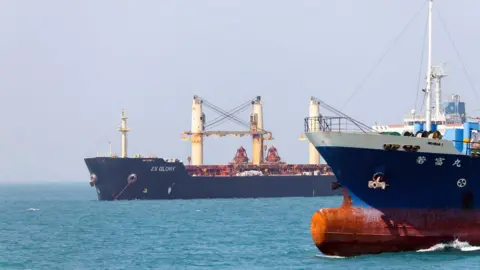
The strait has been closed to most shipping traffic since 28 February, with only limited numbers of vessels friendly to Iran able to pass through.
About 200 vessels have been stuck in the gulf, with the risk of sea mines or drone strikes driving up the danger to crews and preventing safe passage.
Neil Shearing, group chief economist for Capital Economics, said it remained to be seen whether the latest deal “represents a fragile truce or a durable settlement”.
Last time the US and Iran seemed close to a deal, Capital Economics had said it would likely “take some time for oil flows through the Strait to return to return to pre-war levels”.
“Even if ships now have safe passage, tankers are in the wrong place, oil production/refining facilities need to get up to full capacity, and questions over the cost and availability of insurance for ships traversing the Strait will remain.”
Even before the agreement, during the ongoing ceasefire, shipping companies were largely reluctant to try to move their vessels out of the strait – and getting those vessels out will be their first focus.
Given the protracted nature of the conflict, and the shifting messages from both sides, chief executive of Vespucci Maritime and former Maersk director Lars Jensen told the BBC in May that it was most likely that shipping firms would take a “very cautious and hesitant” approach to sending any more vessels into the gulf for the foreseeable future.
“You are likely going to see shipping lines that have vessels stuck in the Persian Gulf try to get them out, but they will be a lot more hesitant to put ships back into the Persian Gulf in case the thing turns south again,” he said.
Normally, about a fifth of the world’s oil and LNG supplies flow through the strait, and the effective halt to traffic has increased oil prices. That in turn has had a knock-on effect on petrol, diesel and jet fuel costs.
Brent crude, the global oil benchmark, was 4.3% lower at $83.55 (£62.10) a barrel on Monday, while US-traded oil was down by 4.9% at $80.74. By comparision, the price of Brent before the war was hovering around $70 a barrel.
Economist Mohamed El-Erian said while oil prices were down in May compared to April, they were still substantially higher for the year, “leaving markets with lingering questions about how quickly they can return to pre-war levels given production startup issues and other structural challenges, even when the Strait is reopened,” he said.
To protect against future energy shocks like this, Capital Economics said it was likely that there would be an ongoing effort from countries around the world to improve their energy security and reduce their reliance on supplies from the gulf, and an expansion of emergency reserves.
“The fact that the UAE is expanding its capacity to bypass the Strait via pipelines as well as looking to increase its storage facilities in India, shows how energy producers are looking to diversify their ability to supply the market too.”
The crisis has affected economies around the world. Before the war, the Bank of England was widely expected to cut interest rates as the UK economy was expected to grow while inflation fell.
That has not come to pass, and the Bank is now expected to hold rates, if not raise them later in the year, as inflation has risen due in part to higher fuel prices thanks to the conflict.
Russ Mould, investment director at AJ Bell said: “Just last week, markets were pricing in two rate hikes by early 2027.
“The probabilities have now shifted to just one rate hike by December and then potentially no change for at least the first half of 2027. That could mean companies having greater confidence to hire more people, consumers being more willing to spend money, and allow the property market to warm up after having gone cold for sellers in recent months.”
Global food prices could also be affected if supplies of fertiliser come on to the market again. It remains to be seen how long the price of fertiliser, a by-product of oil, will take to come down. The soaring cost of fertiliser has put enormous pressure on arable farmers and vegetable growers, those in the industry have said.
Meanwhile, jet fuel traded in the Northwest Europe (NWE) has already seen a small fall, though it is not clear how long lower prices will take to feed through to buyers.
NWE jet fuel is down to $1,033 per tonne, compared with $831 per tonne before the conflict, and around $1,840 at its peak. The decline has not been sudden, though it has fallen following the US-Iran announcement.