Trump says he will increase global tariffs to 15%
1 hour agoDearbail Jordan

 EPA
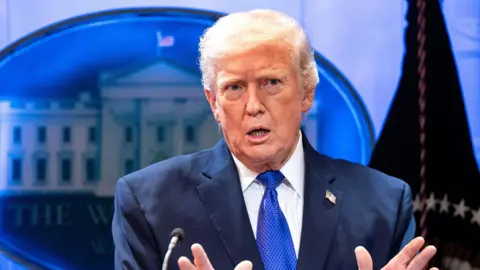
EPAUS President Donald Trump has said that he will impose global tariffs of 15%, as he continued to rail against a Supreme Court ruling that struck down his previous import taxes.
Trump said on Friday that he would replace the tariffs scrapped by the court with a 10% levy on all goods coming into the US.
But on Saturday, he announced on Truth Social that this would be increased to the maximum allowed under a never-used trade law.
These will come into force on Tuesday 24 February and can only stay in place for around five months before the administration must seek congressional approval.
The new 15% tax rate raises questions for countries such as the UK and Australia which had agreed a 10% tariff with the US.
Trump said his administration had reached the decision to lift the levy following a review of the “ridiculous, poorly written, and extraordinarily anti-American decision on Tariffs issued yesterday”.
In a 6-3 decision, the Supreme Court found that the president had overstepped his powers when he introduced sweeping global tariffs last year using a 1977 law known as the International Emergency Economic Powers Act (IEEPA).
Immediately following the ruling, Trump said that he was “ashamed of certain members of the court” and called the justices who rejected his trade policy “fools”.
The decision to strike down the tariffs was joined by the court’s three liberal justices, Chief Justice John Roberts, a conservative nominated by George W. Bush and two justices nominated by Trump: Amy Coney Barrett and Neil Gorsuch.
Three conservative justices, Clarence Thomas, Brett Kavanaugh and Samuel Alito, dissented.
Trump’s tariffs are a key plank of his economic policy which he has said will encourage businesses to invest and produce goods in the US rather than overseas.
Drew Greenblatt, owner of Marlin Steel Wire Products, a steel fabrication plant in Baltimore, said he was “very disappointed” by the Supreme Court’s decision.
“It is a setback for poor people in America that had a chance to climb into the middle class with great manufacturing jobs,” he told the BBC.
But John Boyd, a soybean farmer from Virginia and founder of the National Black Farmers Association, said: “This is a huge win for me and a big loss for the president.
“I don’t care how you look at it, President Trump lost on this.”
Yet Allie Renison, a former UK government trade adviser and director at SEC Newgate, said: “While it may seem like a good day for free trade, I think trade actually just got a lot messier.”
She said that businesses are now facing “much more of a patchwork approach” to tariffs under the Trump administration.
It means that US businesses will have to pay a 15% tariff to import most goods into America under Section 122 of the Trade Act of 1974.
But some products will be exempted such as critical minerals, metals and pharmaceuticals.
Meanwhile, separate tariffs on steel, aluminium, lumber and auto-motives – introduced using a different US law – remain in place, untouched by the Supreme Court’s ruling.
The US has already collected at least $130bn in tariffs using the IEEPA law, according to the most recent government data.
Companies and trade groups have said that they will pursue refunds from the government.
On Friday, Trump indicated that reimbursements would not come without a legal battle which, he claimed, could take years.
But Neil Bradley, chief policy officer at the US Chamber of Commerce, said: “Swift refunds of the impermissible tariffs will be meaningful for the more than 200,000 small business importers in this country and will help support stronger economic growth this year.”
While the National Retail Federation, which represents millions of American businesses, urged the courts “to ensure a seamless process to refund the tariffs to US importers”.
It said: “The refunds will serve as an economic boost and allow companies to reinvest in their operations, their employees and their customers.”