What early election results show us in maps and charts
1 hour ago
Reform UK has been the big winner overnight, picking up hundreds of seats and control of a council in elections around England.
Labour has lost scores of councillors and control of eight councils.
The Conservatives have also lost dozens of seats and control of a council, but gained another.
The Liberal Democrats have also taken control of two councils and lost one, while the Green party of England and Wales has gained more than 20 seats.
Results for 46 areas have been coming in since midnight on Friday, with a further 3,800 council seats across 90 areas due to declare throughout the day and into Saturday.
Counting for the Welsh and Scottish Parliaments as well as six mayors in London and Watford will take place later on Friday.
You can check what’s happening where you live using our interactive tool and your postcode.
This page will be updated regularly as the results come in.
Reform UK took control of Newcastle-under-Lyme from the Conservatives.
Its gains in Hartlepool were enough to strip Labour of its majority and leave both parties with 15 councillors each, while on Redditch and Tamworth councils in the West Midlands, as well as Tameside in Greater Manchester and in Exeter, Labour is still the largest party but no longer has overall control.
Labour has also lost overall control of Southampton and Wandsworth councils.
The Conservatives regained control of Westminster City Council from Labour.
Reform UK became the largest party on Rochford and North East Lincolnshire councils but did not have enough seats for an outright majority.
The Liberal Democrats took full control of Stockport Council, having successfully defended 11 seats and added two more. They also won control of Portsmouth, but lost their one-seat majority on Hull City Council.
In some areas that Labour held on to, its majority was already secure before voters went to their polling stations. The party lost all 22 of the seats it was defending in Wigan to Reform UK, but still controls the council because only a third of seats were up for election.

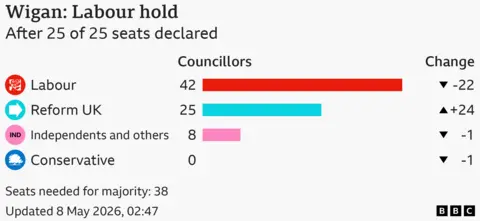
Labour also made losses in other north-west councils including Chorley, Halton and Salford, where its majorities were already safe.
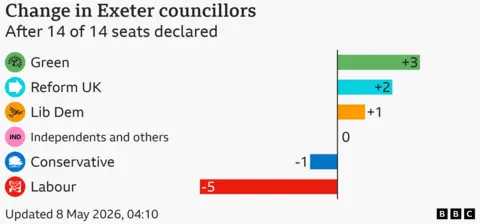
Exeter showed how Labour could lose seats to the Greens and Reform UK, while the Conservatives lost a seat to the Lib Dems.
There were more than 5,000 councillors up for election across 136 councils in England on Thursday, standing for a mixture of district, metropolitan, unitary and county councils as well as all London boroughs.
Labour were defending the most seats with more than 2,500, the Conservatives over 1,300, the Lib Dems just under 700 and the Greens just under 150.
Most of the seats were last contested in 2022, at a time when Reform UK stood in very few areas.
That means it stood to gain the most of all the parties. The map below shows how it has picked up seats across England among the councils that were counting votes overnight, while the Liberal Democrats and Greens have also picked up seats.
The Conservatives have made some gains in areas like Wandsworth in London and Harlow in Essex, where the party also increased its majority.
Many of the councils that were counting results overnight only elect one third of councillors at a time, making it harder for Reform UK to take overall control. Similarly, many of the councils where the Greens stand to make the most gains are among those counting votes later on Friday.
The map below shows where parties have made their biggest losses so far in England.
The overnight results show heavy losses for Labour in the north-west and east of England. The Conservatives have also lost dozens of seats in the east and Midlands.
The majority of results are still to come, including for the elections to the Scottish and Welsh parliaments.
In Scotland, all 129 seats were up for election.
The largest party before the election was the Scottish National Party led by John Swinney.
The last election was in 2021 when the SNP fell one seat short of a majority.
The Welsh Parliament is expanding from 60 to 96 seats and a new electoral system has been introduced.
The boundaries have changed too. The old constituencies and regions have been replaced with 16 new constituencies, each electing six members using a system of proportional representation.
Labour held half of the seats after the last election in 2021.
Interactive tool produced by Wesley Stephenson, Jess Carr, Allison Shultes, Steven Connor, Scott Jarvis and Chris Kay
Reporting by Aidan McNamee and Daniel Wainwright


Sign up for our Politics Essential newsletter to keep up with the inner workings of Westminster and beyond.