What Trump supporters in Florida make of US ‘running’ Venezuela
12 minutes agoBernd Debusmann Jrin Miami, Florida

 Getty Images
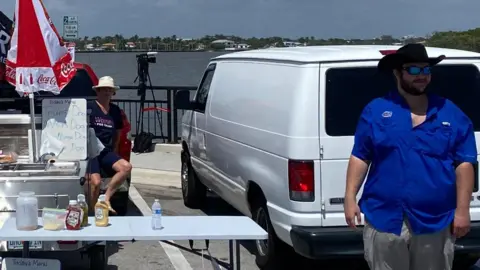
“I grew up with never-ending wars,” said Dirk Frazier, a longtime Trump supporter in Florida who once set up a stand to sell hot dogs to other supporters on a bridge leading to the president’s estate at Mar-a-Lago.
But this time it’s different, he adds. “Venezuela is closer to home.”
Frazier vividly remembers growing up watching the types of messy foreign entanglements that President Donald Trump has vowed to avoid.
Those wars in Iraq and Afghanistan left thousands of Americans dead, tens of thousands wounded and millions of voters keen to avoid open-ended nation-building missions with limited success.
Now the capture of Venezuelan leader Nicolas Maduro and a vow by Trump that the US would “run” the country has prompted concerns that the US would, once again, find itself responsible for rebuilding a deeply fractured country far from home.
To Frazier and other Trump supporters, the nature of the operation to unseat Maduro – quickly and with no US casualties – makes it a “stark contrast” to the unsettling and steady stream of Americans killed during the decades-long “War on Terror”.
Instead, he believes it is indicative of “peace through strength” – a term favoured by Trump to describe his foreign policy.
“It’s not prolonged, or protracted,” the St Augustine resident told the BBC. “We are acting like a world super power again. All bad actors are on notice.”
On the streets of Miami, supporters of Trump spoke of the potential knock-on effects that toppling Maduro might have. Some believe that leftist governments in Cuba and Nicaragua may lose a lifeline.
Others think that an economically strengthened Venezuela would see some migrants return home – itself a key part of the broader MAGA agenda.
“This is chess, not checkers,” Vianca Rodriguez, a Florida resident who formerly worked at the Republican National Committee and Trump campaign, told the BBC.
“This is getting them [Venezuelans] thinking they might want to go back home,” she added. “To help curb immigration, you want people to want to go back. They’re here because they had no choice.”
 Getty Images
So far, only a handful of prominent Republicans have criticised the mission in Venezuela.
Former Georgia Republican Marjorie Taylor Greene, a once staunch ally who has recently soured on Trump, for example, said on X that “this is what many in MAGA thought they voted to end”.
Another Republican critic of Trump in Congress, Representative Thomas Massie of Kentucky, said simply: “This is not what we voted for.”
But the US president, his cabinet members and senior officials have bristled at the suggestion that the strike on Venezuela is in any way akin previous intervention has been critical of, such as Iraq.
“That was Bush… we should never have gone into Iraq,” Trump told the Atlantic. “That started the Middle East disaster.”
Vice-President JD Vance also defended the move, characterising the operation in Venezuela as needed to combat the flow of drugs to the US and accusing Venezuela’s government of expropriating US oil assets for their own enrichment.
“I understand the anxiety over the use of military force, but are we just supposed to allow a communist to steal our stuff in our hemisphere and do nothing?,” he wrote on X. “Great powers don’t act like that.”
 Bernd Debusmann Jr/BBC News
Those arguments appear to have resonated with even the most isolationist wing of the MAGA movement, such as former adviser Steve Bannon, who described the mission on his podcast as “bold and brilliant”.
He did also, however, warn of the spectre of Iraq and in an interview with the New York Times, said: “The lack of framing of the message on a potential occupation has the base bewildered, if not angry.”
For many Trump backers, there is one significant difference between Venezuela and other recent US wars – proximity.
“The isolationists and the Reaganites don’t agree on much, but one area where they do is the Western Hemisphere,” a former Trump administration official told Politico. “The isolationists are more comfortable being a little more internationalist when it comes to our backyard.”
 Getty Images
Giancarlo Sopo, a Florida-based conservative strategist who worked for the Trump campaign in 2020, said that the Middle East and Latin America are “fundamentally different”, with even Maduro feeling “compelled to project the appearance of democracy”.
“There’s also been no indication that we’re going to see a sustained military occupation in South America… perhaps a residual stabilisation presence to prevent a power vacuum,” he said. “That’s a far cry from nation-building.”
But even if some Republican isolationists see a difference, many in the global community and also within the US have said the removal of a president is a clear breach of international law that sets a dangerous precedent.
It’s also unclear how events will unfold in Venezuela now Maduro is no longer in charge.
Former CIA deputy director John McLaughlin told the BBC: “Generally, as a rule in military and clandestine operations, if you inflict violence you don’t really know where it’s going after that – even if you have a plan, an analysis, and assumptions.”
A prolonged period of turmoil could turn more Americans away from supporting intervention. Before the operation, polling by YouGov in late December indicated only 22% supported the use of US military force to overthrow Maduro, rising to 44% among Republicans.
At a restaurant near Miami, Cuban-born restaurateur Irina Vilariño – a one-time Republican candidate who has grown increasingly critical of Trump – told the BBC that that “if she were to take her Latin American hat off”, she would understand why some Americans “wonder why it’s even our business”.
“I can see why that should not be my problem,” she said. “But we [Americans] are being heavily influenced by bad actors. A lot of Americans just don’t get that… they had to do it, to a certain degree.”
Several Florida-based Trump supporters who have spoken to the BBC since the raid on Caracas keep returning to Trump’s term “peace through strength” to describe the strikes in Venezuela.
“That’s been the theme, consistently, with Trump,” said Vianca Rodriguez.
“It’s bringing back the ideals of Ronald Reagan, and no American casualties. They [Venezuela] have been at war with us with drugs. I think it’s about time we bring justice.”