Why I’m terrified of motorways even though I’ve been driving for 20 years
7 hours agoEmily Holt

 Mary McCarthy
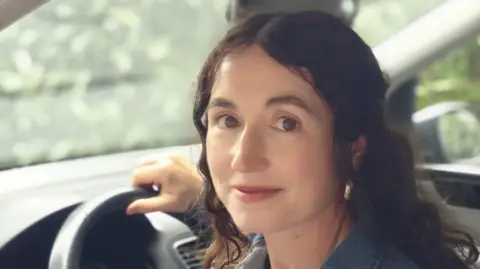
Mary McCarthy has been driving for almost 20 years, but has only driven on the motorway about ten times in her life because they terrify her.
“I can remember every time I used one, and it was an absolute disaster.”
“I sit in my lane and I’m frozen, totally petrified. I can’t overtake and because you don’t overtake, people start to beep at you and that drives me into more of a frenzy,” she says.
Over time, her fear built up, and she just began to avoid motorway driving altogether.
Mary says for her driving on the motorway is akin to playing the video game Mario Kart, with the speed of other drivers making her anxious.
Even as a passenger she can’t relax, and says her anxiety makes her husband a “nervous wreck” when he is driving.
To avoid motorways, Mary usually asks her siblings or her 80-year-old father to take her on longer journeys, but feels embarrassed about it.
“I’m just scared, I’ve set up my life to avoid it,” she tells the BBC’s Woman’s Hour.
Mary’s driving anxiety isn’t unusual.
Diane Curtis Knight, a driving instructor who specialises in helping anxious drivers, says a fear of motorways is one of the most common issues she’s asked to help with.
She explains that often the issue isn’t the motorway itself, but other problems in your life which cause stress or anxiety and can come out when you’re driving.
The first step to addressing the fear, is changing how you talk about the problem, suggesting the word “yet” as a powerful word to help with this, she says.
“If someone says, ‘I can’t drive on motorways’, we need to start planting seeds into their subconscious mind to say, ‘Well, I can’t do that yet, but maybe I can do it at some stage’.”
 Mary McCarthy
Diane also recommends starting a journal to help identify the barriers that are preventing you taking on certain car journeys.
After each drive, she suggests scoring how anxious you felt about the journey beforehand and how it was in reality, with one being totally fine and 10 extremely anxious.
“We tend to find the anticipation of the journey is often worse than the execution.”
Using this as a basis to push yourself to take on more ambitious journeys can slowly help you improve, she says.
Other stories you may enjoy
Tracey Field, a stress management practitioner, runs the website Confident Drivers aimed at helping people who struggle with driving anxiety.
She says the issue is often worse in couples where one person takes the lead on driving, which can lead to the other person becoming “de-skilled” and “less confident”.
Tracey says it’s often this lack of experience that causes problems.
“It’s not actually the driving, it’s the fear of the unknown, of not knowing automatically what to do when.”
If you are struggling, she recommends having motorway lessons and easing yourself in slowly, for example by using a short junction, travelling at a quieter time of day or practising on a small roundabout.
She also suggests learning emotional regulation techniques to keep you calm in the moment, such as breathing exercises or humming.
A turning point for Mary came when she realised her driving anxiety was limiting what she could do with her children.
As they’ve got older they increasingly go to different places, and public transport is not always a practical way to get there.
“There have been times when I’ve said ‘you can’t make that play date’, and I’ll feel really bad.
“By motorway, we could go in 22 minutes, but when we get public transport, it’s going to take two hours.”
Her 14-year-old daughter asked her why she couldn’t just “lock in” and drive, even offering help with directions, forcing Mary to explain that she just couldn’t do it.
Now, ahead of turning 50 next year, she plans to take motorway lessons, partly to set an example to her daughter.
“I need to crack this fear, I would love to be able to drive on a motorway without feeling I am about to die.”