More UK deaths than births expected every year from now on
16 minutes agoRobert Cuffe,Head of Statistics, BBC NewsandHarriet Agerholm,Senior Data Journalist, BBC News

 Getty Images
Deaths are expected to outnumber births in the UK every year from 2026, according to projections from the Office for National Statistics (ONS).
The UK population is now expected to grow at a slower rate than previously thought, reaching 71 million by 2034, owing to a sharp fall in migration.
Declining fertility rates also mean the number of children in the UK is expected to fall in the next decade while pensioners are expected to grow faster than working age adults.
Previous projections suggested the population would continue to grow until 2096, but now “the population is projected to peak in the 2050s before decreasing,” James Robards, ONS head of household and population projections, said.
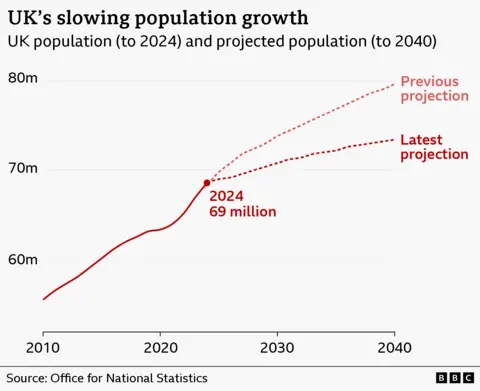
The population is expected to grow by 1.7 million in the 10 years after 2024 as shown by the dotted red line in the graph above.
This is far slower than the growth seen in the previous decade due to people having fewer children and having them later in life.
Between mid-2024 and mid-2034, the ONS projects:
- 6.4 million people will be born
- 6.9 million people will die
- 7.3 million will immigrate to the UK on a long-term basis
- 5.1 million people will emigrate long-term from the UK
Deaths are projected to outnumber births by nearly half a million people in that 10-year period.
The ONS stressed the figures, which cover the next 100 years of the UK’s population, are projections and not predictions or forecasts. It warned real numbers could be higher or lower depending on future births, deaths and migration levels.
Fall in net migration
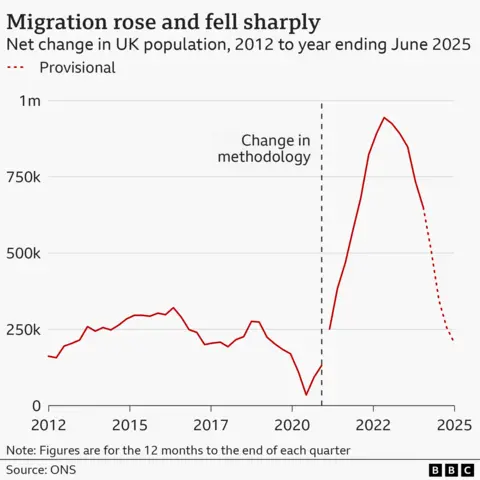
The ONS now expects net migration – the difference between the number of people coming to the UK and those leaving – to add 2.2 million people to the UK population in total between 2024 and 2034.
That is lower than previously projected as the ONS now treats the post Brexit immigration peak as a “blip” rather than an ongoing trend, said Dr Madeleine Sumption, of Oxford University’s Migration Observatory.
“In the short term, the projections suggest net migration will fall temporarily before bouncing back up again.”
The chart below shows that net migration to the UK peaked near a million people in 2023 and has since fallen to just over 200,000 people.
A Home Office spokesperson said: “While these projections do not directly take into account recent policy changes, we must go further to reduce the levels of migration.
“That’s why we are introducing sweeping reforms to our immigration system, ending over-reliance on cheap labour whilst attracting the brightest and the best to the UK.”
More pensioners and fewer children
By 2034 pensioners are expected to make up a fifth of the population. Despite the rising state pension age they are the fastest growing section of the population, while the number of children is projected to fall by 1.6 million.
Meanwhile, the number of working age people will increase by 1.5 million, but not as quickly the 1.8 million extra pensioners.
In December, a House of Lords report found that young people would be hardest hit by the failure of successive governments to adapt to challenges posed by an ageing population.
Policies governments have used to address the impact of declining fertility and rising life expectancy in the UK – raising the state pension age or increasing immigration for example – were not adequate solutions on their own, the report said.
Pressure on pensions, health and social care
The growing ageing population “will add to pressure on the NHS, the state pension and the wider public finances”, said Stuart McDonald, head of longevity and demographic insights at pension consultants LCP.
“For the NHS, the challenge is not simply a larger population, but a larger population at ages associated with greater healthcare need.”
He added: “But for pensions, the projections will intensify an already difficult debate about whether people can realistically and fairly be expected to work longer.”
Sarah Scobie, Deputy Director of Research at the Nuffield Trust, warned end-of-life care services are “ill-prepared for an increase in deaths as the population ages overall”.
“Hospital care accounts for over 80% of public expenditure on health care for people in the last year of life, and most of that is spent on emergency care,” she said.