The threat to summer holidays looming from jet fuel shortages
32 minutes ago
 Theo LeggettTransport Correspondent
 BBC
BBCStep on to the tarmac at any major airport around the world, and you’ll notice an unmistakable smell. A slightly sweet, oily scent, redolent of old workshops or antique paraffin lamps. It is as much part of the travelling experience as lukewarm coffee and queues at passport control. It is, of course, the pervasive smell of jet fuel.
That pungent aroma has become a lot more expensive in recent weeks. The price of jet fuel has risen dramatically on international markets since the start of the conflict in the Middle East. There are now concerns that unless the Strait of Hormuz reopens soon, there could be physical shortages in some areas in the coming months.
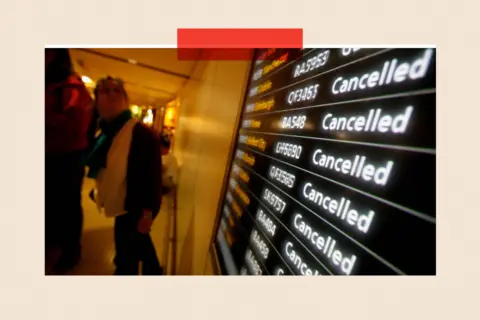
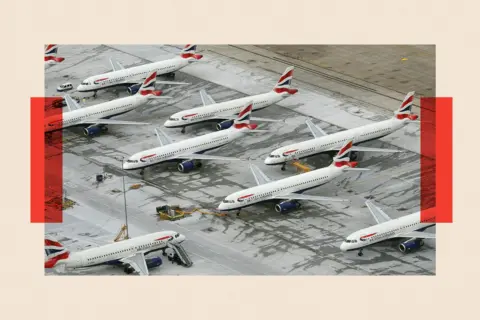
Many airlines have already pushed up ticket prices as the cost of flying has increased, and some have trimmed their capacity. Unless extra supplies can be found, a lack of fuel could lead to further disruption and cancellations heading into the peak summer holiday period.
The crisis has exposed just how vulnerable the industry in the UK – Europe’s biggest consumer of jet fuel – is to disruption in the Middle East. So what impact might that have on our summer holidays – and what could be done about it?
A scramble for jet fuel
The Gulf region produces far more jet fuel than it requires for its own purposes. As a result, under normal circumstances it is a major exporter, accounting for about 20% of the fuel traded on international markets each day. Europe as a whole is a key buyer of that fuel. Due to a lack of refining capacity, it is heavily reliant on imports, more than half of which typically come from the Gulf.
With the Strait of Hormuz having been blocked for the past eight weeks, however, those supplies have not been available, prompting a scramble for fuel produced elsewhere. This has pushed up prices dramatically.
In late February, before the first US and Israeli airstrikes, jet fuel was trading at $831 per tonne in Europe. By early April, it had touched $1838 – an increase of more than 120%. It has since retreated but has consistently remained above $1500.
A lack of refining capacity
Jet fuel is essentially a highly refined form of kerosene with specialised additives, and is usually produced from fractional distillation of crude oil.
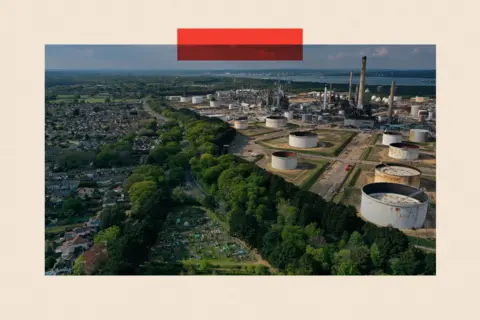
Because supplies are dictated largely by the availability of refining capacity, the loss of output from the Gulf has led to jet fuel prices increasing far more than those for crude oil.
 Getty Images
“We have had five refinery closures in the last two-and a-bit years in Europe, whereas jet fuel demand has been rising year on year,” explains Amaar Khan, head of jet fuel pricing at Argus Media. “So, we see weaker supply, greater demand.”
The UK is particularly dependent on imports, which make up 65% of what we need. Two of the refineries that closed were British, leaving just four in operation here.
Pared-back schedules and rising fares
For airlines, fuel is a major expense. It typically accounts for 25-30% of their operating costs, according to the International Air Transport Association (IATA). As a result, if the price goes up, it can have a major impact on their profitability.
In Europe and Asia, it is common for airlines to use hedging strategies to limit their exposure to rising prices, buying fuel or other oil products at a fixed or capped cost in advance.
However, this does not offer complete protection. EasyJet, for example, hedged 80% of its fuel supply for the first half of the year at $717/tonne – but finding the remainder at prevailing prices cost the airline £25m in March alone.
Other carriers, notably US ones, have preferred not to hedge at all in recent years, because it can prove expensive when prices fall. That has left them heavily exposed to the current crisis.
Some airlines – such as Air France KLM, Air Canada and SAS – have already responded by cutting their summer schedules. The German group Lufthansa said earlier this month it would remove 20,000 flights between now and the end of October.
“If a route was marginally profitable before this crisis came along, it is now firmly under water and losing money in a big way,” says Jonathan Hinkles, a former chief executive of the regional carrier Loganair and current CEO of Skybus.
 Getty Images
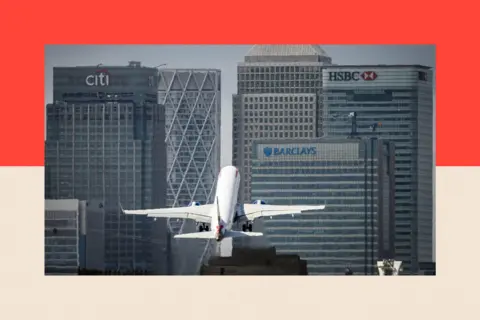
Fares have also been going up. This has been most marked on long-haul routes – especially those normally served by the major Gulf carriers, where a steep reduction in capacity has combined with high fuel prices to make tickets a lot more expensive. A flight from London to Melbourne in June now costs 76% more than it did last year, for example, according to research from the consultancy Teneo.
The US carrier United Airlines has been particularly bullish about making sure passengers bear the brunt of higher fuel costs, with its CEO Scott Kirby telling investors earlier this month the company would do “whatever it takes to recover 100% of the increase in jet fuel prices as quickly as possible”.
IAG, which owns British Airways as well as Iberia, Aer Lingus, Vueling and Level, has also warned that travellers will have to pay more, while Virgin Atlantic has already introduced surcharges ranging from £50 on a return economy class ticket to £360 for a business class fare.
 Getty Images
On short-haul services within Europe, however, the impact on fares has been a lot more muted so far. In fact, according to Wizz Air’s chief executive József Váradi, prices have been going down as airlines have sought to persuade potentially reluctant customers to travel.
“Simply, people don’t know what’s going to happen… so there is a level of hesitancy,” he told reporters in late April. “But to be honest, that level of hesitancy can be overcome through price stimulation. So, short term, you are actually seeing prices dropping.”
According to John Strickland of JLS Consulting, the price spike gives well-hedged low-cost carriers an advantage over rivals who have not bought so much fuel in advance.
“They will look to put pressure on other people who are not in such a healthy position,” he says.
Are we likely to run out of jet fuel?
But although fuel prices have clearly been the leading preoccupation for airlines since the start of the conflict in Iran, there is another looming concern that particularly affects Europe: the risk that supplies could actually run short.
In mid-April, the head of the International Energy Agency (IEA), which advises 32 member governments on energy supply and security, warned that Europe had “maybe six weeks of jet fuel left”.
A detailed analysis from the IEA noted that while imports from the US in particular had picked up, the extra fuel coming across the Atlantic so far was only likely to replace a little over half of the lost Middle Eastern supplies.
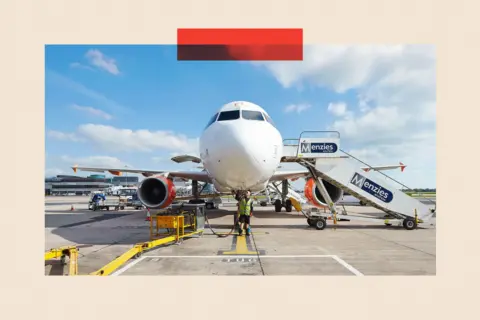
If that trend continued, it warned, reserves would reach critical levels by June. This would mean “physical shortages may emerge at select airports, resulting in flight cancellations and demand destruction”.
 Getty Images
It is important to note that although Europe is highly dependent on Middle Eastern sources, it does get fuel elsewhere. Cargoes come from East Asia, particularly South Korea and Taiwan, as well as from the US and Nigeria.
However, East Asian refineries rely heavily on supplies of crude oil from the Middle East, which have been restricted by the war – and that has curbed the amount of jet fuel available for export.
Imports from the US meanwhile, while growing, have been constrained by the fact that the US aviation market uses a different fuel specification to most of the rest of the world.
It uses Jet A, which has a higher freezing point than the Jet A1 supplied here. Not all US refineries that make jet fuel are currently capable of producing Jet A1, limiting the extra that can be shipped across the Atlantic.
Until last year, India was a major source of fuel as well. However, the EU’s import ban on refined products made from Russian crude oil had a big impact on supplies. “In practice, what that led to was the removal of Indian jet fuel from the European market en masse. It just became too complicated,” explains Amaar Khan of Argus Media.
As a result, reserves have been dwindling. Stocks at the key Amsterdam-Rotterdam-Antwerp hub are at their lowest level in six years, according to the procurement intelligence firm Beroe.
 Getty Images
Before the conflict, Europe as a whole had about 37 days’ supply available. Now, this is likely to have dropped to 30 days, the firm says. 23 days is the critical point at which the IEA believes some airports would run out of fuel.
Beroe’s analysis suggests there is a “high risk of shortages if Hormuz disruption continues”. Mr Khan agrees. “I think there is a huge risk,” he says, although he points out that the effects of any shortage would not be felt equally. “Larger demand hubs, big airports are probably going to be prioritised over smaller demand hubs,” he explains.
Wizz Air’s CEO József Váradi is optimistic that extra supplies will be found, because there is “a lot of room to be creative” when prices are so high. “I don’t think we’re going to run out of fuel,” he told reporters in April. But he agreed that shortages would not be felt equally across Europe.
“This is not going to be like every single European airport is going to be hit on the same minute of the same hour. This is going to be a mess,” he explained. “There are multiple suppliers, and multiple suppliers might be in different positions, so you may not get jet fuel from one guy, but you may get jet fuel from another guy.”
“But the ultimate measure, obviously, is that if there is really no fuel anywhere, then you will have to cancel [flights].”
What could be done about it?
In public, most airlines appear sanguine about the fuel supply situation. But behind the scenes, in London and in Brussels there is intense lobbying going on for measures to mitigate the impact both of high prices and potential shortages.
In the UK, the government is preparing a number of concessions. These include allowing airlines to cancel flights at busy airports like Heathrow well in advance, without the risk of losing valuable take-off and landing slots.
Under normal circumstances, if airlines do not use slots 80% of the time in a given season, they lose the right to use them the following year. In practice, this can encourage airlines to fly half-empty planes in order to retain their slots, which can be worth tens of millions of pounds.
The new plan would make it easier for them to trim their schedules in advance, rather than being forced to cancel flights at the last minute. It would, for example, make it easier for an airline that has a number of flights to the same destination on the same day to cut one or two services without being penalised.
More on InDepth
Refineries have also been asked to maximise jet fuel supply, while the government is exploring the possibility of allowing imports of jet A1 from the United States, although that will depend on whether such a move would be viable with existing infrastructure.
In Brussels, the European Commission is preparing similar steps, and in some areas has gone further.
It has already made it clear that cancellations and severe delays due to jet fuel shortages will qualify as “exceptional circumstances”. Under EU rules, this will allow airlines to avoid paying financial compensation to passengers, though they will still be entitled to reimbursement or an alternative flight.
It is also likely to ease rules that usually restrict a practice known as “tankering”.
This is where aircraft take off with much more fuel than they need for a flight from airports where it is cheap, in order to limit the amount of refuelling needed at their destination, where it may be more expensive. It can save airlines money – but it also involves burning extra fuel, because the aircraft is heavier when it takes off.
All of this, however, is designed to deal with the symptoms of shortages, not the causes.
Structural changes
Addressing the structural reasons why the UK is so dependent on imports, meanwhile, is likely to be trickier. Back in the 1970s, the country had 18 refineries – but that’s now down to four.
“I think there is probably a point in saying, actually, do we need more resilience from a homegrown perspective in terms of our capacity in the UK to be able to refine a higher proportion of our fuel?” says Skybus’ CEO Jonathan Hinkles.
The question is how that could be done. The remaining refineries have already been asked to prioritise jet fuel production. But according to Ameer Khan, “this doesn’t happen overnight, and doesn’t result in a significant increase in jet fuel output”.
One option could be to boost local production of Sustainable Aviation Fuel (SAF). A synthetic fuel, it can be derived from wastes, such as old cooking oil and agricultural residues; from dedicated energy crops; or from using renewable energy to convert water and carbon dioxide into liquid hydrocarbons known as e-fuels.
So far SAF, as the name suggests, has been promoted mainly for its environmental credentials. These can vary widely depending on the method used to make it, but in general burning SAF adds less carbon to the atmosphere than burning fossil fuels. Both the UK and the EU have mandates to significantly increase the amount of SAF used over the next 25 years.
However, the industry is in its infancy. There is relatively little SAF available at the moment, a large chunk of what we use comes from East Asia, and it is very expensive – typically trading at more than $1000 per tonne more than conventional fuel. Nevertheless, Hinkles believes if these problems can be overcome, SAF can help reduce our reliance on foreign imports.
“It really becomes a question of; can you actually get SAF? Can we scale up production of SAF at a meaningful rate in the UK or Europe to take over an increasing proportion of jet fuel supply?”, he says.
Green campaigners agree. “Increasing SAF production won’t eliminate jet fuel imports overnight,” says Tom Taylor, UK policy manager for lobby group Transport and Environment.
“But by scaling it up, we can shift the source of aviation fuel from geopolitically sensitive fossil fuels to locally managed renewable grids and waste streams.”
That would require investment on a large scale, however, and clearly remains a long way off.
In the short term, meanwhile, dark clouds are hanging over the industry. There seems little prospect of jet fuel prices coming down quickly, and if fears of a shortage prove justified, then the aviation industry and the travellers that rely on it are heading for a turbulent summer.

BBC InDepth is the home on the website and app for the best analysis, with fresh perspectives that challenge assumptions and deep reporting on the biggest issues of the day. Emma Barnett and John Simpson bring their pick of the most thought-provoking deep reads and analysis, every Saturday. Sign up for the newsletter here