Two migrants jailed under new small boats law
11 minutes agoSean SeddonandDominic Casciani,Home and Legal Correspondent

 CPS
CPSTwo men have become the first to be jailed under a new law targeting people who risk the safety of others by piloting small boats across the Channel.
Alnour Mohamed Ali, a Sudanese national, was given a 27-month sentence having previously admitted to steering an extremely crowded dinghy carrying 74 people in April.
A second man, Afghan national Tajik Mohammed, was given a two-year sentence after pleading guilty to piloting a vessel across the Channel during poor weather conditions in January.
Both admitted to endangering lives at sea under the new Border, Security, Asylum and Immigration Act, which came into force earlier this year.
It makes causing or risking the death or serious injury of a person at sea in a small boat a crime, a law designed to target people in charge of vessels which have illegally carried more than 200,000 people to the UK since 2018.
While the defendants were charged over separate incidents, they were sentenced together on Wednesday at Canterbury Crown Court due to the similarity of their offences.
The court was played drone footage of both vessels the defendants admitted steering.
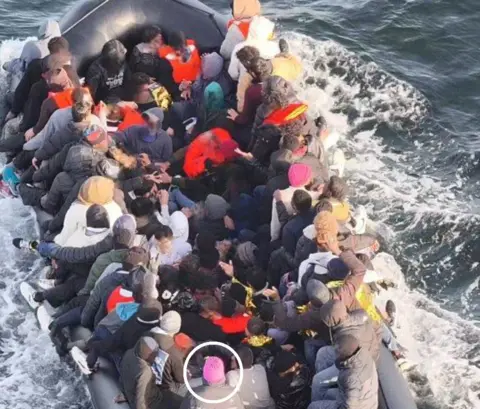
In the case of Ali, 26, the boat was so full people could be seen clinging onto the edges, some with their legs dangling in the water. Many of those on board during the 9 April crossing were not wearing life jackets.
 CPS
CPSFrench officials previously said two men and two women drowned off the coast of northern France while trying to get into the boat, but British prosecutors now accept he was not responsible for those deaths.
At the time, French authorities said more than 40 people were rescued from the water at Equihen-Plage, near Boulogne-sur-Mer.
Ali’s barrister said there had been “misreporting” around those deaths, which had resulted in “severe repercussions” for his client. He accused the National Crime Agency of “wrongly informing the media” Ali was culpable.
The sentencing judge Recorder Simon James agreed that the suggestion from British authorities that Ali was responsible for the deaths amounted to “misinformation”.
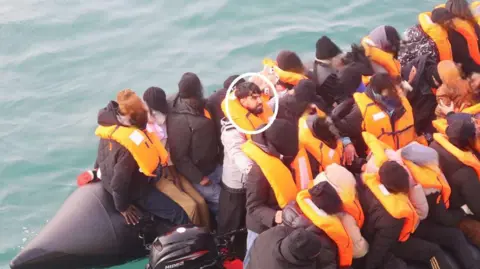
Separately, the court was shown footage of Tajik, 32, with his hand on the tiller of a small boat which embarked on a Channel crossing during foggy conditions on 17 January.
 CPS
CPSSeveral of those inside the crowded boat were not wearing life jackets despite the wintry conditions.
‘At the mercy of the sea’
Wednesday’s double-hearing also laid bare the circumstances in which some migrants decide to risk the Channel crossing.
The court was told Ali fled Sudan in 2019 after his village was targeted by the paramilitary Rapid Support Forces, an armed group which has been involved in bloody fighting for more than a decade.
He travelled to Libya first but was imprisoned without cause on two occasions and tortured, including being starved and stabbed.
The court was told Ali’s village in the Darfur region has been destroyed and he has no idea whether his family in Sudan is still alive.
Tajik’s barrister described how his client witnessed his father and brother being shot dead by Taliban gunmen in Afghanistan 10 years ago, after they refused to poison soldiers who visited their family restaurant.
Fearing being targeted by the Taliban himself, he fled and first sought asylum in Greece, where his application was rejected. He then travelled through Europe to France, from where he intended to reach the UK.
Neither men were accused of organising a crossing, nor did they make any profit from piloting their boats. Ali, the court heard, said he was ordered to steer by armed smugglers in France.
But prosecutors said both men had endangered the safety of others by agreeing to pilot the boats, which were inadequate for the task of crossing the Channel.
Speaking to BBC News prior to Wednesday’s sentencing, CPS prosecutor Sarah Dineley said of Tajik: “The people who pilot these boats generally have little or no experience of piloting a boat, let alone crossing one of the busiest shipping lanes in the world.
“I think what’s important for people to understand is that these boats are completely invisible to other craft in the Channel, particularly cross-channel ferries, and that obviously puts people’s lives at danger.”
She added: “I anticipate that over the coming summer months, given that there is pent-up demand for crossings, we will see that endangerment is being charged more frequently, and I think we will see an increased number of convictions.”
Sentencing Ali on Wednesday, Recorder Simon James said people had been “packed into every inch of available space”, and were left “at the mercy of the unpredictable sea”.
It was “down to luck and good fortune” that they were rescued before coming to serious harm.
Sentencing Tajik, the judge noted that the Afghan national let go of the tiller as rescuers arrived, which resulted in the boat spinning around, further increasing the threat to those on board.
The judge said both men had “arguable” grounds to make an asylum claim, but it will be for the Home Office to decide whether they can remain in the country at a later date. It is not clear whether either could be deported due to the circumstances in their home countries.
As he delivered the first sentences under this new legislation, the judge criticised the Sentencing Council, the body responsible for issuing instructions to judges, for failing to publish definitive guidelines on how offences of this kind should be punished.
The new borders law targeting people who pilot small boats is the latest attempt by successive governments to stem the flow of people arriving in the UK illegally via the Channel.
More than 9,000 people have crossed the Channel in small boats so far this year, according to Home Office statistics.
UN figures show that 10 people are known to have died or gone missing while trying to reach the UK in 2026.
The highest number of arrivals was in 2022, when around 46,000 people made the crossing.